On this page
- Who has to file Form 1041?
- Does a living trust need to file Form 1041?
- What does Form 1041 actually report?
- How do beneficiaries get taxed on estate or trust income?
- When is Form 1041 due?
- What about estimated taxes?
- What mistakes cause problems with Form 1041?
- Frequently asked questions
- What's the next step?
- Related reading
- Related reading
- Related reading
IRS Form 1041: Who Files It, What's On It, and When It's Due
IRS Form 1041 is the U.S. Income Tax Return for Estates and Trusts, the return a fiduciary files to report the income an estate or trust earns and to show how much of it passed to beneficiaries. It works like a Form 1040 for an entity that isn't a person. Here's who has to file it, what the form covers, and where people tend to trip.
Who has to file Form 1041?
An executor, administrator, or trustee generally files Form 1041 for a domestic estate or trust that has any taxable income for the year, or gross income of $600 or more, or a beneficiary who is a nonresident alien. The instructions for the current year control, so confirm the thresholds before you file.
In plain terms, the form comes up in three common situations:
- A decedent's estate that earns income after death, such as interest, dividends, rent, or gains from selling assets.
- A trust that keeps its income or distributes it to beneficiaries, including irrevocable trusts and trusts that became irrevocable at the grantor's death.
- A bankruptcy estate of an individual, in some cases.
Estates and trusts need their own taxpayer ID. If you're the fiduciary, you'll apply for an EIN using Form SS-4 and, in most cases, send the IRS Form 56 to notify it that you're acting as fiduciary.
Does a living trust need to file Form 1041?
Usually a revocable living trust does not file its own return while the person who created it is alive. It's treated as a grantor trust, so the income is reported on the grantor's personal Form 1040 under the grantor's Social Security number. Some grantor trusts use optional reporting methods, but the income still ends up on the grantor's return.
That changes at death. A revocable trust typically becomes irrevocable, gets its own EIN, and starts filing Form 1041 if it has income to report. Many families miss this handoff because nothing about the trust looked like a separate taxpayer for years.
What does Form 1041 actually report?
The main form follows a familiar pattern. Income goes on the front, deductions come next, and the tax is figured at the bottom of the page. The pieces that matter most are these:
- Income: interest, dividends, business income, capital gains, rents, royalties, and other income, as it would be on any return.
- Deductions: fiduciary fees, attorney and accountant fees, and certain other expenses, subject to the usual limits.
- Income distribution deduction: a deduction for income paid or required to be paid to beneficiaries, figured on Schedule B using a concept called distributable net income (DNI).
- Exemption: a small amount that varies by type, roughly $600 for an estate, $300 for a simple trust, and $100 for a complex trust.
If the entity owns rental property, the rental activity is reported much like it would be for an individual, using Schedule E. If it ran a business, the business income flows through as well.
How do beneficiaries get taxed on estate or trust income?
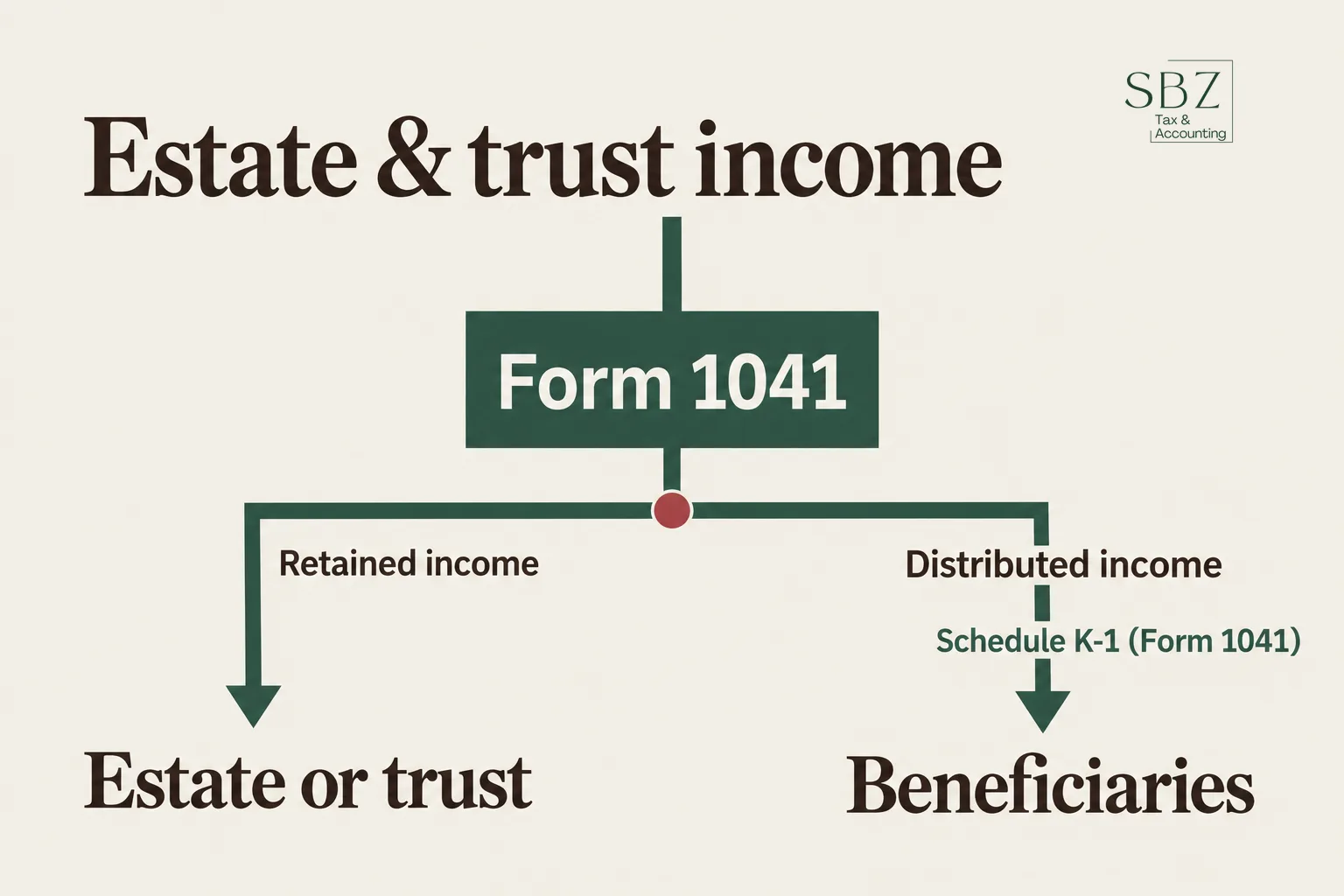
Income distributed to a beneficiary is generally taxed to the beneficiary, not the estate or trust. The fiduciary reports each beneficiary's share on a Schedule K-1 (Form 1041), gives a copy to the beneficiary, and attaches the totals to the return. The beneficiary then reports those amounts on their own tax return.
The part people miss is that income retained inside the trust is taxed to the trust itself. Trust and estate tax brackets are compressed, so the top 37% rate applies at a much lower income level than it does for an individual. That's one reason fiduciaries often look at distributions when planning, and why the decision belongs in a conversation about tax planning before year-end rather than after.
Trustees also have a tool called the 65-day rule. A trust can elect to treat distributions made in the first 65 days of the next year as if they were made in the prior year, which can shift income to beneficiaries in lower brackets.
When is Form 1041 due?
For a calendar-year trust or estate, Form 1041 is due April 15 following the end of the tax year. A fiscal-year estate files by the 15th day of the fourth month after the fiscal year ends. If the date lands on a weekend or legal holiday, it moves to the next business day.
An estate can choose a fiscal year ending on the last day of any month within 12 months of the date of death. That choice can smooth out reporting during administration, and it's made on the first return. Trusts generally use the calendar year.
Need more time? Filing Form 7004 gives an automatic extension of up to five and a half months to file. It does not extend the time to pay, so any tax owed is still due on the original date.
What about estimated taxes?
Estates and trusts generally make estimated tax payments on Form 1041-ES, much like individuals. An estate has a break in the early years: it isn't required to make estimated payments for the tax years ending within two years of the decedent's death. A trust that elected to be treated as part of the estate has the same relief.
Once the break ends, underpayments can trigger a penalty. Our breakdown of estimated tax penalties applies in the same way, just with the entity as the taxpayer.
What mistakes cause problems with Form 1041?
A few come up repeatedly:
- Skipping the return because the estate "didn't make much." The $600 gross income trigger is low, and interest on a single account can reach it.
- Mixing up the decedent's final 1040 and the estate's 1041. Income before death belongs on the final individual return. Income after death belongs to the estate.
- Late or missing K-1s. Beneficiaries can't complete their own returns without them.
- Filing late. Late-filing penalties accrue by the month, and the fiduciary can be on the hook. If a deadline has already passed, see what to do if you missed the tax filing deadline.
If a notice does arrive, help is available for IRS and state tax problems.
Frequently asked questions
Do I file Form 1041 if the estate had no income?
Generally no. If the estate had no taxable income and gross income under the filing threshold, and no nonresident alien beneficiary, a return isn't required. Many fiduciaries still file when there's any doubt, so confirm against the current instructions.
Can I e-file Form 1041?
Yes. The IRS accepts electronic filing of Form 1041 and its schedules through approved software and providers. Paper filing is still allowed.
Who signs Form 1041?
The fiduciary signs it: the executor, administrator, or trustee. A paid preparer who prepares the return also signs in the preparer section.
Is Form 1041 the same as Form 1040?
No. Form 1040 is for individuals. Form 1041 is for estates and trusts, and it has its own rates, deductions, and distribution rules. Partnerships use a different return again, Form 1065.
What's the next step?
Start with the basics: confirm the EIN, decide the tax year, collect the income statements, and track every distribution to beneficiaries. From there, the return is mostly organization. If you'd rather have a professional look at it, you can book a free consultation or review pricing. SBZ Tax works with clients nationwide by phone and online, and you can call 818-748-2020 or visit the office at 190 Sierra Ct Ste 335, Palmdale, CA 93550.
This article is general information, not tax advice for your specific situation. Estate and trust rules depend on the document and the facts, so talk to a qualified professional before you file.