On this page
- Who has to make estimated tax payments in California?
- What are the California estimated tax due dates?
- How much do you actually need to pay?
- How do you make a California estimated tax payment online?
- What about S-corps and other business entities?
- What if you miss a payment or underpay?
- Frequently asked questions
California Estimated Tax Payments: Due Dates, Amounts, and How to Pay
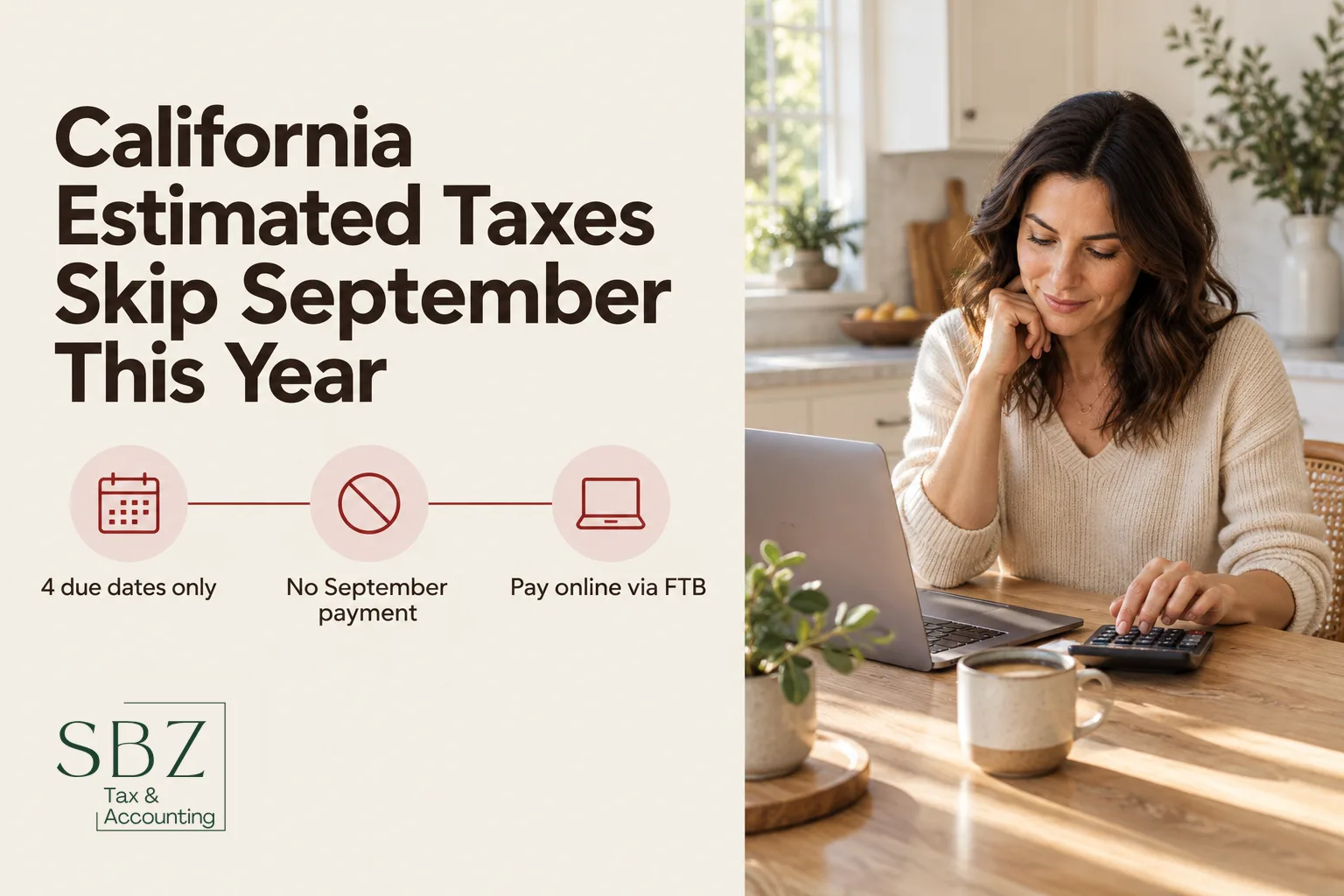
Quick answer: California's estimated tax schedule is front-loaded: 30% of your annual estimate is due April 15, 40% June 15, nothing September 15, and the final 30% January 15 of the next year. The federal schedule splits the year into four equal payments instead. A due date that lands on a weekend or holiday moves to the next business day.
California requires estimated tax payments from anyone who expects to owe at least $500 in state income tax after withholding and credits — and if you're self-employed, an S-corp shareholder, or earning income with no employer withholding, this almost certainly applies to you.
The framework is similar to federal, but California uses a different installment schedule, a lower threshold, and its own safe-harbor calculation. Knowing the differences keeps you off the FTB's penalty list.
Who has to make estimated tax payments in California?
If your California tax liability — after subtracting withholding and refundable credits — is expected to be $500 or more, you're required to pay estimates. The federal threshold is $1,000, so California catches more people.
The most common situations:
- Self-employed individuals and freelancers with no employer withholding income
- Business owners drawing profits from a sole proprietorship, partnership, or LLC
- S-corp shareholders receiving K-1 income or distributions not fully covered by payroll withholding
- Investors with significant capital gains, rental income, or interest income
- W-2 employees who had a large side income year or a bonus that wasn't withheld at a high enough rate
If you're a 1099 contractor or gig worker, estimated payments are almost certainly required. The mechanics are covered in detail in quarterly estimated taxes for self-employed taxpayers.
What are the California estimated tax due dates?
This is where California diverges from federal — and where people get tripped up.
California estimated tax installment schedule:
| Installment | Due Date | Percentage |
|---|---|---|
| 1st | April 15 | 30% |
| 2nd | June 15 | 40% |
| 3rd | None | — |
| 4th | January 15 (next year) | 30% |
There is no September installment in California. At the federal level, a third payment is due September 15. Many California filers make their federal payment that month and assume a state payment is also due — it isn't. The flip side is that California front-loads collections: 70% is due by June 15, compared to 45% at the federal level by the same date.
For reference, federal due dates are: April 15, June 15, September 15, January 15. If any California due date falls on a weekend or state holiday, it shifts to the next business day.
How much do you actually need to pay?
Two safe-harbor methods let you avoid an underpayment penalty:
Option 1 — Prior-year method: Pay 100% of your prior year's California tax liability, spread across the three installments in the 30/40/30 proportions above. This is the simpler choice — you know the exact number from last year's return.
Option 2 — Current-year method: Pay at least 90% of what you actually owe for the current year, allocated by installment period as earnings come in. This can help if your income dropped significantly from the prior year, but it requires tracking income by quarter.
If your California AGI exceeded $1 million in the prior year, different rules apply — verify the current FTB instructions, as this threshold and the applicable percentage can change.
One thing people miss: the penalty is assessed per installment, not just on an annual basis. A short Q1 payment isn't fixed by a catch-up in Q2. If you want to understand what an underpayment actually costs, estimated tax penalties — what they cost and how to avoid them walks through how the FTB calculates it.
How do you make a California estimated tax payment online?
The simplest method is Web Pay through the FTB's website. You can pay directly from a bank account with no processing fee. The FTB also accepts credit card payments through a third-party processor, but that adds a convenience fee you're paying out of pocket.
Other payment options:
- Form 540-ES — mail a check with the paper voucher; it still works, but confirmation is slower
- CalFile — the state's free filing tool lets you schedule payments if you qualify
- Electronic Funds Transfer (EFT) — required for business entities whose payments exceed a certain annual threshold
When paying online, you'll need your Social Security number and prior-year California AGI to verify your identity. Schedule payments a few days before the deadline — bank processing can add a day or two and you don't want to cut it close.
What about S-corps and other business entities?
California S-corps have estimated tax obligations at two levels, and both matter.
The entity itself owes a minimum franchise tax of $800 per year plus an additional 1.5% tax on net income. These are paid via installments using Form 100-ES. Timing rules in the first tax year differ from ongoing years, which catches a lot of new business owners off guard — it's worth confirming the first-year schedule before any payment is due.
Shareholders then separately owe personal estimated taxes on their share of K-1 income. That's the shareholder's individual obligation, not the corporation's. If you're using an S-corp to split income between salary and distributions, making sure those personal estimates are adequate is part of the structure working as intended. More detail at S-corp and business tax services and how to form an S-corp in California.
LLCs have their own layered obligations: the annual $800 fee plus a gross receipts fee above certain revenue thresholds, and then member-level estimated taxes on top. The full breakdown is in California LLC franchise tax explained.
What if you miss a payment or underpay?
The FTB calculates an underpayment penalty using Form 5805. The rate adjusts periodically based on the federal short-term interest rate, so it's not trivial — especially on larger underpayments. And because each installment is evaluated independently, paying in full by April 15 doesn't erase a penalty on a short Q1 payment made months earlier.
There are limited exceptions for unusual income timing or casualty situations, but relying on an exception is less predictable than paying accurately.
If you're behind on estimated payments and working through how to fix it, IRS and state tax problem help covers the options. And if you'd rather get ahead of it, mid-year tax planning — running projections and adjusting installments before due dates pass — is the cleanest approach.
Frequently asked questions
Is the California estimated tax schedule the same as federal?
No. California collects three installments — April 15, June 15, and January 15 — in a 30/40/30 split. There is no September payment in California. Federal installments are due April 15, June 15, September 15, and January 15. The missing September date is the most common source of confusion for California filers.
What form do I use to pay California estimated taxes?
Individuals use Form 540-ES. Corporations and S-corps use Form 100-ES. Most people skip the paper form entirely and pay through Web Pay at ftb.ca.gov, which posts faster and provides a confirmation.
Can I make California estimated tax payments online?
Yes. Web Pay through ftb.ca.gov is the fastest method — no fee when paying from a bank account. Credit card payments are available through third-party processors but carry a convenience fee. Paper checks with a Form 540-ES voucher still work if you prefer.
What's the penalty for missing a California estimated payment?
The FTB assesses an underpayment penalty calculated on Form 5805. The rate is tied to the federal short-term interest rate and adjusts periodically. Because the penalty is assessed per installment period — not as a flat annual charge — a short first-quarter payment keeps accumulating even if later quarters were paid accurately.
Do S-corp shareholders need to make personal estimated payments on top of what the corporation pays?
Yes. The S-corp pays its own franchise tax installments. Each shareholder separately owes personal estimated taxes on their K-1 income — those are two distinct obligations. If you're evaluating whether an S-corp structure still makes sense for your situation, the S-corp vs. LLC comparison covers how the tax layers differ.
This article is general educational information, not tax advice for your specific situation. Tax thresholds, rates, and due dates can change — verify current figures with the FTB or a qualified tax professional before making payment decisions. Book a free consultation if you want to talk through your estimated tax situation.