On this page
- What is the Schedule E tax form used for?
- What are the parts of Schedule E?
- How do you report rental income in Part I?
- What expenses can you deduct on Schedule E?
- Can a rental loss on Schedule E reduce your other income?
- How does K-1 income show up in Part II?
- Schedule E vs. Schedule C: which one do you use?
- What triggers problems with Schedule E?
- Where do you get the Schedule E tax form?
- What should you do next?
- Frequently asked questions
Schedule E Tax Form: What It Is, Who Files It, and How It Works
Schedule E (Form 1040), "Supplemental Income and Loss," is the IRS form you use to report income and expenses from rental real estate and royalties, plus your share of income from partnerships, S corporations, estates, and trusts. If you own a rental property or get a Schedule K-1, you will probably file it. Here's how the form is laid out and the mistakes people make most often.
What is the Schedule E tax form used for?
Schedule E covers income you don't earn from a job or from running a business that you actively operate. The IRS describes most of it as "supplemental" income. In practice, these are the common reasons people file it:
- You own a rental house, condo, duplex, or commercial building
- You receive royalties from oil and gas, minerals, books, music, or other intellectual property
- You're a partner in a partnership or multi-member LLC and got a Schedule K-1 (Form 1065)
- You're an S-corp shareholder and got a Schedule K-1 (Form 1120-S)
- You're a beneficiary of an estate or trust and got a Schedule K-1 (Form 1041)
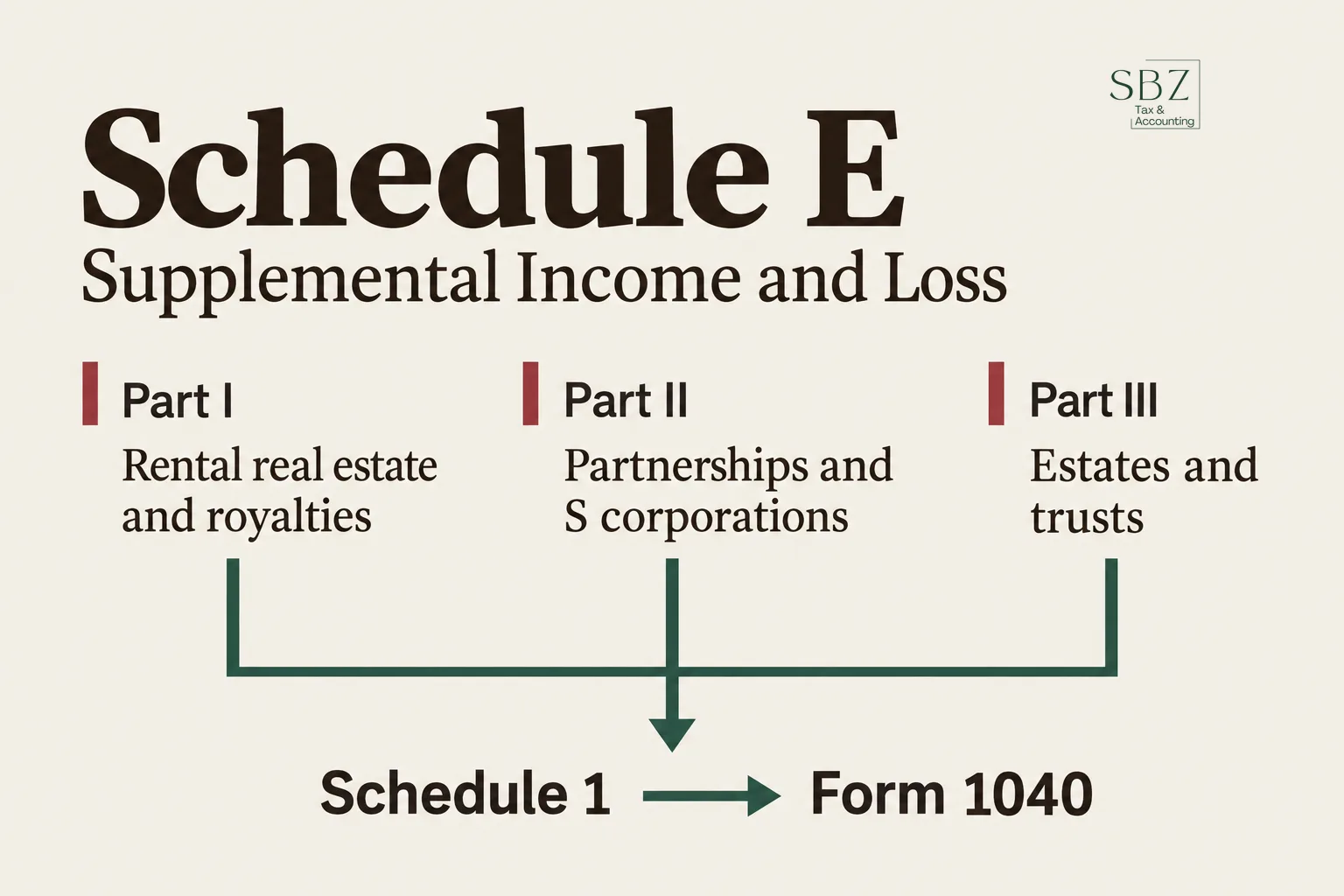
The net result from Schedule E carries to Schedule 1 of your Form 1040 and becomes part of your adjusted gross income. It's filed with your individual return, so it has the same due date (usually April 15, or October 15 if you file an extension).
What are the parts of Schedule E?
The form has five parts. Most filers use only one or two.
| Part | What it covers | Common source documents |
|---|---|---|
| Part I | Rental real estate and royalties | Leases, rent ledgers, 1099-MISC, mortgage statements (1098) |
| Part II | Partnerships and S corporations | Schedule K-1 (Form 1065 or 1120-S) |
| Part III | Estates and trusts | Schedule K-1 (Form 1041) |
| Part IV | Real estate mortgage investment conduits (REMICs) | Schedule Q |
| Part V | Summary, including farm rental income and real estate professional figures | Totals from the parts above |
How do you report rental income in Part I?
Part I has room for three properties per page. If you have more, attach additional pages. For each property you enter the address, the property type (single-family, multi-family, vacation/short-term rental, commercial, land, royalties, self-rental, or other), and the number of fair rental days and personal use days.
Those day counts matter more than people expect. If you or your family used the property for more than 14 days, or more than 10% of the days it was rented at fair value (whichever is greater), the vacation home rules can limit your deductions. Going the other way, if you rented a home you live in for fewer than 15 days in the year, you generally don't report the rent at all.
Then come rents received (line 3), royalties received (line 4), and the expense lines.
What expenses can you deduct on Schedule E?
Lines 5 through 19 list the standard rental expense categories:
- Advertising
- Auto and travel
- Cleaning and maintenance
- Commissions
- Insurance
- Legal and other professional fees
- Management fees
- Mortgage interest paid to banks (and other interest)
- Repairs
- Supplies
- Property taxes
- Utilities
- Depreciation or depletion (line 18)
- Other expenses
Many people get depreciation wrong. In general, you deduct the cost of a residential rental building (not the land) over 27.5 years and a commercial building over 39 years, using Form 4562 in the first year. Skipping depreciation doesn't protect you: when you sell, the IRS generally treats depreciation as "allowed or allowable," which means it can reduce your basis even if you never claimed it.
The other common problem is mixing up repairs and improvements. Fixing a leaky faucet is a repair you deduct this year. Replacing the whole roof is usually an improvement you capitalize and depreciate. For a broader look at what counts as deductible, see our guide to business expenses that are actually tax deductible.
Can a rental loss on Schedule E reduce your other income?
Sometimes. Rental activity is generally treated as passive, and passive losses can usually offset only passive income. Losses you can't use carry forward on Form 8582.
The main exception is the special allowance. If you actively participate (for example, you approve tenants, set rents, and approve repairs), you may be able to deduct up to $25,000 of rental losses against other income. That allowance phases out as modified AGI rises from $100,000 to $150,000. Taxpayers who qualify as real estate professionals follow different rules and can treat rentals as nonpassive.
This is an area where tax planning before year-end usually helps more than fixing things at filing time.
How does K-1 income show up in Part II?
If you own part of a partnership or an S corporation, the business files its own return and sends you a Schedule K-1. You report your share of ordinary business income or loss in Part II of Schedule E, and you mark whether each activity is passive or nonpassive for you.
Two points people miss:
- Basis limits. You generally can't deduct losses beyond your stock or debt basis (S corp) or your basis and at-risk amount (partnership). S-corp shareholders who claim a loss, receive a distribution, or dispose of stock generally have to attach Form 7203.
- S-corp distributions aren't on Schedule E. The K-1 income goes on Schedule E whether or not you took the cash out. Your W-2 salary from the S corp goes on the front of the 1040.
If you're deciding whether an entity setup makes sense, S-corp vs. LLC tax differences is a good place to start, and SBZ Tax handles S-corp and business returns that produce these K-1s.
Schedule E vs. Schedule C: which one do you use?
In short, Schedule E is for passive-type income, and Schedule C is for an active trade or business. Most long-term rentals go on Schedule E, and that income generally isn't subject to self-employment tax.
Short-term rentals are where it gets complicated. If you provide substantial services, like daily cleaning, meals, or concierge-type help, the activity may belong on Schedule C. That can bring in self-employment tax, which may mean you need to make quarterly estimated payments. The average-stay rules (7 days or fewer, for example) can also change how the passive rules apply, even when the income stays on Schedule E.
What triggers problems with Schedule E?
The IRS pays attention to large rental losses claimed by high-income filers, personal-use days that look understated, and depreciation that doesn't match the property's history. Line A of Part I also asks whether you made payments that required you to file Form 1099, and whether you did. If you paid a contractor $600 or more for work on a rental, check the current filing threshold and rules.
For a fuller list of red flags, read what triggers an IRS audit for small business owners. If you've already received a notice about a rental or K-1 item, our IRS tax problem help page explains how we approach it.
Where do you get the Schedule E tax form?
You can download the current Schedule E PDF and its instructions from IRS.gov. Search for "Schedule E (Form 1040)." Use the version for the tax year you're filing: a 2025 return uses the 2025 form, and a prior-year return uses that year's form. Tax software fills it out automatically once you enter your rental and K-1 details.
The form itself is easy. Clean records are the hard part. If your rental income and expenses live in a shoebox or a single checking account mixed with personal spending, monthly bookkeeping makes Schedule E much faster and more defensible.
What should you do next?
Before you sit down to file, gather these for each property or K-1:
- Total rent collected and fair rental days vs. personal use days
- Mortgage interest (Form 1098), property tax, and insurance statements
- Receipts for repairs, with improvements kept separate
- Your depreciation schedule from prior returns, or purchase documents if this is year one
- Every Schedule K-1 you received
If you'd like a second set of eyes, SBZ Tax works with rental owners and K-1 recipients remotely nationwide. You can call 818-748-2020, visit the office, or book a free consultation. This is general information, not tax advice for your specific situation. Talk to a tax professional about how these rules apply to you.
Frequently asked questions
What is Schedule E on a tax return?
Schedule E is an attachment to Form 1040 for reporting supplemental income and loss. That includes rental real estate, royalties, and your share of income from partnerships, S corporations, estates, and trusts.
Do I need to file Schedule E if I have a K-1?
Usually, yes. Income or loss from a partnership, S-corp, estate, or trust K-1 is generally reported in Part II or Part III of Schedule E.
Is Schedule E income subject to self-employment tax?
Rental and royalty income on Schedule E generally is not subject to self-employment tax. If you provide substantial services, such as with some short-term rentals, the income may belong on Schedule C, where self-employment tax can apply.
Can I file Schedule E for a rental property that lost money?
Yes. You report the loss either way. Whether you can deduct it this year depends on the passive activity rules, your level of participation, and your income. Disallowed losses carry forward.
Where do I find the Schedule E tax form PDF?
The current Schedule E (Form 1040) and its instructions are on IRS.gov. Make sure you use the version that matches the tax year you're filing.