On this page
- What is Form 5500?
- Does the IRS actually receive Form 5500?
- Which plans have to file?
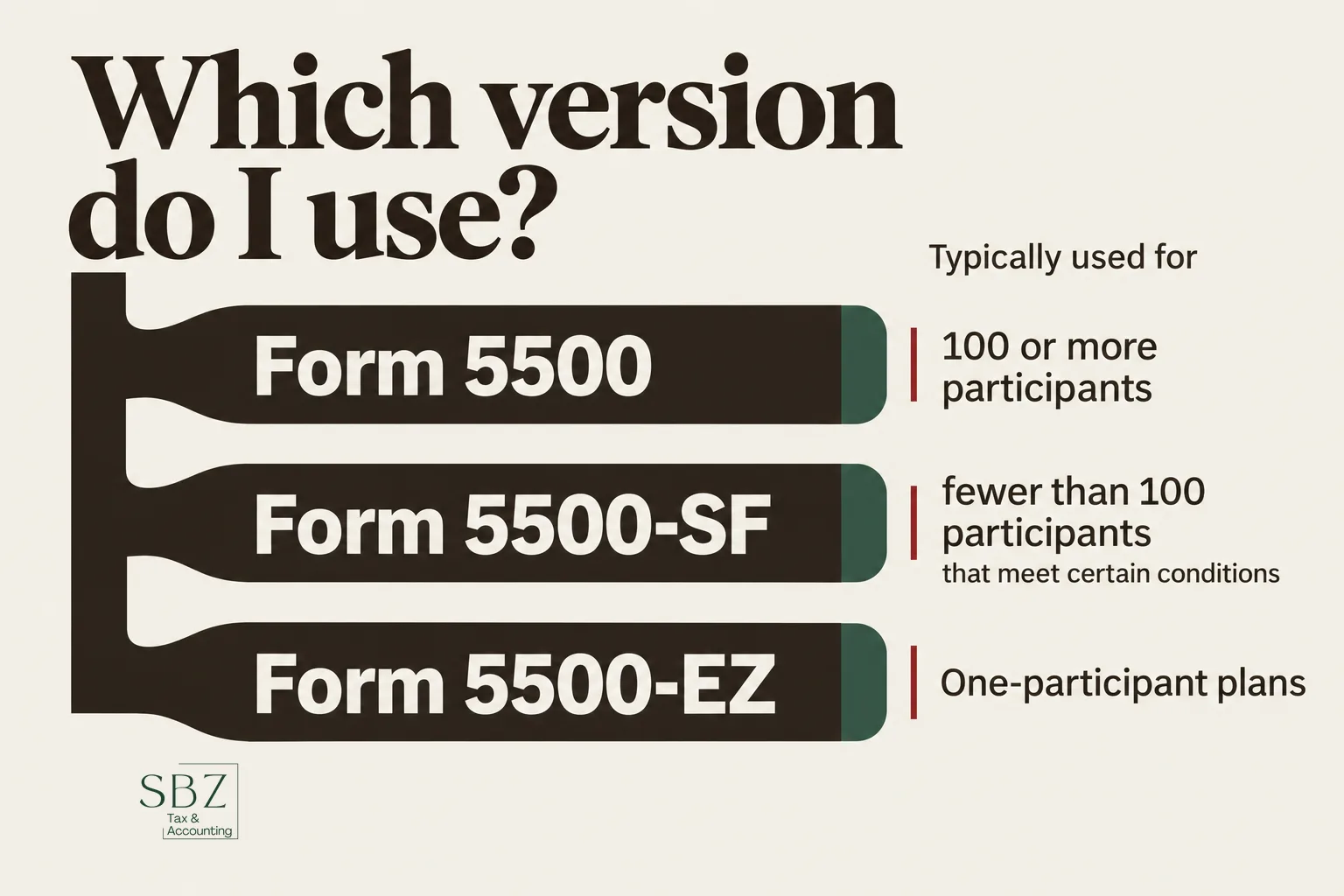
- Form 5500, 5500-SF, or 5500-EZ: which version do I use?
- Why do solo 401(k) owners need to know about the 5500-EZ?
- When is Form 5500 due?
- What happens if I file late or not at all?
- How can I look up a Form 5500 that's been filed?
- Who normally prepares Form 5500?
- What should I do next?
- Frequently asked questions
- Related reading
IRS Form 5500: Who Has to File It, Which Version You Need, and When It's Due
Form 5500 is the annual return or report that most employer-sponsored retirement and benefit plans file to tell the government how the plan is run and what it holds. It is a joint form used by the Department of Labor (DOL), the IRS, and the Pension Benefit Guaranty Corporation, and it is a different filing from your business income tax return. Owners who set up a 401(k) often learn about it only after the plan has been open for a year.
Here's the short version of who files what, when, and where.
What is Form 5500?
Form 5500 is an information return, not a tax return. It reports the plan's financial condition, investments, and operations, and it is how the government checks that the plan follows ERISA and the Internal Revenue Code rules. You do not pay tax with it.
The main form comes with schedules, such as Schedule H or I for plan financials and Schedule C for service providers. Which schedules apply depends on the plan's size and type.
Does the IRS actually receive Form 5500?
For most filers, no, not directly. Plans file Form 5500 and Form 5500-SF electronically through EFAST2, the DOL's system, and the data is shared with the IRS and PBGC. That is why the form is often searched as "IRS Form 5500" even though the DOL runs the filing system.
Form 5500-EZ for one-participant plans is the exception. A plan can file it electronically through EFAST2, or file a paper version with the IRS if the plan isn't required to file electronically. Check the current instructions for the mailing address, since filing details change.
Which plans have to file?
Most 401(k), profit-sharing, defined benefit, and money purchase plans must file once they cover employees. Some benefit plans, such as certain health and welfare plans, file too.
Several common plans generally do not:
- SEP IRAs and SIMPLE IRAs are typically exempt from Form 5500.
- One-participant plans with $250,000 or less in assets at the end of the plan year generally don't need to file, with an important exception: the final year of the plan always requires a return.
- Government plans and church plans have separate rules.
Exemptions have conditions, so confirm yours against the current instructions or with your plan administrator before assuming you're off the hook.
Form 5500, 5500-SF, or 5500-EZ: which version do I use?
The version depends on plan size and who participates.
| Version | Typically used for | Where it's filed |
|---|---|---|
| Form 5500 | Plans with 100 or more participants, and plans that don't qualify for the shorter forms | EFAST2 (electronic) |
| Form 5500-SF | Small plans, generally fewer than 100 participants at the start of the plan year, that meet certain conditions | EFAST2 (electronic) |
| Form 5500-EZ | One-participant plans (an owner and spouse, or partners and spouses) with no common-law employees | IRS paper filing or EFAST2 |
Larger plans often need an audit by an independent qualified public accountant attached to the filing. Small plans usually skip that, though a few have asset or investment conditions that bring it back. A plan with 80 to 120 participants has a special rule that lets it keep filing under the category it used the prior year.
Why do solo 401(k) owners need to know about the 5500-EZ?
A solo 401(k) covers only the owner (and a spouse, if they work in the business). It is a common choice for self-employed people with a Schedule C business and for S-corp owners paying themselves through payroll and distributions.
Once total plan assets pass $250,000 at the end of the year, the owner generally files Form 5500-EZ for that year and every year after. People miss this because the plan grows quietly, then crosses the line with no notice from the brokerage. If you have a solo plan, check the year-end balance every year.
Hiring a common-law employee who becomes eligible changes the picture too. The plan generally stops being a one-participant plan and moves to a different form.
When is Form 5500 due?
The due date is the last day of the seventh month after the plan year ends. For a calendar-year plan, that is July 31 of the following year.
You can extend the deadline by two and a half months with Form 5558, filed on or before the original due date. For a calendar-year plan, that moves the date to October 15. In some cases, an extension of the sponsoring business's income tax return also extends the 5500 deadline when the plan year and tax year match. Owners who already file an extension, such as Form 7004 for a partnership or corporation, should confirm whether it covers the plan filing rather than assuming.
What happens if I file late or not at all?
Penalties can be steep, and they come from two agencies. The IRS can assess a daily penalty for late returns, and the DOL can assess its own penalties that run to well over $2,000 a day under current inflation-adjusted amounts. Both agencies adjust their figures over time, so check the current numbers.
The DOL runs a Delinquent Filer Voluntary Compliance (DFVC) program for plans that haven't filed. It lets late filers pay a much smaller fixed penalty if they come forward before the DOL contacts them. The IRS has separate relief procedures for late 5500-EZ filers.
If a penalty notice has already arrived, our page on IRS and state tax problem help explains how notices like this are typically handled.
How can I look up a Form 5500 that's been filed?
The DOL runs a public Form 5500 search where anyone can look up filings by plan name or sponsor. Plan sponsors use it to confirm a prior year was filed, and researchers use it to compare plans. Search results show filings made through EFAST2, so a paper-filed 5500-EZ may not appear there.
Who normally prepares Form 5500?
Most small employers don't prepare it themselves. The plan's third-party administrator (TPA), recordkeeper, or the company that set up the 401(k) usually prepares the filing and asks the employer to review and sign. The employer is still responsible for the filing being correct and on time.
A tax professional is useful on the surrounding pieces: plan contributions and deductions on your business return, the effect on S-corp taxes, and how retirement contributions fit into broader tax planning. Clean, current books through monthly bookkeeping also make year-end plan reporting easier, since contributions and payroll deferrals need to match what the plan reports.
What should I do next?
If you have a retirement plan, start with four checks. Confirm which plan type and form version you fall under. Find out who prepares the filing. Put the July 31 date (or your plan's equivalent) on the calendar, and if you need more time, file Form 5558 before it passes. If you think a prior year was missed, look into DFVC or IRS relief before a notice arrives.
If you'd like help sorting out the tax side of a plan, you can book a free consultation, call SBZ Tax at 818-748-2020, or visit the office at 190 Sierra Ct Ste 335, Palmdale, CA 93550. We work with business owners nationwide. See our pricing for how engagements are structured.
This article is general information, not tax or legal advice for your specific situation. Plan filing rules depend on your plan's facts, so talk to a qualified professional before you file.
Frequently asked questions
Do I need to file Form 5500 for a SEP IRA?
Generally no. SEP IRAs and SIMPLE IRAs are typically exempt from Form 5500 filing. Other conditions can change that, so confirm with your plan provider.
Is Form 5500-SF the same as Form 5500-EZ?
No. Form 5500-SF is a shorter electronic form for small plans, generally under 100 participants. Form 5500-EZ is for one-participant plans, such as an owner-only 401(k), and can be filed on paper with the IRS in some cases.
What is the Form 5500 due date for a calendar-year plan?
July 31 of the following year, which is the last day of the seventh month after the plan year ends. Form 5558 can extend that by two and a half months.
Do I file Form 5500 with the IRS?
Mostly through EFAST2, the DOL's electronic system, which shares the data with the IRS and PBGC. Form 5500-EZ may be filed on paper with the IRS when electronic filing isn't required.
Is there a penalty for filing Form 5500 late?
Yes. Both the IRS and the DOL can assess daily penalties, and the amounts are adjusted for inflation. The DOL's DFVC program offers reduced penalties to plans that file late voluntarily.