On this page
- What is an IRS tax transcript?
- Which type of IRS transcript should you request?
- How do you request an IRS transcript online?
- How do you request an IRS transcript by mail or phone?
- Can a tax professional request a transcript for you?
- What if your IRS transcript request is rejected or comes back wrong?
- Does an IRS transcript cover your state taxes too?
- What's the best next step?
- Frequently asked questions
IRS Transcript Request: How to Get Your Tax Transcript Online, by Mail, or Through a Pro
The fastest way to request an IRS transcript is online through your IRS Online Account, where you can view and download it right away at no cost. If you can't verify your identity online, you can request it by mail, by phone, or with Form 4506-T. Which transcript you ask for matters more than how you ask.
Lenders, financial aid offices, and immigration or housing applications routinely ask for a transcript. Here's how each option works and what to do when a request stalls.
What is an IRS tax transcript?
An IRS tax transcript is a free summary of information the IRS has on file for your tax account. It is not a copy of your return. It is a text-based printout the IRS generates from its own records, and most third parties accept it as proof of income and filing.
A transcript is different from a photocopy of your actual return. Photocopies come through Form 4506, which carries a fee and takes much longer. Most people asking for "proof of income" only need a transcript.
Which type of IRS transcript should you request?
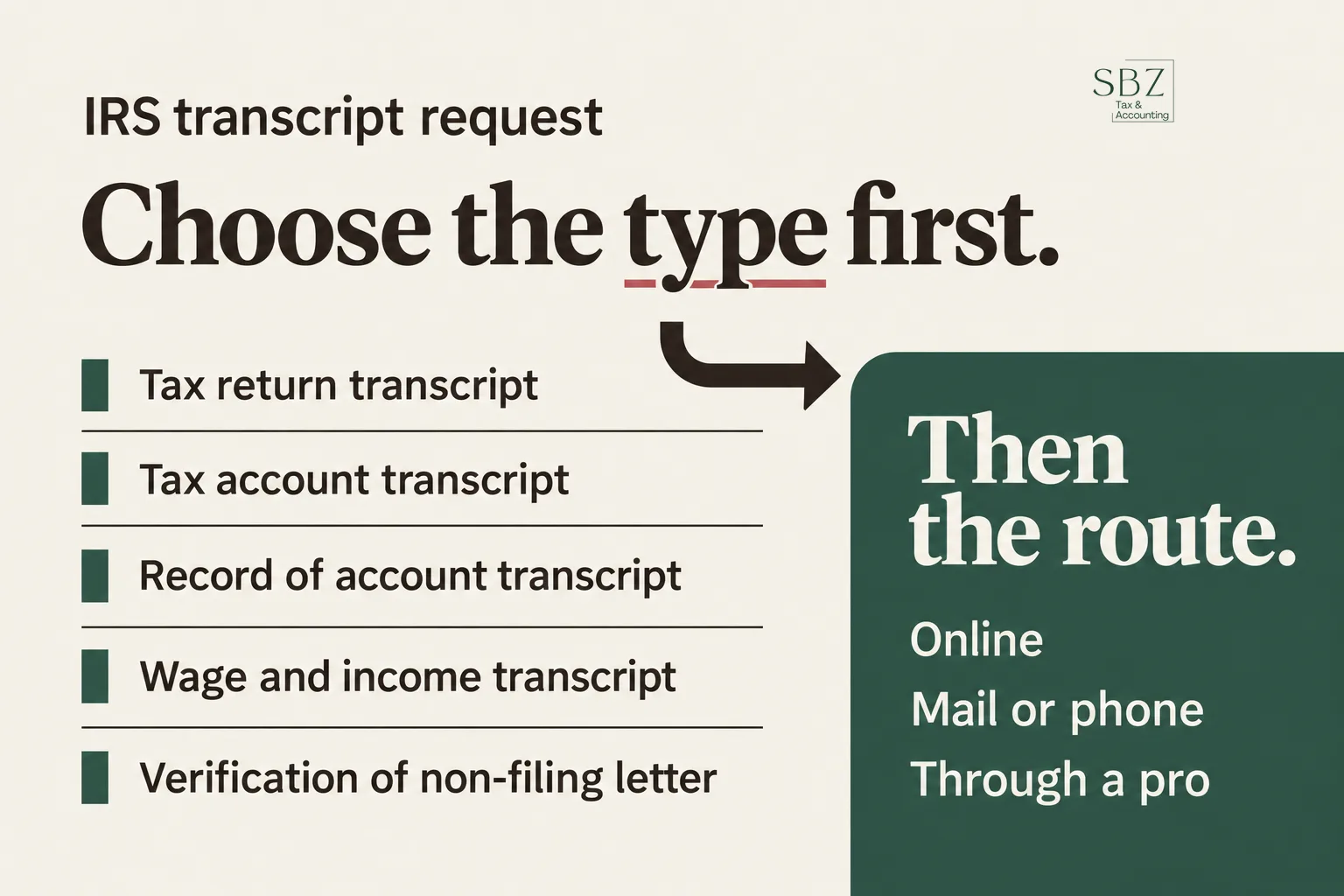
The IRS offers several transcript types, and each answers a different question. Ask for the wrong one and the lender or agency will bounce it back.
| Transcript | What it shows | Typical use |
|---|---|---|
| Tax return transcript | Most line items from your return as originally filed, including Schedules | Mortgage, loans, financial aid |
| Tax account transcript | Filing status, taxable income, payments, penalties, and adjustments made after filing | Checking balances, penalties, and amended-return changes |
| Record of account transcript | Return transcript and account transcript combined | When you need both views |
| Wage and income transcript | Data reported to the IRS on W-2s, 1099s, 1098s, and similar forms | Rebuilding a lost W-2, catching missing 1099s |
| Verification of non-filing letter | Confirms the IRS has no return on file for a year | Financial aid, some benefit applications |
The part people miss: a return transcript shows the return as you filed it. If you amended later or the IRS adjusted something, that appears on the account transcript instead. If you amended, see our guide to Form 1040-X and how to amend a return for how those changes flow through.
Availability varies by type and year. Return transcripts generally cover the current and three prior years, while wage and income transcripts reach back further. Check the current limits when you request.
How do you request an IRS transcript online?
Sign in to your IRS Online Account at IRS.gov and open the transcript section. If you don't have an account yet, you'll create one and verify your identity, which currently runs through a third-party service (ID.me). Have a photo ID, your Social Security number, and a phone number in your name ready.
Once you're in, pick the transcript type and tax year, and the IRS displays it on screen. You can download or print it immediately. This is the route to use when someone needs the document today.
Two tips:
- Your account only shows your own records. A joint filer can pull a transcript under their own login.
- Any name or address mismatch with the IRS's records can trip up verification. Use the details exactly as they appear on your most recent return.
How do you request an IRS transcript by mail or phone?
If online verification fails or you'd rather not use it, there are two paper-friendly options.
By mail or phone through the transcript request tool. You can order return and account transcripts to be mailed to the address the IRS has on file. The IRS says to allow roughly 5 to 10 calendar days. The automated transcript line is 800-908-9946.
With Form 4506-T. This form requests a range of transcript types, including wage and income transcripts and non-filing letters, by mail or fax. Processing generally takes longer than the online route, and the transcript goes to the address on file unless you've authorized a third party.
Mailed transcripts only go to your address of record. If you've moved and haven't updated the IRS, you'll need to fix that first or use another method.
Can a tax professional request a transcript for you?
Yes, with your authorization. A tax professional with the right credentials can pull transcripts through IRS professional tools once you sign a Form 8821 (Tax Information Authorization) or Form 2848 (Power of Attorney), depending on the situation.
This is often the cleaner path when you're dealing with an IRS notice, missing years, or a payment plan. The transcripts show what the IRS thinks happened, which may not match your records. Seeing both before you respond to a notice is worth the time. Our IRS and state tax problem help covers that process.
What if your IRS transcript request is rejected or comes back wrong?
The most common reasons are small and fixable:
- Identity verification failed. Try the mail or Form 4506-T route instead.
- No record for that year. If you filed recently, processing may not be complete. Electronic returns generally post faster than paper ones.
- Address mismatch. Mailed transcripts only go to the address on file.
- Wrong transcript type. Check what the requesting party actually asked for.
- The numbers look off. A transcript can show income you didn't expect, such as a 1099 you never received. Don't ignore it. If you haven't filed for that year, read what to do if you missed the tax filing deadline before you do anything else.
If the transcript shows an unfamiliar adjustment or balance, that's usually a notice problem rather than a transcript problem. Understanding what triggers IRS attention can help you read what you're seeing.
Does an IRS transcript cover your state taxes too?
No. An IRS transcript only covers federal records. State agencies keep their own accounts, so a California refund question goes to the Franchise Tax Board, not the IRS. Our guide on checking your California state tax refund status walks through that side.
What's the best next step?
Decide what the requester needs, then match the transcript to it. For a mortgage or loan, that's usually a return transcript, and sometimes a wage and income transcript. For a notice or balance question, start with the account transcript. Then use the online route if you can verify your identity and the mail route if you can't.
If a transcript turns up something you didn't expect, or you'd like a second set of eyes before sending it to a lender, SBZ Tax can help. You can book a free consultation, see pricing, call 818-748-2020, or visit the office at 190 Sierra Ct Ste 335, Palmdale, CA 93550. We also work with clients remotely nationwide. Exploring ahead of next year? Our tax planning services are a good place to start.
This article is general information, not tax advice for your specific situation. Talk with a qualified professional before acting on it.
Frequently asked questions
How long does an IRS transcript request take?
Online requests are immediate once you've verified your identity. Mail requests through the IRS transcript tool or phone line generally take about 5 to 10 calendar days. Form 4506-T requests usually take longer.
Is there a fee for an IRS transcript?
No. Tax transcripts are free from the IRS. Be cautious of anyone charging to "get" a transcript you can pull yourself. A professional charging for analysis or representation is a different matter.
What's the difference between a tax return transcript and a tax account transcript?
A return transcript shows your return as originally filed. An account transcript shows your account activity, including payments, penalties, and changes made after filing. Many people need both.
Can I get a transcript for a year I didn't file?
Not a return transcript, because there's no return. You can request a verification of non-filing letter, and a wage and income transcript will show what employers and payers reported for that year.
Can I request a transcript for someone else?
Only with proper authorization, such as a signed Form 8821 or Form 2848, or in limited cases like a deceased taxpayer's representative. Check the IRS instructions for your situation.