On this page
- Who has to file Form 1065?
- What does Form 1065 actually report?
- What is a Schedule K-1, and why does it matter so much?
- How are partners taxed on their share?
- When is Form 1065 due?
- What happens if a partnership files late?
- Does the partnership have to e-file?
- Should a partnership consider a different structure?
- Next step: getting the 1065 filed cleanly
- Frequently asked questions
- Related reading
- Related reading
IRS Form 1065: Who Files It, What's On It, and When It's Due
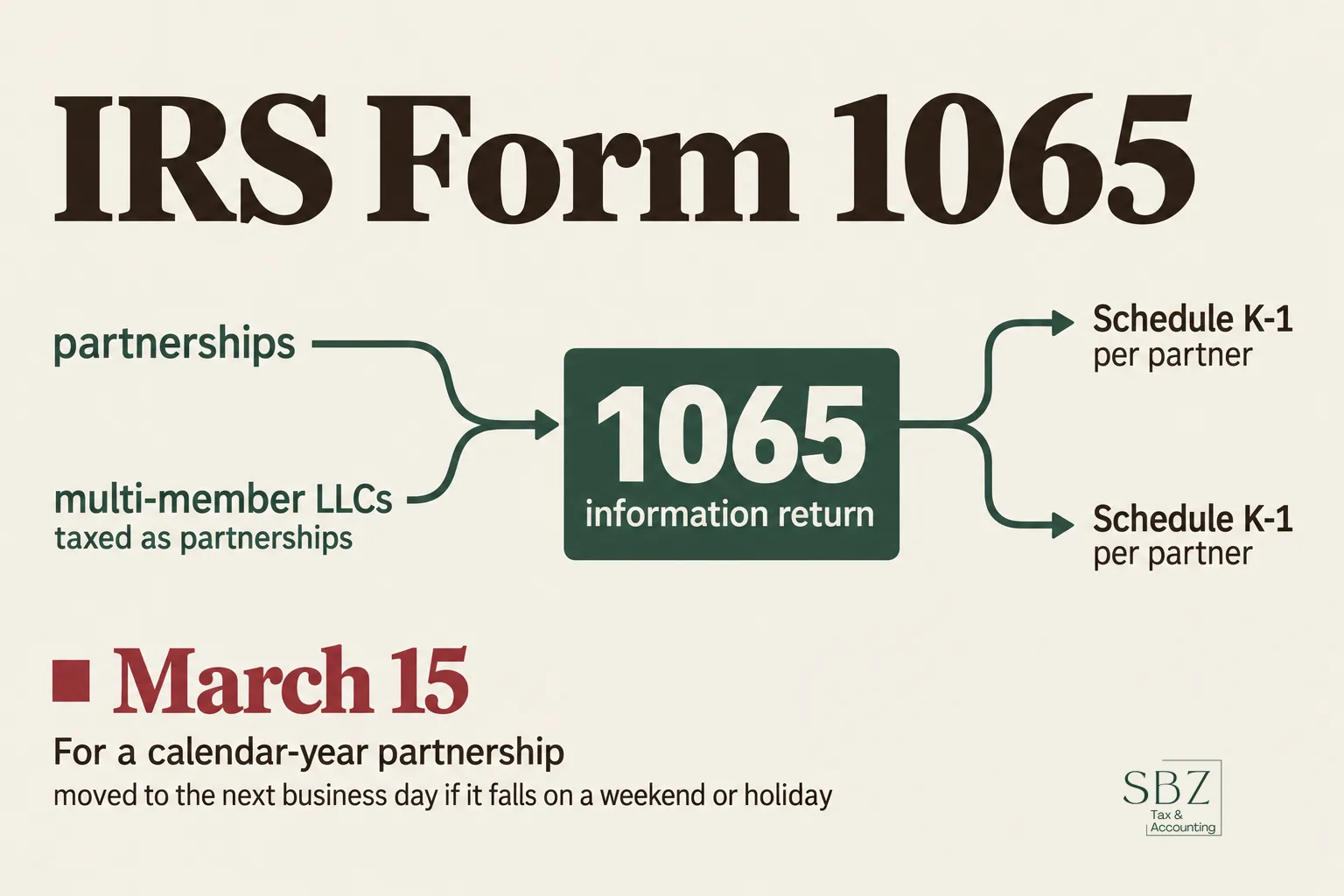
IRS Form 1065, U.S. Return of Partnership Income, is the annual information return that a partnership files to report its income, deductions, gains, losses, and credits. The partnership itself generally owes no federal income tax. Instead, the results pass through to the partners, who report their share on their own returns.
If you co-own a business with someone and never made an S-corp election, this is probably the form your business files. Here's what it covers and where people go wrong.
Who has to file Form 1065?
Any entity treated as a partnership for federal tax purposes has to file. That includes general partnerships, limited partnerships, limited liability partnerships, and, the part people miss, multi-member LLCs that haven't elected to be taxed as a corporation.
A partnership generally has to file even if it had no income or lost money for the year. The IRS treats a partnership as a filer if it does business in the U.S. or has U.S.-source income.
A single-member LLC is different. By default it's a "disregarded entity," so its owner reports everything on their personal return, usually on Schedule C. No Form 1065.
One narrow exception: a husband-and-wife business in a community property state can sometimes choose to be treated as a disregarded entity instead of a partnership. That is a specific election with its own conditions, so confirm it applies before relying on it.
What does Form 1065 actually report?
The first page covers the partnership's ordinary business income and deductions: gross receipts, cost of goods sold, wages, rent, interest, depreciation, and so on. The result is ordinary business income or loss.
The rest of the return carries the detail:
- Schedule B asks general questions about the partnership: who owns it, whether it has foreign partners, and which other schedules are required.
- Schedule K summarizes everything that passes through to the partners as a group. That includes ordinary income, guaranteed payments, rental income, interest, capital gains, Section 179 deductions, and credits.
- Schedule K-1 breaks Schedule K down per partner.
- Schedules L, M-1, and M-2 are the balance sheet and reconciliation schedules. Smaller partnerships can skip them if they meet the exemption on Schedule B: total receipts under $250,000, total assets under $1 million, K-1s filed on time, and no Schedule M-3 required.
- Schedule M-3 replaces M-1 for larger partnerships, based on asset and receipt thresholds listed in the instructions.
If you're reading the official instructions for Form 1065, the Schedule B questions are the best place to start. They determine which of the other schedules you owe.
What is a Schedule K-1, and why does it matter so much?
Schedule K-1 (Form 1065) is the partner's copy of their share of the partnership's results. The partnership files the K-1s with the IRS and gives each partner their own. Partners then use that information on their personal returns, usually Form 1040 with Schedule E.
Here's the part that surprises new partners: you owe tax on your share of the income whether or not the partnership distributes any cash to you. A partnership can show a profit, hold the cash in the business, and you still get a K-1 with taxable income on it.
K-1s also feed into basis tracking. Each partner's basis in the partnership goes up with income and contributions and down with losses and distributions, and it limits how much loss a partner can deduct. The partnership doesn't track this for you on the K-1, so partners generally need to keep their own running record.
How are partners taxed on their share?
Partnership income isn't wages, so no payroll taxes are withheld. A general partner's share of ordinary business income is typically subject to self-employment tax, and guaranteed payments to a partner for services are too. Rules for limited partners differ, so the K-1 box coding matters.
Because nothing is withheld, partners usually need to make quarterly estimated tax payments. Missing them can trigger estimated tax penalties even if the return is filed on time.
When is Form 1065 due?
For a calendar-year partnership, Form 1065 is due on the 15th day of the third month after the tax year ends, which is March 15 (moved to the next business day if it falls on a weekend or holiday). Fiscal-year partnerships follow the same "15th day of the third month" rule based on their year-end.
Need more time? Form 7004 gives a six-month extension to file. It extends the filing deadline, but a partnership has no income tax payment due on Form 1065 anyway, so what matters is that partners still need to account for their own tax. Partners often file their personal returns late while waiting on a K-1, which is why an on-time partnership return helps everyone.
What happens if a partnership files late?
The late-filing penalty is charged per partner, per month (or part of a month), for up to 12 months. The dollar amount is adjusted for inflation each year, so check the current figure in the instructions. A partnership with several partners adds up fast.
Separate penalties can apply for failing to furnish K-1s to partners on time or filing incorrect ones. The IRS may waive penalties for reasonable cause, and certain small partnerships may qualify for relief if they met specific conditions, but you generally have to ask. If a notice has already arrived, our page on IRS and state tax problem help covers the next steps.
Does the partnership have to e-file?
Partnerships with more than 100 partners must e-file. The IRS e-file mandate has also been broadened to cover many smaller filers, depending on how many returns of all types they file in a year. Check the current instructions for the threshold that applies to you.
Even when it isn't required, e-filing tends to be faster to confirm and easier to fix when the IRS sends something back.
Should a partnership consider a different structure?
Sometimes. Partners can't be employees of their own partnership, so everything they earn is subject to self-employment tax. Some owners look at an S corporation, filed on Form 1120-S, to split pay between salary and distributions. That change brings payroll, a reasonable-compensation requirement, and an election on Form 2553. It's not automatically better. Our comparison of S-corp vs. LLC tax differences walks through the tradeoffs, and how to pay yourself from an S-corp explains the mechanics after the switch.
Next step: getting the 1065 filed cleanly
Most late or wrong partnership returns trace back to messy books. A sensible order:
- Close out the year with reconciled bank and credit card accounts. Our monthly bookkeeping service exists for exactly this.
- Gather the partnership agreement, capital contributions, and distribution records.
- Confirm each partner's name, taxpayer ID, and ownership percentage.
- File the return, or an extension on Form 7004, by the due date.
- Deliver K-1s to partners as soon as the return is done.
SBZ Tax helps small business owners with partnership and S-corp returns nationwide, and tax planning for the year ahead. You can see pricing, book a free consultation, call 818-748-2020, or stop by the office at 190 Sierra Ct Ste 335, Palmdale, CA 93550.
This is general information, not tax advice for your specific situation. Talk to a qualified tax professional before making decisions about your partnership.
Frequently asked questions
Does a partnership pay income tax with Form 1065?
Generally no. The partnership files an information return, and the partners pay tax on their share of the income on their own returns. Some states do charge entity-level taxes or fees, so check your state's rules.
Do I need to file Form 1065 if my partnership had no income?
In most cases, yes. A partnership that is in business generally has to file even with zero income or a loss, and the K-1s may still carry deductions or credits partners need.
Can I file Form 1065 myself?
You can, and the IRS publishes the form and instructions for free. But the K-1 reporting, basis issues, and Schedule B exemptions are easy to get wrong, so many partnerships hire a professional, especially in the first year.
What is the difference between Form 1065 and Form 1120-S?
Form 1065 is for partnerships, including multi-member LLCs taxed as partnerships. Form 1120-S is for S corporations. Both pass income through to owners via K-1s, but the ownership rules, payroll treatment, and basis calculations differ.
Is a Schedule K-1 the same as a 1099?
No. A K-1 reports your share of the partnership's income, deductions, and credits, whether or not you received cash. A 1099 reports payments actually made to a contractor. If you hire contractors, see whether you need to send 1099s.