On this page
- Did the California mileage tax pass?
- What is the California road charge program?
- What about AB 1421, AB 130, and other bill numbers?
- Would a mileage tax replace the gas tax?
- Does my mileage already affect my taxes?
- How does this affect rideshare and delivery drivers?
- How should you prepare while the policy is unsettled?
- Frequently asked questions
California Mileage Tax: What's Been Proposed, What's Law, and What It Means for Drivers
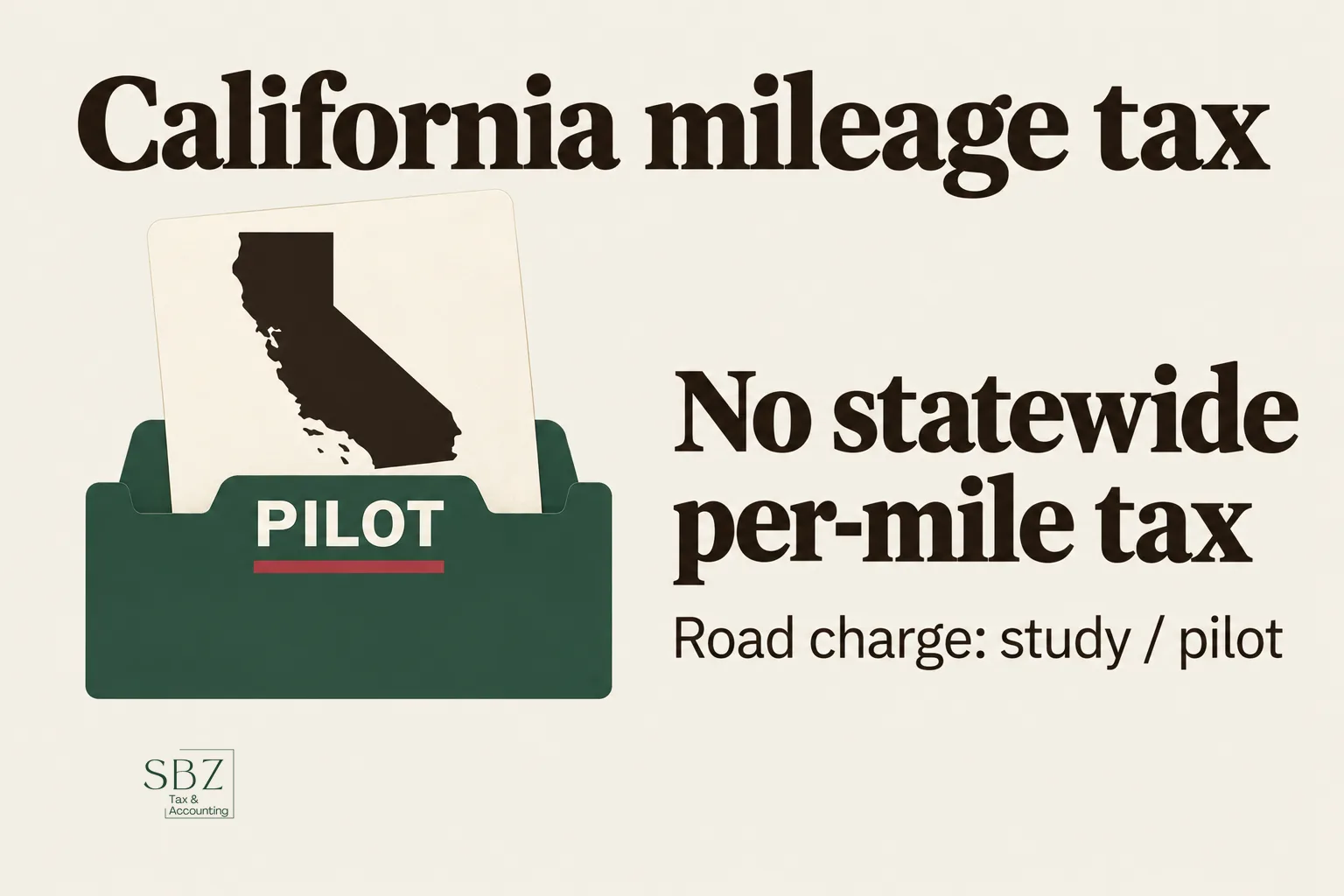
California does not currently charge a statewide per-mile tax on all drivers. What exists is a gas excise tax that drivers already pay at the pump, plus a state-run road charge program that has been studied and piloted as a possible replacement. Check the current status before relying on this article, because legislation moves quickly.
Here's the short version of what's real, what's only proposed, and where your own mileage actually does show up on a tax return.
Did the California mileage tax pass?
As of this writing, no law requires California drivers to pay a general tax per mile driven. Searches like "did the CA mileage tax pass" usually trace back to news about road charge studies or to bills that mention mileage-based fees. Neither one is the same as an enacted tax.
The reason the topic keeps resurfacing is simple. California funds roads largely through a per-gallon fuel excise tax, which is adjusted for inflation each July. As cars get more efficient and electric vehicles spread, fewer gallons are sold per mile driven. Lawmakers have been looking at ways to close that gap.
What is the California road charge program?
The California Road Charge Program is the state's long-running effort to test a pay-per-mile alternative to the fuel tax. It grew out of legislation passed in 2014 and was followed by a pilot that enrolled volunteer drivers. The Transportation Agency and Caltrans have continued to study it.
In a pilot, participants report their miles through a device, a smartphone app, or a manual odometer reading. Drivers are typically credited for the fuel tax they paid at the pump so they aren't charged twice. The pilots were designed to test technology, privacy protections, and administration, not to collect a new tax from the general public.
Anything that moved from pilot to mandatory would need new legislation, so a pilot on its own doesn't create a tax.
What about AB 1421, AB 130, and other bill numbers?
People search for specific bill numbers because a headline or social post mentioned one. The part people miss is that a bill number often covers far more than a headline suggests, and many mileage-related proposals never leave committee.
If you want to know what a bill actually does, read its text and status on the California Legislature's official site rather than relying on a summary. Check whether it was passed, signed, or amended, and whether it creates a tax or only authorizes a study or pilot. Those are very different outcomes.
Would a mileage tax replace the gas tax?
In most proposals and studies, a per-mile charge would replace or offset the fuel excise tax rather than stack on top of it. Electric vehicles pay no fuel tax today, so a per-mile structure would be the main way to have them contribute to road funding.
Details such as the rate, who is covered, how miles are verified, and how privacy is handled would all be set by whatever law eventually passes. Until that happens, any specific number you see online is a proposal or an illustration.
Does my mileage already affect my taxes?
Yes, in a different way. The IRS lets self-employed taxpayers deduct business driving, and that is where mileage matters on your return today. The IRS sets a standard mileage rate each year, so use the current year's figure from the IRS rather than a number from an old article.
Here's what actually matters if you drive for work:
- Keep a contemporaneous log. Date, destination, business purpose, and miles for each trip. The IRS expects records made at or near the time of the trip.
- Commuting isn't deductible. Driving from home to a regular workplace is personal. Trips between job sites, to clients, or from a qualifying home office are treated differently.
- Pick a method and be consistent. You can generally use the standard mileage rate or actual expenses. Switching rules depend on how the vehicle was first used.
- Report it on the right form. Sole proprietors report vehicle expenses on Schedule C, and landlords driving to rentals may use Schedule E.
If you take actual expenses and depreciation on a heavier vehicle, the details run through Form 4562 and sometimes the Section 179 deduction. Those rules are technical, so it's worth confirming the current limits.
For a wider look at what counts, see what business expenses are actually tax deductible.
How does this affect rideshare and delivery drivers?
High-mileage drivers feel any change in road funding first, and they also benefit most from a clean mileage record today. Gig drivers typically deduct business miles rather than tracking every gas receipt, and they owe self-employment tax on net profit.
If that's you, our guide on rideshare and delivery driver taxes covers the deduction mechanics. You'll also want to stay on top of quarterly estimated taxes, since no one withholds for you.
How should you prepare while the policy is unsettled?
You can't plan around a tax that doesn't exist, but you can make sure your records would hold up under any rule. Track miles by trip, separate business from personal use, and keep vehicle purchase and maintenance records in one place.
Good habits here pay off whether or not a state mileage charge ever arrives. They also help in an audit, since vehicle deductions are a common area of review; see what triggers an IRS audit for small business owners.
SBZ Tax helps self-employed taxpayers and business owners across the U.S. set up mileage tracking and monthly bookkeeping so the numbers are ready at filing time. If you'd like a second look at your vehicle deductions, you can book a free consultation, call 818-748-2020, or visit the office at 190 Sierra Ct Ste 335, Palmdale, CA 93550. For broader planning, see our tax planning services.
This article is general information, not tax advice for your specific situation. Talk to a qualified professional before making decisions based on it.
Frequently asked questions
Is there a mileage tax in California right now?
No statewide tax on all drivers' miles is in effect as of this writing. California collects a fuel excise tax at the pump and has run a voluntary road charge pilot to test an alternative. Confirm current status on the Legislature's website.
What is the California mileage tax proposal?
Proposals generally suggest replacing some or all of the fuel excise tax with a charge based on miles driven, so electric and high-efficiency vehicles contribute to road funding. The specifics vary by bill, and many never become law.
Will electric vehicle owners pay a mileage tax in California?
Electric vehicles don't pay the gas tax today, which is a major reason a per-mile charge is discussed. Whether and how EVs would be charged depends on legislation that hasn't been enacted. California does charge an annual registration fee related to road funding for zero-emission vehicles.
Can I deduct mileage on my taxes?
Self-employed taxpayers and some other filers can deduct qualifying business miles, but commuting generally doesn't count. You need a log of dates, purposes, and miles, and the IRS publishes the standard rate each year.
Where can I check whether a mileage bill passed?
Use the California Legislative Information website, which shows a bill's text, amendments, votes, and whether the Governor signed it. News summaries often skip those details.