On this page
- Who actually needs to pay quarterly?
- What are you actually paying?
- When are quarterly payments due?
- How do you calculate what to pay?
- How do you actually make the payment?
- What happens if you underpay?
- Do state estimated taxes work the same way?
- A starting point if you're new to this
- Frequently asked questions
- Related reading
Quarterly Estimated Taxes for the Self-Employed: What to Pay and When
If you're self-employed, you're required to pay taxes in four installments throughout the year — the IRS calls these quarterly estimated payments, and skipping them can trigger an underpayment penalty even if you settle everything by April 15.
When you work for an employer, withholding happens automatically: Social Security, Medicare, and income tax come out of every paycheck before you see a dollar. When you work for yourself, none of that happens. Quarterly estimated payments are how you replicate that system on your own schedule.
Who actually needs to pay quarterly?
The general rule: if you expect to owe at least $1,000 in federal taxes for the year — after subtracting any withholding and credits — the IRS expects quarterly payments.
That threshold catches most freelancers, sole proprietors, single-member LLC owners, and partners in a partnership. S-corp owners who pay themselves a salary get some withholding through payroll, but may still owe estimated payments if distributions push their total liability high enough.
If this is your first year self-employed and you're unsure where you'll land, estimate cautiously. Paying a bit extra quarterly is harmless — you'll get it back when you file. Underpaying means a penalty calculated from the missed due date forward.
What are you actually paying?
Quarterly payments cover two separate things:
- Federal income tax — the same graduated rate structure as any individual taxpayer, based on your net income
- Self-employment (SE) tax — your contribution to Social Security and Medicare. Employees split this 15.3% with their employer; self-employed people pay the full amount on net self-employment income, up to the annual Social Security wage base (then only the 2.9% Medicare portion applies above that)
One offset worth knowing: you can deduct half of your SE tax from gross income when calculating your overall tax liability. It doesn't eliminate the SE tax, but it lowers the base it's calculated against.
SE tax is why self-employed tax bills often surprise people in the first year. Even modest income generates a meaningful SE tax bill on top of income tax.
When are quarterly payments due?
The four deadlines each year:
| Period covered | Payment due |
|---|---|
| January 1 – March 31 | April 15 |
| April 1 – May 31 | June 15 |
| June 1 – August 31 | September 15 |
| September 1 – December 31 | January 15 (following year) |
When a due date falls on a weekend or federal holiday, it shifts to the next business day. The IRS publishes exact dates each year — worth a quick check.
Missing a deadline doesn't mean you immediately owe a large penalty, but interest accrues from the missed date forward, not just from the April filing deadline.
How do you calculate what to pay?
Two approaches hold up well in practice:
Safe harbor based on last year's tax Pay 100% of what you owed in total federal tax the prior year, split evenly across four quarters. If your prior-year adjusted gross income exceeded $150,000, the bar is 110% of last year's tax. The appeal here: you don't have to forecast this year's income at all. As long as you pay on time, you're protected from the underpayment penalty regardless of what you actually earn.
90% of this year's actual tax Estimate your current-year income, calculate your likely tax liability, and pay in 90% of that across the four quarters. This method is more accurate when income is growing significantly, but it requires real forecasting.
Most self-employed people use the safe harbor method. It's predictable and penalty-proof.
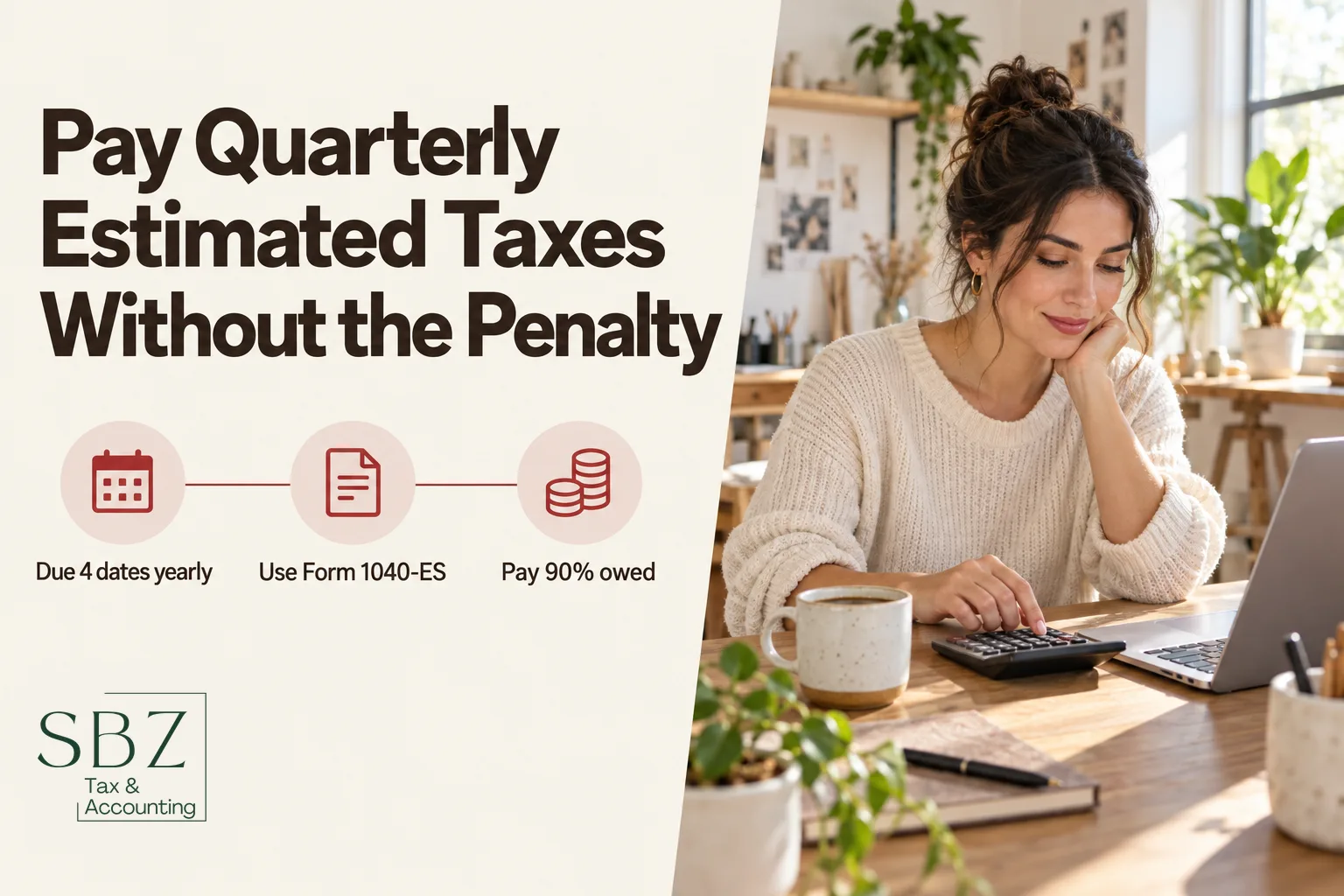
Form 1040-ES is the IRS worksheet for calculating estimated payments. It walks through both approaches and includes payment vouchers if you're mailing a check.
How do you actually make the payment?
Three main options:
- IRS Direct Pay — free, pulls directly from a bank account, no registration required
- EFTPS (Electronic Federal Tax Payment System) — free, requires a one-time enrollment, but lets you schedule all four payments at the start of the year
- Check — mail with the Form 1040-ES payment voucher for the correct quarter, made out to "United States Treasury"
Direct Pay works well for one-off payments. EFTPS is worth setting up if you want to automate the schedule. Credit card payments are accepted through IRS-authorized processors, but they charge a convenience fee that's rarely worth it.
What happens if you underpay?
The IRS assesses an underpayment penalty if you fall short of the safe harbor thresholds. The rate adjusts periodically — it's tied to the federal short-term interest rate — so it's not a fixed number. You can figure out what you'd owe using Form 2210 at the time you file.
The penalty is calculated per quarter, so a full year of underpaying can add up meaningfully. Paying under one of the safe harbor methods eliminates it entirely.
Do state estimated taxes work the same way?
Most states with an income tax also require quarterly estimated payments for self-employed filers. Thresholds, due dates, and calculation rules vary — some states track the IRS system closely, others have their own schedules and minimums.
If you're self-employed and your state has an income tax, check your state tax agency's requirements. Missing state estimated payments carries its own penalties, separate from anything the IRS calculates.
A starting point if you're new to this
If you don't have a prior-year self-employment return to anchor your safe harbor amount, here's a reasonable first-year approach:
- Estimate your net self-employment income (revenue minus legitimate business expenses)
- Multiply by roughly 14.13% as an approximation of SE tax after the deductible portion — exact math depends on your situation
- Add estimated income tax based on your expected taxable income and filing status
- Divide by four and pay that each quarter
This won't be exact, but it gets you in the right range. Adjust mid-year if income comes in significantly different from your projection.
The part people miss most often: SE tax. Run that calculation before you assume your quarterly payment is just income tax. It makes a real difference to the number.
This article covers how federal estimated taxes work generally for self-employed taxpayers. It's not tax advice for your specific situation — the rules have thresholds and details that depend on your individual circumstances. Talk to a qualified tax professional before making decisions.
Frequently asked questions
What do quarterly estimated payments cover?
They cover both income tax and self-employment tax rather than income tax alone.
Can the prior-year return help set estimated payments?
Yes. The safe-harbor approach described in the article uses the prior year's total tax as an anchor.
Should an estimate change when income changes?
Yes. Adjust it during the year if actual income differs significantly from the projection.