On this page
- What taxes does a 1099 contractor in California owe?
- How do quarterly estimated payments work?
- Which deductions matter most for contractors?
- What is the qualified business income deduction?
- How can a contractor save for retirement and cut taxes?
- When does an S-corp make sense for a 1099 contractor?
- Are you really a contractor, or an employee?
- What records should you keep all year?
- What's the best next step?
- Frequently asked questions
Tax Planning for 1099 Contractors in California: What to Do Before the Year Ends
Tax planning for a California 1099 contractor comes down to four things: knowing what you owe, paying it in installments during the year, tracking every legitimate deduction, and choosing a structure that fits your income. Nobody withholds taxes from your 1099 pay, so the planning falls to you.
Here's the short version of how it works, and where the planning decisions actually matter.
What taxes does a 1099 contractor in California owe?
You owe three layers of tax on your net profit: federal income tax, federal self-employment tax, and California income tax.
Self-employment tax covers Social Security and Medicare. The rate is 15.3% on 92.35% of your net self-employment earnings, with the Social Security portion capped at an annual wage base that changes each year. You calculate it on Schedule SE and deduct half of it when figuring your income tax.
California taxes the same profit under its graduated brackets. Our guide to California tax brackets shows how the rates stack. California has no separate self-employment tax, but it does not conform to every federal break, which is the part people miss.
How do quarterly estimated payments work?
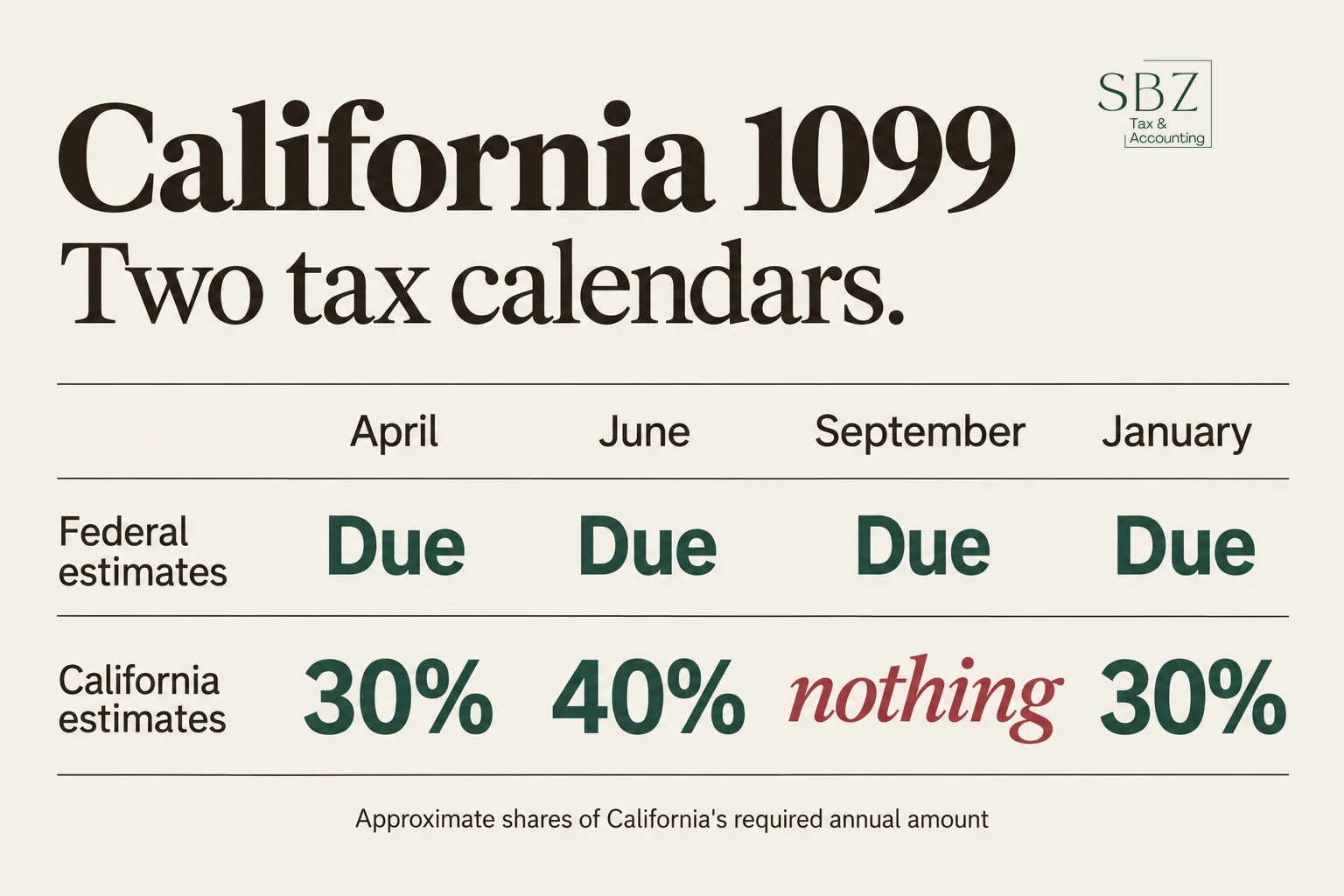
You pay estimated tax four times a year instead of having it withheld. The federal due dates fall in April, June, September, and January. California uses a different split: roughly 30% of the required annual amount in the first installment, 40% in the second, nothing in the third, and 30% in the fourth.
That California pattern surprises people who assume the state mirrors the IRS. Underpay and both agencies can charge penalties and interest. Our guides on quarterly estimated taxes for the self-employed, California estimated tax payments, and estimated tax penalties cover the due dates and safe-harbor rules in detail.
A practical habit many contractors use: move a fixed percentage of every payment into a separate savings account the day it lands, then pay estimates from that account. The right percentage depends on your income, so treat any rule of thumb as a starting point.
Which deductions matter most for contractors?
Net profit is what gets taxed, so every legitimate business expense lowers the bill. The ones that come up most often:
- Home office, if you use a space regularly and exclusively for work. See how to deduct a home office and the line-by-line walkthrough of Form 8829.
- Vehicle costs for business driving, using either the standard mileage rate or actual expenses, with a mileage log.
- Equipment and software, sometimes expensed in the year of purchase under Section 179.
- Self-employed health insurance, which is generally an above-the-line deduction if you meet the requirements.
- Professional fees, insurance, phone, internet, and education tied to your work.
Not everything qualifies. Our breakdown of what business expenses are actually tax deductible separates the clear cases from the ones that draw questions. Contractors in the Antelope Valley may also want the local angle in tax write-offs for self-employed and 1099 contractors in Palmdale.
What is the qualified business income deduction?
Many sole proprietors can deduct up to 20% of qualified business income on their federal return under Section 199A, subject to income limits and, for some service businesses, additional restrictions. It reduces federal income tax, not self-employment tax.
California does not follow the federal QBI deduction. That means your federal and state taxable income can differ, and your California return needs to reflect that. Whether you qualify, and how much the deduction is worth, depends on your taxable income and type of work, so confirm the current rules each year.
How can a contractor save for retirement and cut taxes?
Self-employed retirement plans are among the larger planning levers. A SEP IRA and a Solo 401(k) both let you make contributions that reduce taxable income, with annual limits the IRS adjusts regularly. Check the current figures before funding either one.
The Solo 401(k) generally allows higher contributions at lower income levels but has an earlier setup deadline in some cases. A SEP IRA is simpler to open. Which one fits depends on your income, whether you have employees, and your cash flow. Many contractors also pair retirement planning with an HSA if they have a qualifying high-deductible health plan; the reporting is covered in Form 8889.
When does an S-corp make sense for a 1099 contractor?
An S-corp becomes worth discussing once your net profit is consistently high enough that the payroll tax savings outweigh the added costs. Under an S-corp, the owner takes a reasonable W-2 salary and the remaining profit passes through as distributions, which are not subject to self-employment tax.
The tradeoffs are real: payroll, a separate business return, and California's $800 minimum franchise tax. The IRS also expects the salary to be reasonable, as explained in S-corp reasonable salary rules. For a side-by-side look, see S-corp vs LLC, and for the election itself, Form 2553. Our S-corp and business tax services page explains how SBZ Tax supports that process.
Are you really a contractor, or an employee?
California applies the ABC test to decide whether a worker is an independent contractor or an employee for most purposes, and many occupations fall under specific exemptions. Misclassification can create payroll tax, wage, and penalty exposure for the company that hired you.
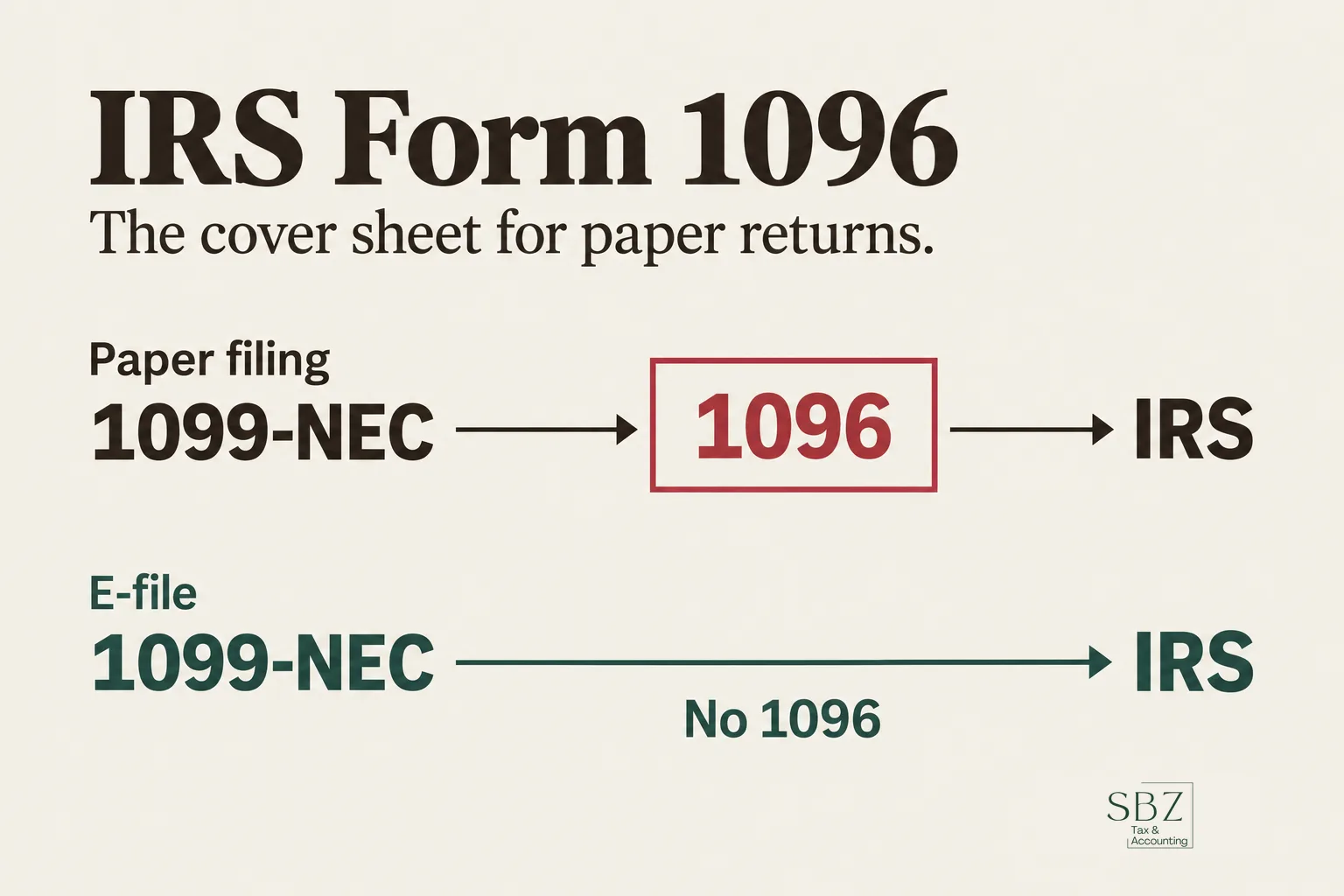
If you are unsure where you fall, it's worth sorting out before you plan around contractor status. Companies paying contractors have their own reporting duties, covered in do I need to send 1099s to my contractors.
What records should you keep all year?
Good records drive good planning. Keep a separate business bank account, save receipts, log mileage as you drive, and reconcile monthly. Monthly bookkeeping keeps the numbers current so you can see your real profit before the year closes, when planning moves are still possible.
What's the best next step?
Start with a profit-to-date check before year end. Estimate your net income, compare it to what you've paid in estimates, and decide whether to make a final payment, fund a retirement plan, or buy needed equipment before December 31. If your income has grown or your structure hasn't changed in years, that's the time to review it.
SBZ Tax is a local office at 190 Sierra Ct Ste 335, Palmdale, CA 93550, and works with contractors across the U.S. remotely. You can learn about tax planning services, see pricing, or book a free consultation. You can also call 818-748-2020 or stop by the office.
This article is general information, not tax advice for your specific situation. Talk to a qualified tax professional about your own numbers.
Frequently asked questions
Do 1099 contractors in California have to pay quarterly estimated taxes?
Generally yes, if you expect to owe $1,000 or more federally after withholding and credits, and California has its own estimated payment requirements. Missing them can lead to underpayment penalties.
How much should a 1099 contractor set aside for taxes?
It depends on net profit, deductions, and filing status, so there is no single percentage that fits everyone. Many contractors reserve a fixed share of each payment and adjust it after reviewing their year-to-date profit.
Can a 1099 contractor deduct health insurance in California?
Often yes. Self-employed health insurance premiums are generally deductible above the line if you are not eligible for employer-subsidized coverage and you show net profit from the business.
Does California allow the 20% QBI deduction?
No. California does not conform to the federal Section 199A deduction, so you may claim it on your federal return but not on your California return.
Is it too late to plan if the year is almost over?
No. Retirement contributions, equipment purchases, and a final estimated payment can often still affect the current year, and some retirement plan contributions can be made after year end. Earlier review leaves more options.