On this page
IRS Form 945: What It Is, Who Files It, and When It's Due
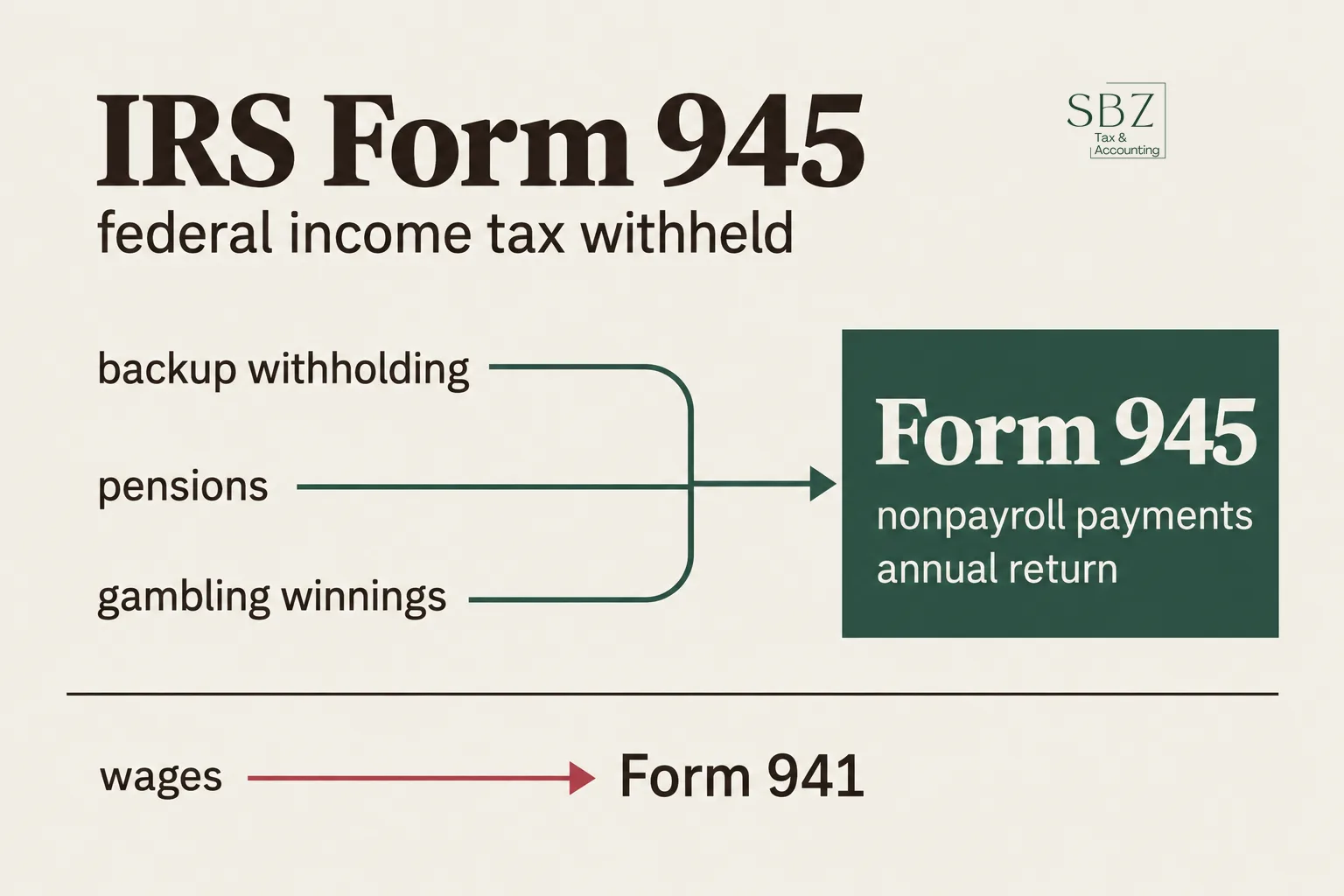
IRS Form 945 is the annual return you file to report federal income tax you withheld from nonpayroll payments, such as backup withholding on contractor payments, pension and annuity distributions, IRA payouts, and gambling winnings. It is the nonpayroll counterpart to the quarterly return employers file for wages. Here's the short version of how it works.
What is IRS Form 945 used for?
Form 945, Annual Return of Withheld Federal Income Tax, reports federal income tax withheld from payments that are not wages. Withholding from wages goes on Form 941 instead.
The payments that typically belong on Form 945 include:
- Backup withholding (currently 24%) on payments such as 1099-NEC or 1099-MISC amounts when a payee fails to provide a valid taxpayer identification number
- Voluntary or mandatory withholding on pensions, annuities, and IRA distributions
- Withholding on gambling winnings
- Withholding on certain military retirement pay
- Withholding on Indian gambling profits
The key idea: Form 945 reports the withholding that appears on the related information returns, such as Forms 1099-R, 1099-NEC, 1099-MISC, and W-2G. The totals should agree.
Who has to file Form 945?
Anyone who withheld federal income tax from nonpayroll payments during the year generally must file. That includes businesses, plan administrators, payers of retirement distributions, and casinos or other gambling payers.
For small business owners, the most common trigger is backup withholding. If a contractor never gave you a Form W-9 and you were required to withhold, that tax gets deposited and then reported on Form 945. If you pay independent contractors, see Do I Need to Send 1099s to My Contractors? for the information-return side.
You file Form 945 under your EIN. It is a separate account from your payroll filings, so don't combine the two.
When is Form 945 due?
Form 945 is due January 31 of the year after the withholding. If January 31 falls on a weekend or holiday, the due date moves to the next business day. For 2026 payments, that means Monday, February 1, 2027, because January 31, 2027 is a Sunday.
If you deposited all of the tax on time and in full, the IRS generally allows an extra ten days to file. Check the current instructions for the exact date.
If you're looking at the form for 2025 payments and the January 2026 deadline has passed, file as soon as possible. Late filing and late deposit penalties grow the longer the balance sits. If notices have already arrived, our page on IRS and state tax problem help explains the options.
How do you deposit the tax before you file?
Most filers don't wait until the return. Federal income tax withheld has to be deposited electronically, generally through EFTPS or your IRS online account, on a schedule based on how much you withhold.
In plain terms:
- Under $2,500 for the year: you can usually pay the balance with the return instead of making deposits.
- Monthly depositors: if your total nonpayroll tax liability was $50,000 or less in the lookback period, you generally deposit by the 15th of the following month.
- Semiweekly depositors: if it was above $50,000, deposits are due on a semiweekly schedule.
- $100,000 next-day rule: once you accumulate $100,000 or more in a day, the deposit is due the next business day.
Missing these deadlines can trigger failure-to-deposit penalties that run in tiers from 2% up to 15% of the underpayment. Because rules and thresholds are updated, confirm the current figures in the Form 945 instructions.
What is Form 945-A?
Form 945-A, Annual Record of Federal Tax Liability, is an attachment to Form 945. It shows when your tax liability arose, day by day, which tells the IRS whether your deposits were on time.
Semiweekly schedule depositors, and any filer who hit the $100,000 next-day deposit rule, generally attach it. Monthly depositors usually enter their monthly totals directly on Form 945 and don't need Form 945-A. Leaving it off when it's required is a common reason for notices, because the IRS may assume your deposits were late.
What goes on the form itself?
The form is short. In plain terms:
- Line 1 is the federal income tax withheld from pensions, annuities, IRAs, gambling winnings, and similar payments.
- Line 2 is backup withholding.
- Line 3 is the total, which is your total tax liability.
- Line 4 is your total deposits for the year, including any overpayment applied from a prior year.
- The balance due or overpayment lines show what you owe or what to apply to next year's return or have refunded.
- Line 7 is the monthly liability summary for monthly depositors.
Sign it, and note whether it is your final return if you've stopped withholding. The balance due can be paid with Form 945-V if you file on paper, or electronically.
Can you e-file Form 945?
Yes. Form 945 can be e-filed through IRS-approved software. If you file on paper, the mailing address depends on your state and whether you enclose a payment, so check the current instructions rather than relying on an old address.
How do you fix a mistake on Form 945?
Use Form 945-X, the adjusted return, to correct errors on a Form 945 you've already filed. It has its own deadlines and rules, so don't simply file a second Form 945.
If the underlying mistake was a missed deposit, address that quickly. Sorting out the penalty and abatement options is easier before the balance snowballs. For ongoing issues, monthly bookkeeping services keep withholding and deposits matched to your records throughout the year.
What if you also have payroll?
Employers with W-2 employees file Form 941 for wage withholding and California payroll taxes at the state level. Form 945 sits alongside those filings; it never replaces them. A business owner who runs payroll, pays contractors, and handles retirement distributions could have all three types of filings in a single year.
If you're also deciding how to pay yourself from an entity, the S-corp tax guide covers how owner compensation interacts with payroll reporting.
Next step
If you suspect you withheld nonpayroll tax but never filed, start by gathering your 1099-R, 1099-NEC, or W-2G totals and your deposit confirmations from EFTPS. Compare them to what, if anything, you filed. From there, either file the return or correct a prior one.
SBZ Tax helps business owners nationwide with these filings, and you're welcome to call 818-748-2020 or visit the office at 190 Sierra Ct Ste 335, Palmdale, CA 93550. You can also book a free consultation. This article is general information, not tax advice for your specific situation. Talk to a qualified professional before acting.
Frequently asked questions
What is IRS Form 945 used for?
It reports federal income tax withheld from nonpayroll payments such as backup withholding, pensions, annuities, IRA distributions, and gambling winnings. It is filed once a year.
What is the difference between Form 941 and Form 945?
Form 941 reports withholding from employee wages and is filed quarterly. Form 945 reports withholding from nonpayroll payments and is filed annually. Many filers need both.
Do I need Form 945-A?
Form 945-A is generally required for semiweekly schedule depositors and for filers who accumulated $100,000 or more in a day. Monthly depositors usually report monthly totals on Form 945 itself.
What is the Form 945 due date?
January 31 of the following year, or the next business day if that date falls on a weekend or holiday. An extra ten days may apply if you deposited all tax on time.
Do I file Form 945 if I had no withholding?
If you had no reportable withholding for the year, you generally don't file. If you filed before and are stopping, check the final return box on your last Form 945.