On this page
- Why the independent contractor label matters so much
- What forms will you receive — and when?
- Which deductions actually move the needle?
- How does mileage tracking actually work?
- Do Antelope Valley gig drivers need to pay quarterly taxes?
- What about California state taxes?
- When does a business structure make sense?
- Frequently asked questions
- Related reading
How to Handle Taxes as an Antelope Valley Rideshare or Delivery Driver
Rideshare and delivery drivers — whether you're running Uber or Lyft trips, delivering for DoorDash or Uber Eats, or running Amazon Flex routes across the Antelope Valley — are classified as independent contractors, not employees. That classification changes everything about how your taxes work.
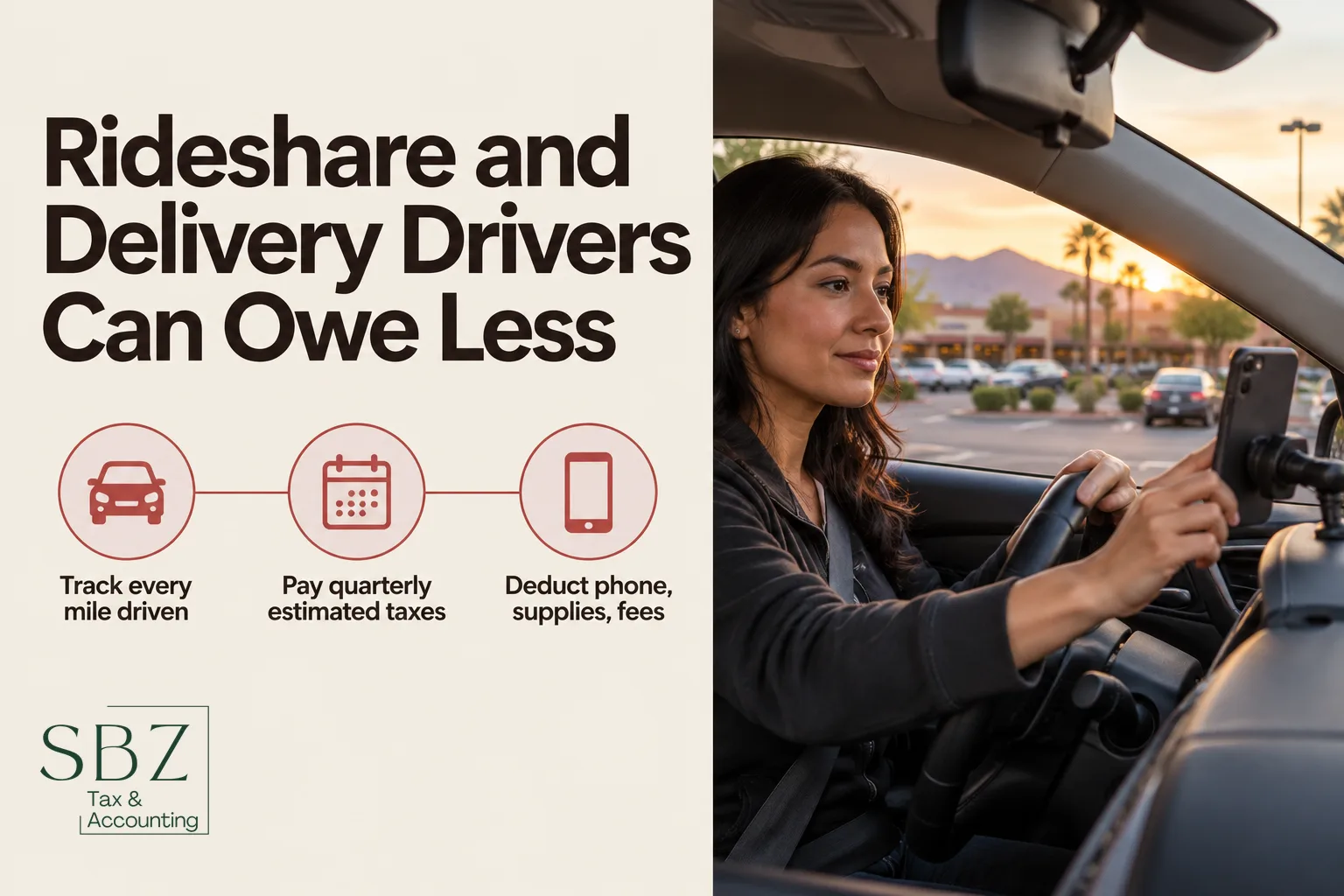
No withholding comes out of your app earnings. You're responsible for tracking income, claiming deductions, paying self-employment tax, and in most cases sending quarterly payments to both the IRS and the California Franchise Tax Board (FTB).
Why the independent contractor label matters so much
As an employee, your employer splits Social Security and Medicare taxes with you — each side pays 7.65%. As a self-employed contractor, you pay both halves yourself. That's 15.3% on net self-employment earnings (up to the Social Security wage base, which the IRS adjusts annually), and it's calculated on top of your regular income tax.
This is the number that catches most first-year gig drivers off guard. You report income and expenses on Schedule C (Profit or Loss from Business), and every deduction you claim reduces the net earnings that self-employment tax is calculated against — not just your income tax bill.
What forms will you receive — and when?
Uber, Lyft, DoorDash, and similar platforms issue 1099 forms depending on your earnings:
- 1099-K: Issued by the platform's payment processor if gross earnings exceeded $5,000 for tax year 2024 (this threshold is scheduled to decrease in future years — verify the current year's figure before filing).
- 1099-NEC: Used for non-trip income like referral bonuses, incentive pay, and other direct payments.
Here's the part people miss: even if you don't receive a 1099, all income is taxable. The IRS gets copies of whatever the platform files. If the forms don't match your return, expect a notice.
Which deductions actually move the needle?
Vehicle expenses — mileage or actual costs
This is almost always the biggest deduction. You choose one method per vehicle per year:
- Standard mileage rate: A set cents-per-mile rate the IRS adjusts annually. Simple to calculate; requires a contemporaneous mileage log.
- Actual expense method: Deduct the business-use percentage of gas, insurance, repairs, registration, and depreciation. More precise for high-expense vehicles; more work to document.
Most drivers find the standard rate easier to maintain and often comparable or better in practice. The choice in Year 1 has implications for future years, so it's worth thinking through before filing.
Phone and data plan
Your phone is the tool you use to accept gigs, navigate, and communicate with customers. The business-use percentage of your monthly bill and the cost of the device (depreciated or expensed) is deductible. If 70% of your phone use is work-related, you can deduct 70%.
Supplies and equipment
Insulated bags, car mounts, chargers, and similar delivery gear qualify. Rideshare drivers can deduct car washes and items that keep the vehicle presentable for passengers.
Parking and tolls
These are deductible separately from the mileage rate — keep receipts, since they add up.
For a broader look at how deductions work across 1099 income, the article on tax write-offs for self-employed and 1099 contractors in Palmdale covers the full landscape.
How does mileage tracking actually work?
The IRS requires contemporaneous records — you track miles as you drive, not reconstructed from memory at tax time. A mileage log should include the date, starting and ending location, business purpose, and total miles.
Apps like Stride or MileIQ automate most of this. A simple spreadsheet works too, as long as it's updated regularly.
One important limit: the drive from home to wherever you first go online is generally treated as a commute, not a business mile. Miles driven while the app is active — between gigs, during trips or deliveries, and returning after your last job — typically qualify. The line isn't always obvious, so consistent tracking from the moment you open the app is the safest approach.
Do Antelope Valley gig drivers need to pay quarterly taxes?
In most cases, yes. If you expect to owe $1,000 or more in federal tax for the year, you're required to make quarterly estimated payments. California has a parallel rule at $500 or more owed to the FTB.
The IRS due dates don't fall at even calendar-quarter intervals:
| Period covered | Federal due date |
|---|---|
| January 1 – March 31 | April 15 |
| April 1 – May 31 | June 15 |
| June 1 – August 31 | September 15 |
| September 1 – December 31 | January 15 (following year) |
Missing these payments results in an underpayment penalty, even if you pay everything in full at filing. Many drivers in Palmdale, Lancaster, and Quartz Hill underestimate what they owe because they're only thinking about income tax — the self-employment tax added on top is what closes the gap.
The article on quarterly estimated taxes for Antelope Valley self-employed walks through how to calculate what to send each quarter.
What about California state taxes?
The FTB expects quarterly payments on roughly the same schedule (California's second-quarter payment is due in June, which catches people off guard). You'll file a California return on Form 540, with Schedule CA reflecting your federal Schedule C figures.
California doesn't have a separate self-employment tax on top of income tax — but state income tax rates are among the higher ones nationally, so the combined federal-plus-state bill surprises many drivers in their first year of gig work.
When does a business structure make sense?
Most part-time drivers do fine as sole proprietors filing Schedule C. But if gig work is your primary income and you're clearing $40,000–$50,000 or more in net profit, an S-corp election may reduce your self-employment tax exposure. It's not right for every situation — the administrative costs and payroll requirements need to pencil out.
Our overview of S-corp and business tax services explains how the election works and when it typically makes sense. Tax planning done at the start of the year gives you room to act on decisions like this — filing-time scrambles rarely do.
Good monthly bookkeeping is the foundation regardless of which structure you use — you can't plan around numbers you haven't tracked. View our pricing or book a free consultation if you want to talk through where to start.
Frequently asked questions
Do I have to file a tax return if I only drove part-time?
Yes. Any net self-employment income of $400 or more in a year triggers a federal filing requirement, regardless of whether you had other income or received a 1099. Platforms report your earnings to the IRS independently of whether they issued you a form.
Can I deduct my car payment?
No — a loan payment is not a deductible expense. What you can deduct is either the standard mileage rate or the business-use portion of actual vehicle costs (gas, insurance, repairs, depreciation). Depreciation is the mechanism the IRS uses to account for the vehicle's cost over time.
I drove for multiple apps — do I file separate forms for each?
You can combine all gig income on a single Schedule C, or file separate ones if you treat them as distinct businesses. Either way, your mileage log covers all platforms together. There's no separate form required per app.
How long should I keep my mileage logs and receipts?
The IRS generally has three years from your filing date to audit a return, so keep records for at least that long. If there's any chance your income was significantly underreported, six years is the safer standard. Mileage logs, all 1099 forms, expense receipts, and quarterly payment confirmations should all be retained.
What if I didn't track my mileage all year?
Reconstructed logs — built from calendar records, bank statements, or app trip history — carry real audit risk. They can be used, but they're harder to defend than contemporaneous records. Going forward, start tracking immediately; for the current year, pull whatever documentation you can from the apps and supplement with any records you have.
This article is general educational information, not tax advice for your specific situation. Tax rules change and individual circumstances vary — consult a qualified tax professional before making decisions based on what you read here.