On this page
- What is Form SS-4 used for?
- Who needs an EIN?
- How do you apply for an EIN?
- Is the SS-4 really free?
- What does each line of the SS-4 ask?
- What mistakes cause trouble after you get the EIN?
- What if you lose your EIN or the confirmation letter?
- What should you do after getting an EIN?
- Frequently asked questions
IRS Form SS-4: How to Apply for an EIN (Line by Line, Free)
IRS Form SS-4 is the Application for Employer Identification Number, the form you use to get an EIN, a nine-digit number the IRS assigns to businesses, estates, trusts and other entities. The IRS charges nothing for it. Most applicants never touch the paper form, because the online application asks the same questions and issues the number immediately.
This guide covers who needs an EIN, the ways to apply, what each part of the form asks, and the mistakes that cause problems later.
What is Form SS-4 used for?
Form SS-4 is how an entity asks the IRS for a federal tax identification number. The EIN works like a Social Security number for a business. It goes on tax returns, payroll filings, bank account applications and many licenses.
The form is only the application. Once the IRS issues your EIN, you don't file the SS-4 again. You simply keep the confirmation notice (CP 575 or the online confirmation) in your permanent records.
Who needs an EIN?
Many businesses need one, and some people get one even when they don't strictly have to. Generally, you'll need an EIN if you:
- Have employees, or plan to hire any
- Operate as a corporation or partnership
- Operate a multi-member LLC, or a single-member LLC that has employees or elects corporate treatment
- File employment, excise, or alcohol, tobacco and firearms tax returns
- Set up a trust, an estate, or certain retirement plans
- Withhold taxes on income paid to a nonresident alien
A sole proprietor with no employees can usually use their own Social Security number. Many still get an EIN so they don't hand out their SSN to clients and banks. That's a reasonable privacy choice, and it's free.
How do you apply for an EIN?
You have four options, and they differ mainly in speed.
| Method | How it works | Typical timing |
|---|---|---|
| Online | IRS EIN Assistant on IRS.gov | EIN issued immediately |
| Fax | Send the completed SS-4 to the fax number on the form's instructions | About four business days |
| Mail | Send the SS-4 to the IRS address listed in the instructions | Roughly four to five weeks |
| Phone (international only) | Applicants with no U.S. address or legal residence call the IRS | Handled during the call |
The online application runs during set hours, so check IRS.gov for the current schedule. It also requires that the person listed as the responsible party has a valid taxpayer identification number (an SSN, ITIN or existing EIN). Fax numbers and mailing addresses change by state and by revision, so take them from the current Instructions for Form SS-4 rather than from an old copy.
Is the SS-4 really free?
Yes. The IRS does not charge a fee to issue an EIN. Several private websites show up in search results for this form, and some charge a fee for what is the same free application. If a site asks for payment before you reach the IRS questions, you're not on the IRS site. The address to look for is irs.gov.
A formation service or a professional may legitimately charge for handling the application as part of a larger setup. That's a service fee, not a government fee, and you should know which one you're paying.
What does each line of the SS-4 ask?
The form has about 18 numbered lines. These are the ones people most often stumble on.
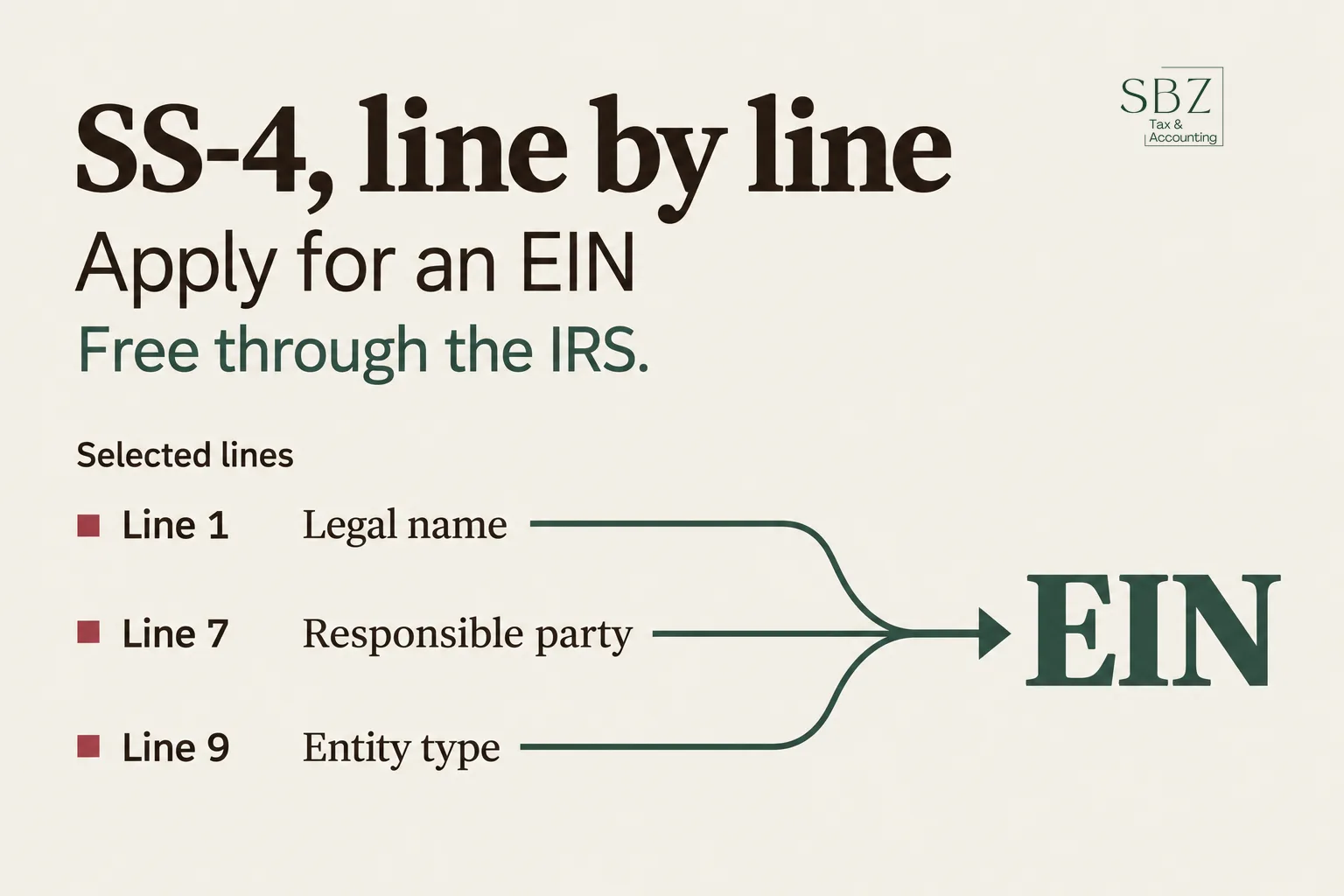
Lines 1 to 6: names and addresses. Line 1 is the legal name of the entity exactly as it appears on your formation documents. Line 2 is a trade name or "doing business as" name, if different. Line 4 is the mailing address and line 6 is the county and state where the principal business is located.
Line 7: the responsible party. This is the individual who ultimately owns or controls the entity and directs how its funds and assets are handled. It must be a real person (with a few exceptions for government entities and certain others), not another company. You'll provide that person's SSN, ITIN or EIN on line 7b.
Line 8: LLC details. Line 8a asks whether the applicant is an LLC. If so, line 8b asks for the number of members, and 8c asks whether it was organized in the United States.
Line 9: type of entity. Pick one: sole proprietor, partnership, corporation, S corporation, personal service corporation, trust, estate, and so on. Choosing "corporation" and writing in the form number (such as 1120 or 1120-S) tells the IRS what you expect to file. If an LLC wants to be taxed as an S corporation, the entity classification and election steps are separate, covered in the guides on IRS Form 8832 and IRS Form 2553.
Line 10: reason for applying. Common choices are "started new business," "hired employees," "banking purpose," or "changed type of organization." Pick the one that matches what is actually happening.
Lines 11 to 13: dates and employees. Line 11 is the date the business started or was acquired. Line 12 is your accounting year closing month (December for most). Line 13 is the highest number of employees you expect in the next 12 months, split between agricultural, household and other.
Line 14: employment tax. If you expect to owe $1,000 or less in annual employment taxes, the IRS may let you file Form 944 once a year instead of quarterly. If you plan to run payroll, see how quarterly filing works in the article on IRS Form 941.
Lines 16 and 17: what the business does. Line 16 is the principal activity, and line 17 asks for the principal line of merchandise, construction work done, products produced, or services provided. A matching business code helps keep your filings consistent, and our guide to IRS business codes shows how to find the right one.
The form closes with an optional third-party designee section and the signature block. Someone with authority over the entity must sign.
What mistakes cause trouble after you get the EIN?
The EIN itself is simple to get. The problems usually come from what was entered on the form.
- Wrong legal name. If line 1 doesn't match your state formation records or your tax returns, notices and rejected filings can follow.
- Wrong entity type. Picking the wrong box on line 9 can send mismatched filing requirements. It can be corrected, but it takes extra back-and-forth with the IRS.
- Naming a company as the responsible party. The IRS wants an individual.
- Applying twice. Duplicate EINs for the same entity create a mess. If you can't find your number, don't apply again.
- Losing the confirmation. You can replace it, as explained below.
What if you lose your EIN or the confirmation letter?
First check old tax returns, bank account paperwork and payroll records, since the EIN appears on all of them. If you still can't find it, the IRS can issue a verification letter, covered in our guide to IRS Form 147C. Banks and lenders often accept that letter as proof of your EIN.
What should you do after getting an EIN?
Getting the number is step one of setting up the business correctly. Typical next steps are opening a business bank account, deciding how the entity will be taxed, and setting up bookkeeping so income and expenses are separated from personal ones from day one. Owners weighing structure may want to read S-corp vs LLC: which structure actually fits your business before choosing, and then look at monthly bookkeeping services so the records are clean from the start.
If you're forming a new entity, planning to hire, or unsure which entity type to select on line 9, SBZ Tax can walk through it with you. Call 818-748-2020, book a free consultation, or stop by the office at 190 Sierra Ct Ste 335, Palmdale, CA 93550. SBZ Tax serves clients in person in the Antelope Valley and Los Angeles County and remotely nationwide. You can also see how engagements are priced on the pricing page.
This is general information, not tax advice for your specific situation. Talk to a qualified tax professional before making entity or filing decisions.
Frequently asked questions
Can I fill out Form SS-4 myself?
Yes. The form and its instructions are free on IRS.gov, and the online application asks the same questions. Many owners complete it in a few minutes. Professional help makes sense mainly when the entity type or ownership structure is complicated.
How long does it take to get an EIN after submitting Form SS-4?
Applying online generally produces the EIN immediately. Faxed applications take about four business days, and mailed ones can take four to five weeks. Check the current IRS instructions for exact timing.
Does a sole proprietor need an EIN?
Not always. A sole proprietor with no employees can generally use their Social Security number. An EIN is required if you hire employees or file certain returns, and many sole proprietors get one anyway to keep their SSN private.
Does an EIN expire or need to be renewed?
No. An EIN is permanent and stays with the entity. If the business closes, you generally notify the IRS and file final returns, but the number is not reused for another entity.
Can I change information on my SS-4 after the EIN is issued?
Some changes, such as a new mailing address, are handled with other IRS forms, and a change in the responsible party is reported on Form 8822-B. For other corrections, follow the IRS guidance for the specific change instead of applying for a new EIN.