On this page
- Who has to file Form 4562?
- What are the parts of Form 4562?
- How does Part I (Section 179) work?
- What is bonus depreciation in Part II?
- What is MACRS in Part III?
- What is listed property in Part V?
- What is amortization in Part VI?
- Where do the Form 4562 totals go?
- What mistakes happen with Form 4562?
- What's the next step?
- Frequently asked questions
- Related reading
IRS Form 4562: Who Files It, What's On It, and How Depreciation Gets Reported
IRS Form 4562, Depreciation and Amortization (Including Information on Listed Property), is the form you attach to your return to claim depreciation, the Section 179 deduction, and amortization on business or rental property. If you bought equipment, a vehicle, or a building this year and want to deduct its cost over time (or all at once), this is usually where that deduction gets calculated. Here's who needs it, what each part does, and how the totals reach your return.
Who has to file Form 4562?
You generally file Form 4562 when you do any of the following for the tax year:
- Claim depreciation on property you placed in service during that year
- Elect the Section 179 deduction, or carry over a Section 179 amount from a prior year
- Claim depreciation on listed property (such as a vehicle) in any year, not just the year you bought it
- Claim amortization for costs that began this year
Here's the part people miss: you don't need a new Form 4562 every year just because you still own an asset. If you only have depreciation on property placed in service in earlier years, and none of it is listed property, the annual amount usually goes straight onto the return without the form. The exact rules sit in the Form 4562 instructions for your tax year, so use the version that matches the return you're filing.
The form is used by sole proprietors (with Schedule C), landlords (with Schedule E), partnerships, and corporations, including S corporations. Entities file it with Form 1065 or Form 1120-S.
What are the parts of Form 4562?
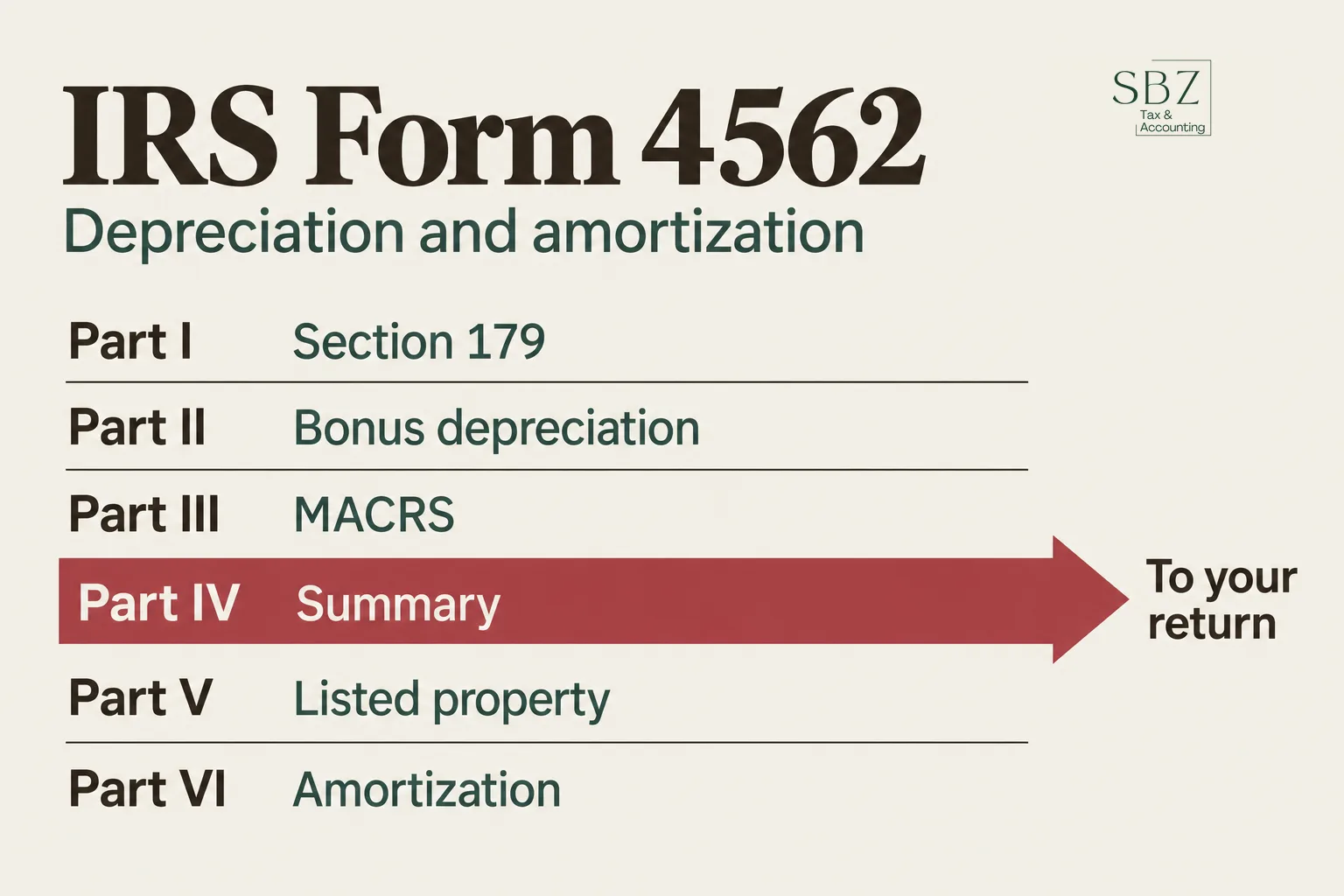
The form has six parts. Most filers only touch two or three.
| Part | What it covers |
|---|---|
| I | Election to expense property under Section 179 |
| II | Special (bonus) depreciation and other depreciation |
| III | MACRS depreciation: the regular schedule by asset class |
| IV | Summary: totals the deductions to carry to your return |
| V | Listed property: vehicles and similar assets, with use tracking |
| VI | Amortization of intangible costs |
How does Part I (Section 179) work?
Section 179 lets you deduct the cost of qualifying equipment and certain other property in the year you place it in service, rather than spreading it over several years. It comes with an annual dollar limit, a phase-out once total purchases get large, and a cap based on your business taxable income. Anything you can't use this year carries forward.
Those figures change, and recent legislation raised them for 2025. Confirm the current limits in the instructions before relying on a number. We cover eligibility and the mechanics in our guide to the Section 179 deduction.
What is bonus depreciation in Part II?
Part II is where the special depreciation allowance goes, commonly called bonus depreciation. It lets you deduct a percentage of an asset's cost in the first year, after any Section 179 amount. The percentage depends on when the property was acquired and placed in service. For property acquired after January 19, 2025, the rate returned to 100%, but check the instructions for your tax year before assuming it applies to a specific purchase.
Unlike Section 179, bonus depreciation isn't capped by your business income, so it can create or increase a loss. Some taxpayers can elect out of it for certain asset classes, so it's worth a conversation before filing.
What is MACRS in Part III?
MACRS (the Modified Accelerated Cost Recovery System) is the standard depreciation method for most business property. Each asset is assigned a recovery period, and the IRS publishes tables for the percentage you deduct each year.
Common recovery periods:
- 5 years: computers, cars, light trucks
- 7 years: most office furniture and equipment
- 27.5 years: residential rental buildings
- 39 years: nonresidential real property
Land is never depreciable. If you buy a building, only the structure's cost basis is depreciated, not the lot underneath it.
Timing also matters. If more than 40% of the year's depreciable basis was placed in service in the last three months, the mid-quarter convention applies, which reduces the first-year deduction. This is a common surprise when a business buys heavily in December.
What is listed property in Part V?
Listed property is property the IRS considers easy to use personally, so it requires more documentation. The most common example is a passenger vehicle. Part V asks for business, commuting, and personal mileage, plus whether you have evidence supporting the business use.
If a listed asset isn't used more than 50% for business, you generally can't use Section 179 or accelerated depreciation on it. Vehicles also have annual depreciation caps, with different treatment for heavier vehicles. Using the standard mileage rate instead means you aren't depreciating the vehicle separately, because depreciation is already built into the rate.
Keep a contemporaneous mileage log. It's the first thing examiners ask for, which is one reason vehicle deductions show up in our overview of what triggers an IRS audit for small business owners.
What is amortization in Part VI?
Amortization is depreciation's counterpart for intangible costs, such as certain business start-up and organizational costs, and Section 197 intangibles like purchased goodwill, which are generally spread over 15 years. Part VI reports amortization only for costs that begin in the current tax year. Amortization that started in earlier years is reported directly on the return.
Where do the Form 4562 totals go?
Part IV totals everything, and that figure moves to the return that matches your situation. On Schedule C it lands on the depreciation line. On Schedule E it goes to the depreciation line for rental properties. S corporations and partnerships carry it to their own return, where it flows through to owners.
Two related forms come up often:
- If you take a home office deduction, depreciation on the home is calculated on Form 8829.
- When you later sell a depreciated asset, the depreciation you claimed can be "recaptured" and taxed, which is reported on Form 4797.
What mistakes happen with Form 4562?
The same few errors show up repeatedly:
- Deducting land or personal-use portions of an asset
- Skipping vehicle logs, then losing the deduction in an exam
- Taking a Section 179 amount that exceeds business income without tracking the carryover
- Forgetting that depreciation reduces your basis, which increases your gain on a later sale
- Leaving depreciation off a rental because it "wasn't required." The IRS treats depreciation as allowed or allowable, so skipping it can still reduce your basis later.
Good records make most of these easy to avoid. Keeping an asset list with purchase date, cost, date placed in service, and business-use percentage is a core part of clean monthly bookkeeping. Questions about whether a purchase counts as a deductible expense or a depreciable asset are also part of tax planning, ideally before year-end rather than after.
What's the next step?
Gather your asset purchases for the year, with dates and receipts, and sort them into three groups: items you'll expense, items that need depreciating, and anything with personal use. Then decide on Section 179 and bonus depreciation before you file, because those choices can be hard to change afterward.
If you'd rather have a professional review the numbers, SBZ Tax works with business owners and investors nationwide, remotely or at our Palmdale office. Call 818-748-2020, visit us at 190 Sierra Ct Ste 335, Palmdale, CA 93550, or book a free consultation.
This article is general information, not tax advice for your specific situation. Depreciation rules and limits change, so talk with a qualified tax professional before making decisions.
Frequently asked questions
Do I need to file Form 4562 every year?
Not necessarily. You generally file it in years when you place new property in service, elect Section 179, claim amortization that begins that year, or claim depreciation on listed property. Ongoing depreciation on older non-listed assets is often reported directly on the return.
Can I deduct the full cost of equipment on Form 4562?
Often, yes, through Section 179 or bonus depreciation, subject to the current limits and your business income. Eligibility depends on the asset, how it's used, and when it was placed in service, so check the instructions for your tax year.
Does Form 4562 apply to rental property?
Yes. Landlords report depreciation on residential rental buildings, generally over 27.5 years, on Form 4562, and the result carries to Schedule E. The building is depreciable, but the land is not.
Where do I find the Form 4562 instructions for 2025?
The IRS publishes the form and its instructions on IRS.gov under Forms and Instructions. Use the version for the tax year you're filing, because limits and percentages are updated and can differ from prior years.
What happens if I forget to claim depreciation?
Depreciation is treated as allowed or allowable whether or not you claimed it, so your basis may still be reduced when you sell. If you missed it in earlier years, fixing it may involve an amended return or an accounting method change, so ask a professional before acting.