On this page
- What is a Section 179 deduction?
- How much can you deduct under Section 179?
- What property qualifies for Section 179?
- How does the Section 179 deduction work for vehicles?
- Section 179 vs. bonus depreciation: what's the difference?
- Does a big Section 179 deduction always make sense?
- How do you claim the Section 179 deduction?
- Frequently asked questions
Section 179 Deduction: How It Works, What Qualifies, and the Current Limits
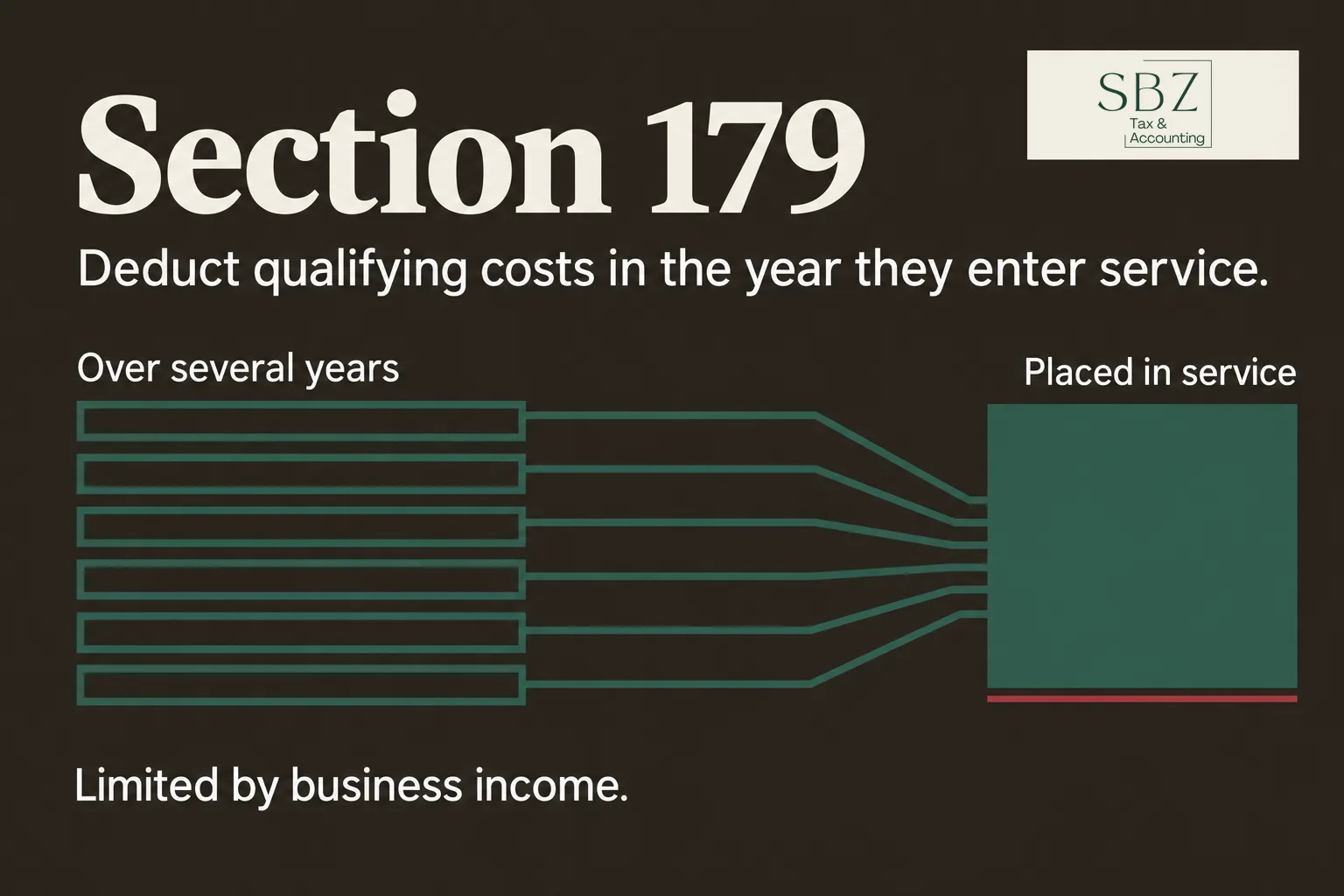
The Section 179 deduction lets a business deduct the full cost of qualifying equipment, software, and certain vehicles in the year it starts using them, instead of spreading that cost over several years. It's one of the most useful tools a small business has for timing its taxes. It also has rules that catch people out every filing season.
Here's the short version of what qualifies, how much you can deduct, and where it fits next to bonus depreciation.
What is a Section 179 deduction?
Normally, when a business buys something that lasts more than a year, like a machine, a computer, or office furniture, the IRS makes it recover that cost through depreciation over the asset's useful life. That can be five, seven, or more years.
Section 179 of the Internal Revenue Code lets you skip most of that wait. You choose to treat the purchase as an expense and deduct it in the year the asset is placed in service. You make that election on Form 4562, Part I, filed with your return.
The part people miss is that "placed in service" means ready and available for use in the business. Buying a truck on December 30 counts for that year. Paying a deposit on equipment that arrives in February doesn't.
How much can you deduct under Section 179?
The One Big Beautiful Bill Act, signed in July 2025, raised the limits a lot:
| Item | Tax years beginning in 2025 |
|---|---|
| Maximum Section 179 deduction | $2,500,000 |
| Phase-out begins when total qualifying purchases exceed | $4,000,000 |
| Deduction reaches zero at roughly | $6,500,000 in purchases |
Starting in 2026, both figures are indexed for inflation, so the 2026 numbers are a bit higher. Check the current figure for the year you're filing.
For most small businesses the dollar cap is a non-issue. The limit that actually matters is the next one.
The business income limitation
Your Section 179 deduction can't be more than your taxable income from the active conduct of a trade or business for the year. In plain terms, Section 179 can't create a loss. Anything over that limit carries forward to future years.
Wages count toward that income figure, which helps some owners who also have a W-2 job. Even so, a business with a thin profit year often gets less out of Section 179 than it expected.
What property qualifies for Section 179?
Generally, the property has to be tangible, depreciable, bought for business use, and used more than 50% for business. Common examples:
- Machinery, tools, and equipment
- Computers, servers, and peripherals
- Office furniture and fixtures
- Off-the-shelf software (not custom-built)
- Business vehicles, subject to special limits (covered below)
- Qualified improvement property, meaning interior improvements to nonresidential buildings
- Roofs, HVAC, fire protection, alarm, and security systems on nonresidential real property
What doesn't qualify: land, most buildings themselves, property used mainly to furnish lodging (like residential rentals), property bought from a related party, and property used outside the U.S.
If you aren't sure whether a purchase is a capital asset or an ordinary expense in the first place, our guide to what business expenses are actually tax deductible covers the basics.
How does the Section 179 deduction work for vehicles?
This is the most-searched part of the topic, and it's where the rules are strictest.
Passenger vehicles (6,000 lbs gross vehicle weight rating or less) fall under the "luxury auto" depreciation caps. Section 179 and bonus depreciation can't push the first-year deduction past those annual caps, which are far below the price of most new cars.
Heavy SUVs, pickups, and vans (over 6,000 lbs GVWR) escape the luxury auto caps, but SUVs in this weight class have their own Section 179 limit. It was $31,300 for 2025 and is adjusted for inflation each year. The rest of the cost can often be recovered through bonus depreciation.
Some work vehicles avoid the SUV cap entirely. That includes pickups with a cargo bed at least six feet long, cargo vans with no seating behind the driver, and vehicles that seat more than nine passengers behind the driver's seat.
Three rules apply to every vehicle:
- Business use must be over 50%. If it drops to 50% or below in a later year, part of the deduction is "recaptured" and added back to income.
- You deduct only the business-use percentage. At 80% business use, 80% of the cost is eligible.
- You need records. A mileage log is what keeps the deduction standing if the IRS asks. Consistent monthly bookkeeping makes this a lot easier than rebuilding a log at tax time.
Section 179 vs. bonus depreciation: what's the difference?
Both let you write off assets quickly, and the same 2025 law permanently restored 100% bonus depreciation for qualifying property acquired after January 19, 2025. So when do you use which?
| | Section 179 | Bonus depreciation |
|---|---|---|
| Elective? | Yes, you opt in asset by asset | Automatic unless you opt out by asset class |
| Annual dollar cap | Yes | No |
| Can create a loss? | No, limited to business income | Yes |
| Choose a partial amount? | Yes, any amount up to cost | All or nothing per class |
| Used property? | Yes, if new to you | Yes, if new to you |
What actually matters is that Section 179 gives you precision. You can deduct exactly the amount that brings taxable income to a target and depreciate the rest normally. Bonus depreciation is the blunt instrument. It's useful when you want a loss to carry forward or to offset other income.
Many businesses use both: Section 179 on some assets, bonus on others, regular depreciation on whatever's left. Which mix makes sense depends on your income this year and what you expect next year. That's a tax planning question, not a filing-season one.
Does a big Section 179 deduction always make sense?
Not always. A few cautions:
- Deductions are worth more in high-income years. Writing off $80,000 in a low-bracket year to "save taxes" can mean giving up deductions you'd value more later.
- Don't buy equipment just for the deduction. A deduction saves you a fraction of what you spend. It never makes a purchase free.
- S-corp and partnership owners have an extra layer. The deduction passes through to owners and is limited at both the entity and owner level. If you run an S-corp, see how that fits with S-corp tax planning and how S-corps and LLCs are actually taxed.
- States don't always follow federal rules. Many states cap Section 179 well below the federal limit or don't allow bonus depreciation, so the state return may show a different depreciation schedule. Check your state's rules.
- A large deduction changes your estimated tax picture. If a big purchase lowers your expected liability, adjust your quarterly estimated tax payments so you don't overpay all year.
How do you claim the Section 179 deduction?
- Confirm the asset was placed in service during the tax year.
- Document the cost, date placed in service, and business-use percentage.
- Elect Section 179 on Form 4562, Part I, and list each asset.
- Carry the result to your business return (Schedule C, Form 1120-S, Form 1065, or Form 1120).
- Keep the records for as long as you own the asset, plus the normal retention period after you dispose of it.
At SBZ Tax, most Section 179 questions we see aren't about the form. They're about whether to use it this year at all, and how much.
Frequently asked questions
Can I take the Section 179 deduction if my business has a loss?
No. Section 179 is limited to your taxable business income for the year, and any unused amount carries forward. Bonus depreciation, by contrast, can create or increase a loss.
Does financed equipment qualify for Section 179?
Yes. You can deduct the full eligible cost in the year the asset is placed in service, even if you financed it and have only made a few payments.
What vehicles qualify for the full Section 179 deduction?
Vehicles over 6,000 lbs GVWR that meet the work-vehicle exceptions avoid the SUV cap. Examples are pickups with a bed at least six feet long and cargo vans with no rear seating. They still have to be used more than 50% for business.
Can I use Section 179 on used equipment?
Yes, as long as the property is new to you, wasn't acquired from a related party, and is used more than 50% in your business.
What happens if I sell an asset I expensed under Section 179?
The gain, up to the amount you deducted, is generally taxed as ordinary income through depreciation recapture. The same thing can happen if business use falls to 50% or below.
Your next step: if you're planning a major purchase, run the numbers before you buy, not after December 31. SBZ Tax can model Section 179, bonus depreciation, and regular depreciation side by side so you can see what each choice does to this year's and next year's tax. Call 818-748-2020, email hello@sbztax.com, stop by our office, or book a free consultation.
This is general information, not tax advice for your specific situation. Tax rules and limits change, so talk to a qualified professional before you act.