On this page
- What does tax resolution actually cover?
- What should you do first?
- What are the main ways to resolve IRS debt?
- How does the financial statement work?
- What if the IRS has already sent a levy or lien notice?
- What about California FTB debt?
- Who can represent you before the IRS?
- How do you keep this from happening again?
- What's the next step if you're in Palmdale?
- Frequently asked questions
Tax Resolution in Palmdale, CA: How to Resolve IRS and FTB Debt
Tax resolution is the process of settling a debt or dispute with the IRS or the California Franchise Tax Board (FTB), usually through a payment plan, a reduced settlement, a penalty request, or a temporary hold on collection. Which option fits depends on what you owe, which returns are missing, and what you can realistically pay.
Here's the short version of how it works, and what to do first.
What does tax resolution actually cover?
It covers three separate problems that tend to get lumped together: unfiled returns, unpaid balances, and active collection. Each has its own fix, and the order matters.
Most people searching for tax resolution in Palmdale are dealing with one of these:
- A balance they can't pay in full
- Years of unfiled returns
- A notice threatening a levy or lien
- Penalties that have grown larger than the original tax
Our IRS and state tax problem help page covers how we approach these. The rest of this article explains the mechanics so you can judge any plan you're offered.
What should you do first?
Open the notices, read the dates, and don't ignore anything. Every IRS or FTB notice has a response deadline, and some rights, like requesting a hearing, expire quickly.
Then get the facts on paper:
- Pull your transcripts. They show what the IRS believes you owe and which years are unfiled. See how to get your tax transcript.
- List every unfiled year. The IRS generally won't approve a payment arrangement or settlement while required returns are missing.
- Gather income and expense records. You'll need them for any hardship-based option.
If a deadline already slipped, what to do if you missed the tax filing deadline lays out the catch-up order.
What are the main ways to resolve IRS debt?
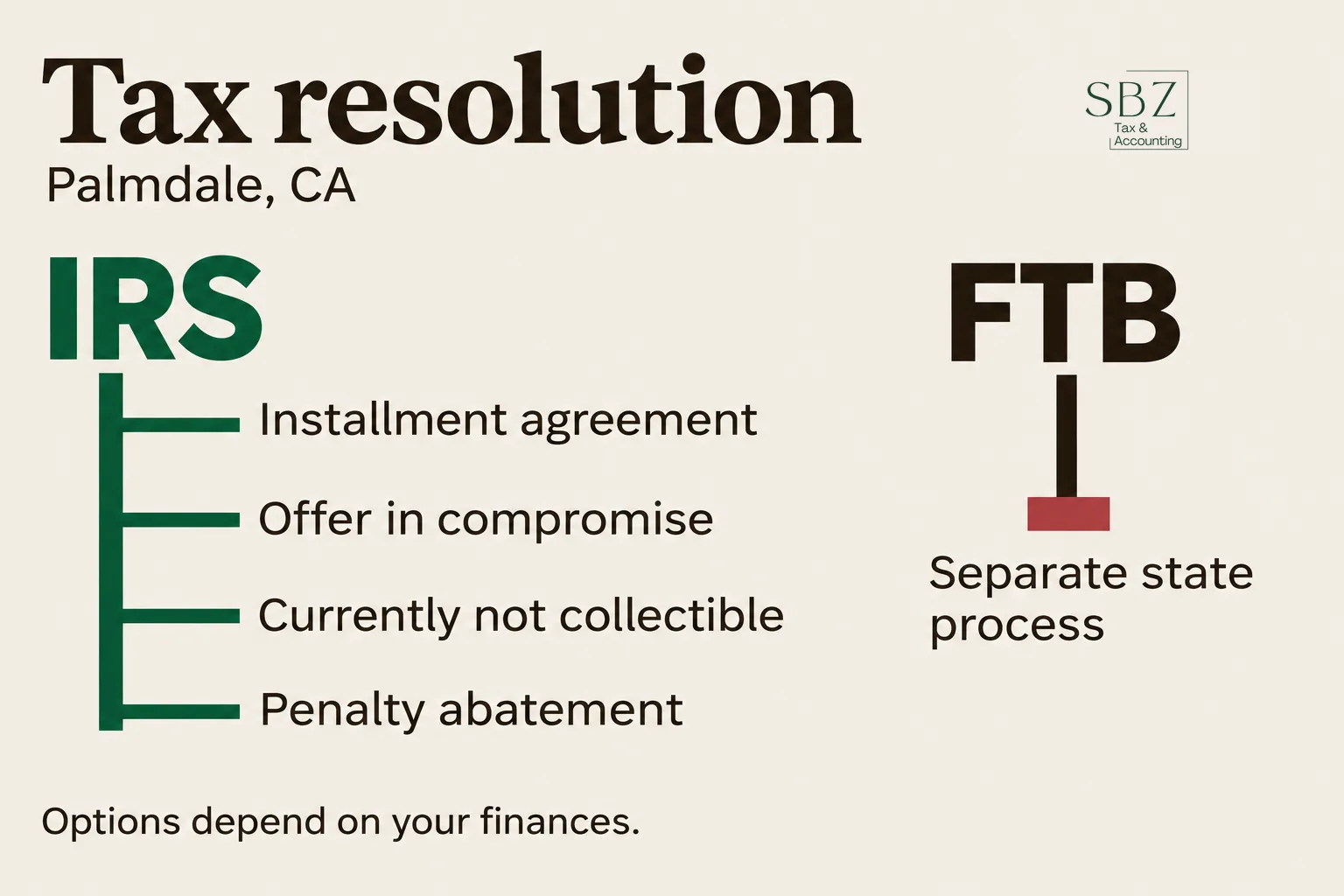
There are four common routes. None is automatic, and the IRS decides based on your finances.
| Option | What it does | Typical fit |
|---|---|---|
| Installment agreement | Monthly payments over time | You owe more than you can pay at once, but have steady income |
| Offer in compromise | Settles for less than the full balance | Full payment would be unrealistic given your assets and income |
| Currently not collectible status | Pauses collection | Paying would leave you unable to cover basic living expenses |
| Penalty abatement | Removes some penalties | Clean history or reasonable cause |
How does an installment agreement work?
You agree to pay the balance in monthly installments. Interest and penalties keep accruing until the balance is paid, though the failure-to-pay penalty rate is lower during an approved agreement.
Many smaller balances can be arranged online. Larger or more complicated ones may use Form 9465 or a full financial statement.
What is an offer in compromise?
It's a settlement for less than you owe, and the IRS accepts it only when it doesn't expect to collect the full amount from your income and assets. The IRS evaluates your finances using a collection information statement and sets minimum payment terms. It's often harder to qualify for than people assume.
Be skeptical of anyone who promises you'll qualify before looking at your numbers. No one can guarantee an outcome, and the IRS publishes a free prequalifier on its own site.
What is currently not collectible status?
If paying anything would leave you unable to cover basic necessities, the IRS can temporarily pause collection. The debt doesn't go away, interest continues, and the IRS may revisit your finances later.
Can penalties be reduced?
Sometimes. First-time abatement can apply if your compliance history has been clean, and "reasonable cause" can apply to events like serious illness or disaster. Penalties often make up a meaningful share of a balance, so it's worth asking before you pay.
How does the financial statement work?
Most hardship-based options depend on a collection information statement, which lists income, expenses, bank accounts, and assets. Accuracy matters because the IRS verifies it. Here is what the collection information statement asks and how to fill it out.
What if the IRS has already sent a levy or lien notice?
Act on it right away. Certain final notices give you the right to a Collection Due Process hearing, but you generally have about 30 days to request one. Form 12153 explains how to request a Collection Due Process hearing.
If a collection employee rejects your proposal, you may also have appeal rights. Form 9423 is the collection appeal request.
What about California FTB debt?
California's FTB runs its own collection process, separate from the IRS. It has its own payment plans, its own notices, and its own authority to levy bank accounts and garnish wages. Resolving federal debt doesn't resolve state debt, and the reverse is also true.
For the state side, see how to set up an FTB installment agreement.
Who can represent you before the IRS?
Representation rights depend on credentials. Enrolled agents, CPAs, and attorneys have unlimited rights to represent taxpayers before the IRS. Other preparers have narrower authority.
Ask any provider exactly what they can do for you before you pay. Ask what the fee covers and which parts they'll handle themselves, and get it in writing. The IRS lets you authorize a representative with a power of attorney (Form 2848), and you should know exactly who holds it.
At SBZ Tax, our principal is a CTEC Registered Tax Preparer (CRTP). We can help you get organized: reviewing notices, identifying missing returns, preparing the filings, and mapping out options. Ask us what we can handle directly for your situation and where a different credential is needed.
How do you keep this from happening again?
Most balances grow because of no estimated payments, no withholding adjustments, or no records. A few habits fix most of it:
- Set quarterly estimates. See how quarterly estimated taxes work for the self-employed.
- Keep books current with monthly bookkeeping.
- Review your numbers before year-end through tax planning.
What's the next step if you're in Palmdale?
Start with your notices and transcripts, then talk to someone who will look at the actual numbers before recommending anything. If you want a second set of eyes, book a free consultation or call 818-748-2020.
SBZ Tax is a walk-in office at 190 Sierra Ct Ste 335, Palmdale, CA 93550, open Monday through Friday 9:00 AM to 8:00 PM and weekends 9:00 AM to 7:00 PM. See our tax services in Palmdale, or Lancaster if you're nearer there. Pricing is available upfront.
This is general information, not tax advice for your specific situation. Talk to a qualified professional before choosing a resolution path.
Frequently asked questions
Can the IRS take my paycheck or bank account?
Yes. After required notices and deadlines, the IRS can levy wages and bank accounts. Responding to notices promptly, and requesting a hearing when you're entitled to one, can stop or delay this.
How long does the IRS have to collect a debt?
Generally 10 years from the date the tax was assessed, though certain actions can extend that period. Don't count on the clock running out, because many situations pause or extend it.
Do I need to file missing returns before I can set up a plan?
Typically yes. The IRS generally requires you to be current on required filings before approving payment arrangements or settlements.
Is tax resolution different for self-employed people?
The options are the same, but self-employed taxpayers often owe more because nothing is withheld. Current estimated payments matter as much as the old balance, since new debt can undo an arrangement.
Does paying a resolution company guarantee a settlement?
No. The IRS makes its own decision based on your finances. Be wary of anyone who guarantees results or quotes a settlement before reviewing your numbers.