On this page
- What is IRS Form 9465 used for?
- Should I use Form 9465 or apply online?
- What do you need before you file it?
- How do you fill out Form 9465?
- Where do you mail IRS Form 9465?
- What does it cost, and what happens to interest and penalties?
- What happens after you send it?
- What if you can't make the payments later?
- Next step
- Frequently asked questions
- Related reading
- Related reading
IRS Form 9465: How to Request an Installment Agreement and Where to Send It
IRS Form 9465 is the Installment Agreement Request, the paper form you use to ask the IRS to let you pay a tax balance in monthly payments instead of all at once. Many people never need it, because the online payment agreement is faster. But if you're mailing a return with a balance due, or you got a notice and prefer paper, this is the form.
Here's what it does, how to fill it out, and where it goes.
What is IRS Form 9465 used for?
Form 9465 asks the IRS to set up a monthly payment plan for taxes you owe and can't pay in full. You propose a monthly amount and a payment date, and you can request direct debit from your bank account.
It's built mainly around individual balances, such as tax owed on Form 1040. Business balances often go through the IRS online payment agreement for businesses or a different form, so check the current instructions before assuming 9465 fits.
The form does not erase or reduce what you owe. It only spreads out the payments.
Should I use Form 9465 or apply online?
For most individuals, applying online is the easier route. The IRS online payment agreement tool generally covers individuals who owe roughly $50,000 or less in combined tax, penalties, and interest, and it often gives an answer right away. Thresholds change, so confirm the current figures on IRS.gov.
Paper makes sense in a few situations:
- You're mailing a paper return and want to attach the request.
- Your balance is above the online limit.
- You received a notice that directs you to mail the request.
- You aren't comfortable setting up an online IRS account.
Online and paper requests also differ in cost, covered below.
What do you need before you file it?
Gather these first, because the IRS will reject or delay a request that's missing basics:
- All required returns filed. The IRS generally won't approve a plan if you have unfiled returns. If that's you, start with what to do if you missed the tax filing deadline.
- The amount you owe and the tax year(s). Pull these from your return or the notice.
- A realistic monthly payment. Pick a number you can sustain, because a missed payment can put the agreement in default.
- Bank details for direct debit, if you choose it. This is usually the cheaper option.
- Current-year payments handled. Keep up with quarterly estimated taxes or withholding, since new tax debt can sink an existing agreement.
How do you fill out Form 9465?
The form is short. It asks for your identifying information, the type of return and tax year, how much you owe, how much you can pay now, your proposed monthly payment, and the day of the month you want to pay. You also sign it, and your spouse signs too if it's a joint balance.
A few practical points:
- Choose a payment date you can reliably make. The instructions recommend a date early in the month and say to avoid the 29th through the 31st.
- Pay what you can up front. Paying part of the balance now reduces the amount subject to interest and penalties.
- Propose a payment that clears the balance within the allowed period. The form generally allows payments over as many as 72 months.
- Keep a copy. Write down the date you mailed it and how.
Where do you mail IRS Form 9465?
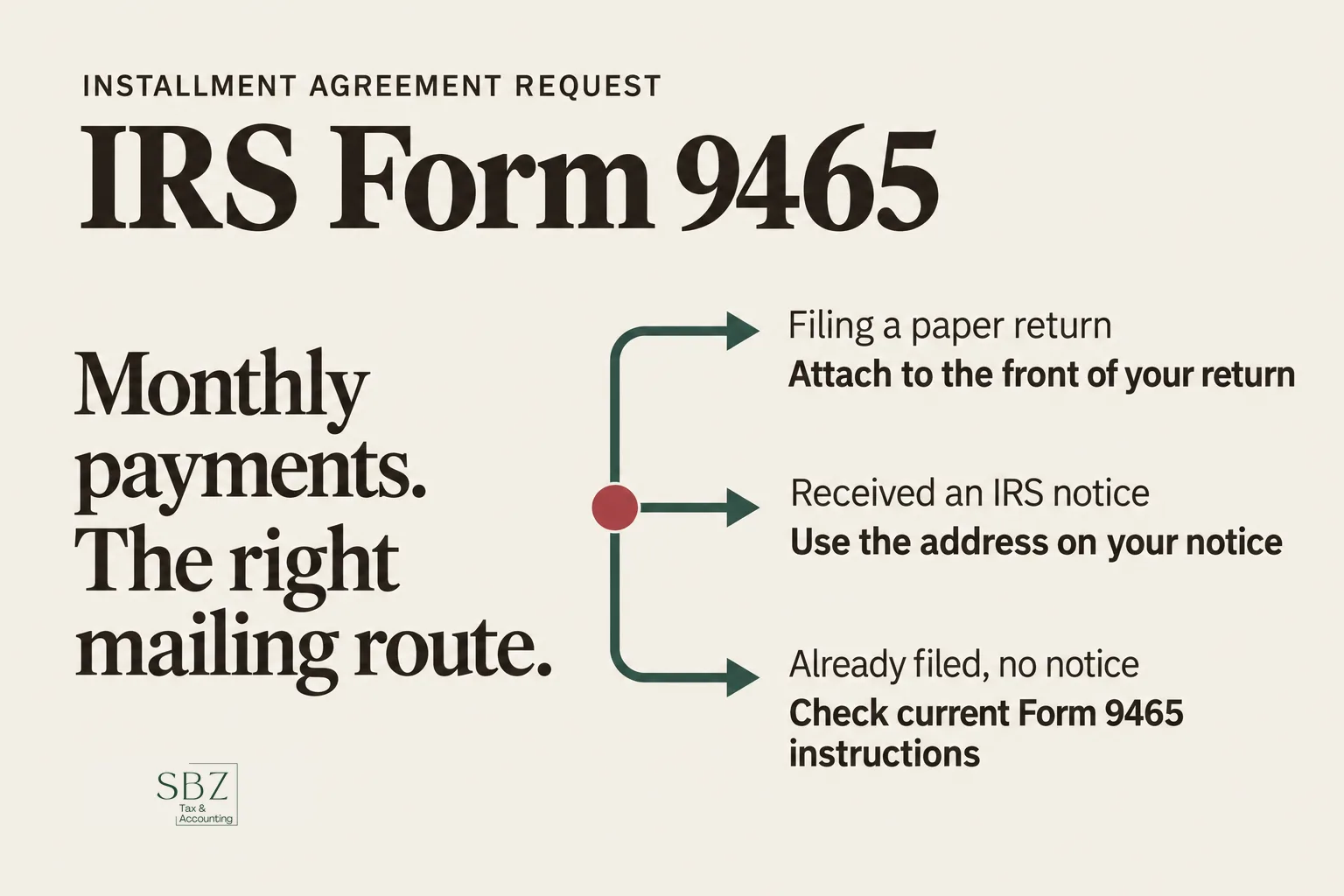
Where to send it depends on your situation:
- Filing a paper return with a balance due: attach Form 9465 to the front of the return.
- Responding to an IRS notice: mail it to the address printed on the notice, or call the number listed there.
- Already filed and no notice yet: use the mailing address in the Form 9465 instructions, which varies by the state where you live.
Addresses change, so use the current instructions on IRS.gov for the correct one. Mailing to a stale address is a common reason for delays. Consider certified mail with a receipt so you have proof of delivery.
What does it cost, and what happens to interest and penalties?
The IRS charges a user fee to set up an installment agreement. Recent fees ran about $22 for an online direct-debit plan and about $69 for an online plan without direct debit. Plans set up by mail, phone, or in person cost more, around $107 with direct debit and $178 without. Lower fees may apply if your income is below certain levels. Check the current amounts on IRS.gov, since they get updated.
Interest keeps accruing on the unpaid balance while you're on the plan. The failure-to-pay penalty continues too, but it can drop from 0.5% to 0.25% per month during an approved agreement if you filed your return on time. For more on how these add up, see estimated tax penalties and how to avoid them.
What happens after you send it?
The IRS generally responds within about 30 days. If you hear nothing after that, call the number on your notice or the IRS directly to confirm they received it.
Keep paying while you wait. Send the proposed monthly amount on schedule, even before you get approval, so you don't fall further behind.
If the IRS rejects your request, the rejection letter explains how to appeal. For the appeal process itself, see IRS Form 9423 and the collection appeal request.
What if you can't make the payments later?
Missed payments, a new balance, or an unfiled return can all cause a default. If your situation changes, contact the IRS before you miss a payment, since you may be able to adjust the agreement.
If the balance is more than you can realistically pay, other options exist, and which one fits depends on your finances and filing history. Our overview of IRS and state tax problem help covers how these situations are typically approached.
Next step
Before you mail anything, confirm three things: every required return is filed, your proposed payment is one you can keep making, and you're using the current form and mailing address from IRS.gov. If you'd like help sorting out what you owe and which option fits, book a free consultation or call SBZ Tax at 818-748-2020. You can also visit our Palmdale, CA office, and we work with clients remotely nationwide. If a balance caught you off guard, tax planning can help keep next year from repeating it.
This is general information, not tax advice for your specific situation. Talk to a qualified tax professional before choosing a payment option.
Frequently asked questions
Is IRS Form 9465 the same as an installment agreement?
Not exactly. Form 9465 is the request. The installment agreement exists only once the IRS accepts it and sets your payment terms.
Can I download IRS Form 9465 as a PDF?
Yes. The IRS publishes Form 9465 and its instructions as free PDFs on IRS.gov. Use the current version, since older ones may list outdated addresses or terms.
Do I have to wait for approval before I start paying?
No. Send your proposed monthly payments while the request is pending. Paying on time reduces what you owe and shows good faith.
Can I amend a return and then request a payment plan?
You can, but an amended return doesn't pause what you currently owe. If you're correcting a mistake, see how Form 1040-X works, then address the payment plan separately.
Will the IRS file a lien if I set up an installment agreement?
It can, particularly on larger balances. Whether a lien is filed depends on the amount owed and the plan's terms, so ask the IRS or a tax professional about your situation.