On this page
- What is the property tax rate in Acton, CA?
- How is my Acton property tax calculated?
- What triggers a reassessment?
- Who assesses my property and who bills me?
- When are Acton property taxes due?
- Can I lower my Acton property taxes?
- How does property tax affect my income tax return?
- What if I fall behind on property taxes?
- What's the next step?
- Frequently asked questions
Acton Property Tax: How the Rate Works for Acton, CA Homeowners
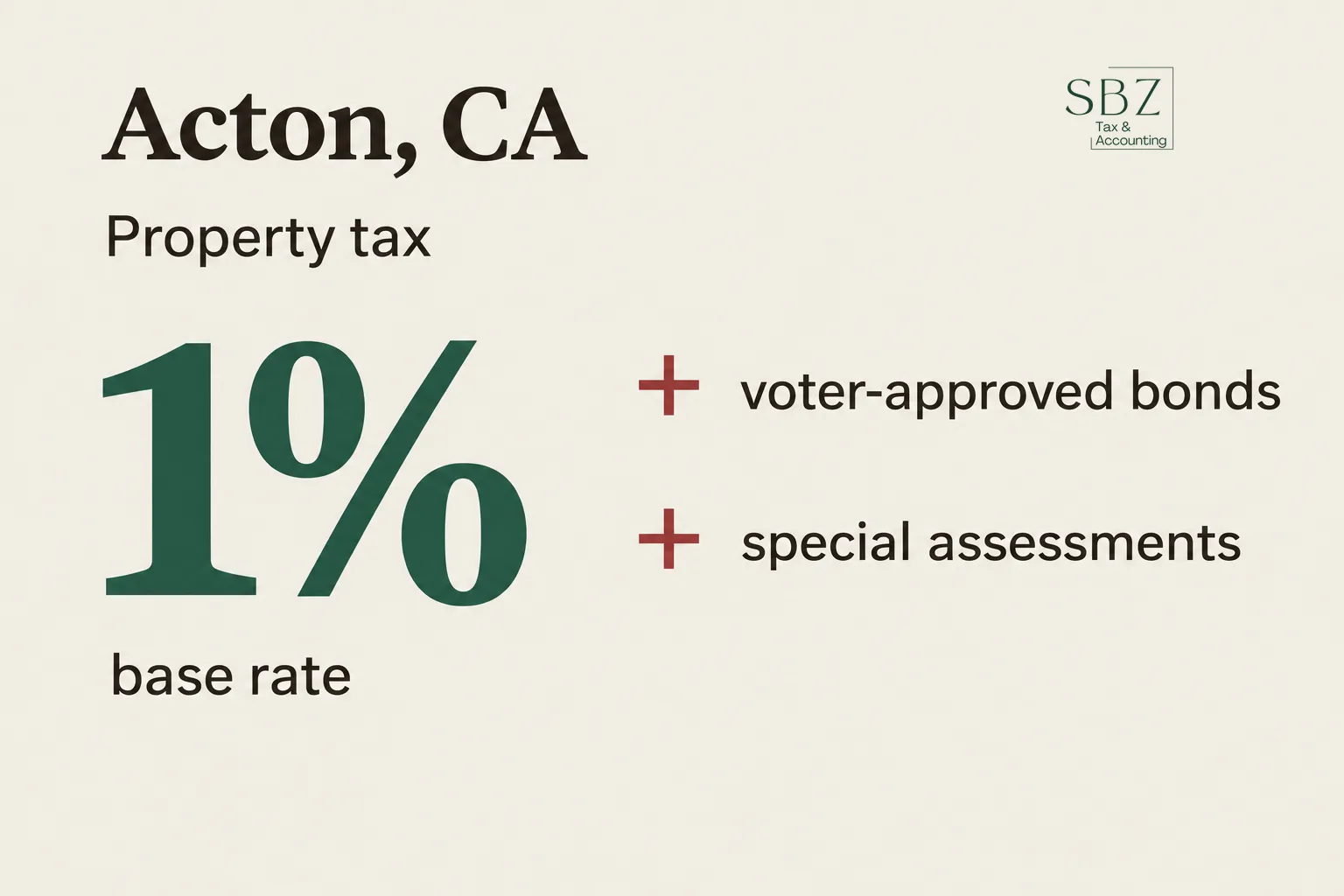
Property tax in Acton, California is a 1% base rate on your property's assessed value, plus voter-approved bonds and special assessments, so most bills come out a little above 1% of assessed value. Acton sits in unincorporated northern Los Angeles County, in the Antelope Valley, and its bills follow the same California rules as the rest of the county.
This guide covers how the bill is built, what Prop 13 limits, when payments are due, and how property tax shows up on your income tax return.
Looking for Acton, Massachusetts? That's a different state with a different system. This article covers Acton, CA only.
What is the property tax rate in Acton, CA?
There is no single published "Acton rate" the way there is in some states. California caps the base rate at 1% of assessed value under Proposition 13. On top of that, your parcel picks up voter-approved debt charges, such as school and community college bonds, and any special assessments tied to your location.
The combined total is why bills usually run somewhat over 1%, and the exact figure varies by parcel. Your actual rate is on your bill, and the Los Angeles County Treasurer and Tax Collector publishes it. Don't rely on a blog post, this one included, for the current number.
How is my Acton property tax calculated?
The formula is simple: assessed value × 1%, plus the voter-approved charges and direct assessments on your parcel. The assessed value is the part people misunderstand.
Your assessed value usually starts at your purchase price in the year you bought. After that, it can rise by no more than 2% a year, even if the market jumps. That's why two similar Acton homes can carry very different bills if one was bought in 2005 and the other last year.
For a deeper walk-through of the mechanics, see how California property taxes work.
What triggers a reassessment?
A reassessment resets the value to current market value. The usual triggers are a change in ownership and new construction. Both happen in Acton, where larger parcels often get additions, barns, guest units, or detached garages.
Some transfers between parents and children, or between spouses, can be excluded from reassessment, and the rules were changed by Proposition 19. Those rules are detailed and the filing deadlines are strict, so check them before you transfer anything. Our guide to California property tax assessment covers the triggers and the appeal process.
Who assesses my property and who bills me?
Two different offices handle your property tax, and mixing them up wastes time.
- The Assessor sets the assessed value. If you think the value is wrong, that's who you talk to. See what the Los Angeles County Assessor does and doesn't do.
- The Treasurer and Tax Collector sends the bill and collects payment. They don't set the value or the rate and can't change either.
If your value is too high, the route is an assessment appeal, not a call to the collector. Our article on Los Angeles property tax appeals explains when filing is worth it.
When are Acton property taxes due?
California's property tax year runs July 1 to June 30, and the bill is paid in two installments.
| Installment | Due | Delinquent after |
|---|---|---|
| First | November 1 | December 10 |
| Second | February 1 | April 10 |
If an installment falls on a weekend or holiday, the deadline generally moves to the next business day. Late payments carry a 10% penalty, and unpaid taxes can add further costs. Details are in our guide to California property tax due dates.
If you pay through a mortgage escrow account, your lender typically pays these for you. It's still worth confirming that they were paid.
Can I lower my Acton property taxes?
Sometimes, and the options are narrower than people hope.
- Homeowners' exemption. Owner-occupants can claim an exemption that reduces assessed value by a fixed amount. It's a small savings, but you have to file for it once.
- Decline-in-value review. If market value dropped below your assessed value, you can ask the Assessor to review it.
- Assessment appeal. If the assessed value is simply wrong, an appeal is the formal route.
What won't work: arguing about the rate, or arguing that the tax is too high without challenging the value. For the full picture, read Can I lower my property taxes? and how to lower your property taxes in Los Angeles County.
How does property tax affect my income tax return?
For many owners, property tax is a deduction, but only if you itemize. It falls under the state and local tax (SALT) deduction, which has an annual cap. The cap amount and its phase-outs have changed in recent years, so check the current figure for the year you're filing rather than assuming last year's number applies.
Where you report it depends on how you use the property:
- Personal residence: itemized deduction on Schedule A, subject to the SALT cap.
- Rental property: an expense on Schedule E, generally not subject to the SALT cap.
- Business property or the business-use share of a home: may be deductible against business income. See how to deduct a home office.
Many Acton owners have mixed use: a home with a workshop, a horse property with a rental unit, or a home-based business. Keeping the bill and your records organized by use makes this much easier, and monthly bookkeeping is built for exactly that.
What if I fall behind on property taxes?
Missing an installment adds a penalty right away. Unpaid taxes can eventually lead to default status and, after years, a tax sale. If you're behind, pay as much as you can as soon as you can, and ask the Treasurer and Tax Collector about payment options.
Property tax delinquency is separate from IRS or state income tax debt, but the same discipline applies. If you also have income tax balances, our page on IRS and state tax problem help lays out the options.
What's the next step?
Pull your most recent bill and check three things: the assessed value, the voter-approved charges, and whether the homeowners' exemption is applied. Then match your deductions to how you use the property.
If you want a second set of eyes on how your property tax fits into your return, SBZ Tax offers tax planning and can walk through your situation. Our office is local to Acton at 190 Sierra Ct Ste 335, Palmdale, CA 93550. Call 818-748-2020 or book a free consultation. You can also see our Palmdale services and pricing.
This is general information, not tax advice for your specific situation. Talk to a qualified professional about your circumstances.
Frequently asked questions
What is the property tax rate in Acton, CA?
The base rate is 1% of assessed value under Proposition 13, plus voter-approved bond charges and special assessments on your parcel. The total varies by parcel, so check your bill or the Los Angeles County Treasurer and Tax Collector for your exact rate.
Is Acton, CA the same as Acton, MA for property tax?
No. They are in different states with different systems. This article covers Acton, California, which is in the Antelope Valley in Los Angeles County.
When are property taxes due in Acton?
The first installment is due November 1 and becomes delinquent after December 10. The second is due February 1 and becomes delinquent after April 10.
Can my Acton property tax increase every year?
Yes, but your assessed value can generally rise by no more than 2% a year unless there's a change in ownership or new construction. Voter-approved charges can also change from year to year.
Is Acton property tax deductible?
If you itemize, you can generally deduct it as part of the SALT deduction, subject to the annual cap. Rental property taxes are usually reported on Schedule E instead.