On this page
- What is IRS Form 12153?
- Which IRS notices let you use Form 12153?
- What is the deadline to file Form 12153?
- How do you fill out Form 12153?
- Where do you mail or fax Form 12153?
- What can you ask for in a CDP hearing?
- What happens after you file?
- Is Form 12153 the same as Form 9423?
- What's the next step if you've received a lien or levy notice?
- Frequently asked questions
IRS Form 12153: How to Request a Collection Due Process Hearing
IRS Form 12153, Request for a Collection Due Process or Equivalent Hearing, is the form you use to appeal a federal tax lien filing or a notice of intent to levy. Filing it on time gets your case in front of the IRS Independent Office of Appeals and, in most cases, pauses levy action on the tax periods listed while the hearing is pending. The deadline is short, so the date on your notice matters more than anything else in this article.
What is IRS Form 12153?
Form 12153 is a request for a hearing, not a payment form and not a dispute letter. It asks the IRS to have an Appeals officer, someone who did not work your collection case, review what the IRS is about to do or has already done.
The hearing is called a Collection Due Process (CDP) hearing. It exists because the law gives you a right to be heard before the IRS levies your assets, and after it files a notice of federal tax lien. Many people find the form after receiving a scary letter, which is usually the right moment to find it.
Which IRS notices let you use Form 12153?
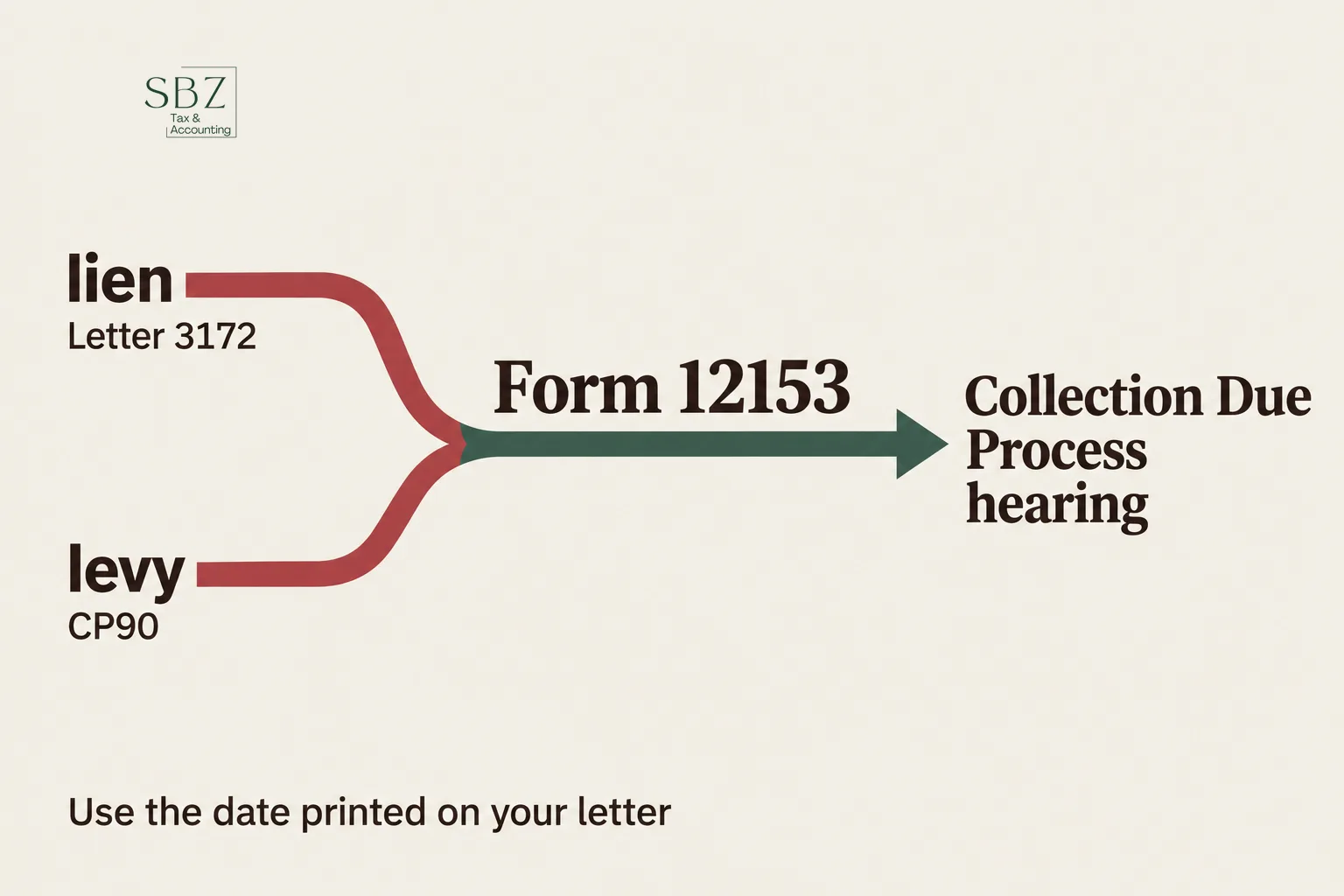
You can file Form 12153 in response to a notice that gives you CDP hearing rights. The common ones are:
- Final Notice of Intent to Levy and Notice of Your Right to a Hearing (often labeled CP90, CP297, LT11, or Letter 1058)
- Notice of Federal Tax Lien Filing and Your Right to a Hearing (Letter 3172)
The notice itself states that you have hearing rights and gives a deadline. If your letter doesn't mention a right to a hearing, it is probably not a CDP notice, and a different response applies. A routine balance-due bill is not one, for example. If you're unsure what you received, IRS and state tax problem help is a good place to start sorting it out.
What is the deadline to file Form 12153?
For a levy notice, you generally have 30 days from the date on the notice to request a CDP hearing. For a lien notice, the deadline is stated in the notice and falls after a short waiting period that follows the lien filing. Use the date printed on your letter, not a date you calculated from memory.
Miss that window and you can still request an equivalent hearing on the same form. That request generally has to come within one year of the levy notice date, or within one year plus five business days after the lien filing. The trade-off is that an equivalent hearing doesn't carry the same protections, including the right to take the result to Tax Court, and levy action may not be paused.
How do you fill out Form 12153?
The IRS publishes the form as a free PDF on IRS.gov, and a fillable version is available. You can fill it out on screen, then print it and sign it. A signature is required.
Here's what the form asks for, in plain terms:
- Your identifying information. Name, address, taxpayer ID number, and a daytime phone number.
- The tax periods and type of tax. Copy these from the notice, such as Form 1040 for a given year or Form 941 for specific quarters.
- The type of notice you received. Lien, levy, or both.
- Why you want a hearing. The form lets you check boxes for the collection alternatives you want considered, and you can explain your position in your own words.
If your reason doesn't fit in the space provided, attach a short statement. Keep it factual and specific. "I can't pay the full balance but can pay a monthly amount" is more useful to an Appeals officer than a long account of how the debt happened.
Where do you mail or fax Form 12153?
Send it to the address shown on your notice. The notice is the controlling source, because the correct address depends on the type of notice and where your case is being handled. If the notice lists a fax number, you may use that too, but don't rely on a number you found on a third-party site.
Whichever route you use, keep proof. Certified mail with a return receipt is the standard approach for a deadline-driven filing, and a copy of the signed form and the notice belongs in your records. The postmark date is your evidence that you filed on time.
What can you ask for in a CDP hearing?
The hearing is your chance to propose a way to resolve the debt. Common requests include:
- An installment agreement to pay over time. State programs work similarly; for example, setting up an FTB installment agreement follows a similar logic on the California side.
- An offer in compromise if the full amount truly isn't collectible.
- Currently not collectible status if paying would leave you unable to cover basic living expenses.
- Challenging the appropriateness of the collection action itself, such as whether a levy is more intrusive than necessary.
You can dispute the underlying tax bill only in limited situations, generally if you never received a notice of deficiency or otherwise had no earlier chance to contest it. Appeals will also check that the IRS followed the required procedures before the lien or levy.
What happens after you file?
If your request is timely, the IRS generally can't levy on the tax periods covered while the hearing is pending, and the collection statute of limitations is suspended during that time. Interest and penalties keep accruing, so a hearing delays collection but does not freeze the balance.
An Appeals officer will usually schedule a phone conference. Expect to be asked for financial information and to be current on filing and estimated payments. If you have unfiled returns, that is the first problem to fix, and our guide on what to do if you missed the filing deadline covers it. Staying current going forward also matters, which is where quarterly estimated taxes for the self-employed comes in.
When the hearing ends, Appeals issues a Notice of Determination. If you disagree, you generally have 30 days from that notice to petition the U.S. Tax Court.
Is Form 12153 the same as Form 9423?
No. Form 12153 requests a CDP hearing in response to a lien or levy notice, with statutory deadlines and court review rights. Form 9423 is for the Collection Appeals Program, which handles disputes with a collection action at other times. Details are in our guide on how to use the collection appeal request.
If you only need a record of what the IRS shows on your account before responding, see how to get an IRS transcript.
What's the next step if you've received a lien or levy notice?
Find the date on your notice, confirm it gives you hearing rights, and decide this week whether to file. If you want a second set of eyes on the notice or on the payment option to propose, book a free consultation or call SBZ Tax at 818-748-2020. You're also welcome to visit the office at 190 Sierra Ct Ste 335, Palmdale, CA 93550. For representation before the IRS, a credentialed representative such as an enrolled agent, CPA, or tax attorney can act on your behalf.
This is general information, not tax advice for your specific situation. Talk to a qualified professional before filing.
Frequently asked questions
Is there a fee to file IRS Form 12153?
No. Requesting a CDP hearing doesn't cost anything. The form is free to download from IRS.gov, and you aren't charged to file it.
Can I file Form 12153 online?
The IRS instructions direct you to mail or fax the signed form to the address or fax number on your notice. Check the notice itself, because the filing method it lists is the one that counts.
What if I miss the 30-day deadline?
You can still request an equivalent hearing on the same form, generally within one year of the notice. You lose some protections, including Tax Court review, so file as early as you can.
Does filing Form 12153 stop the IRS from collecting?
A timely request generally stops levy on the tax periods covered while the hearing is pending, with limited exceptions. It doesn't stop interest and penalties from accruing.
Do I need a professional to file Form 12153?
No, you can file it yourself. A professional can help you choose the right collection alternative and prepare the financial information Appeals will ask for.