On this page
- Why is canceled debt taxable in the first place?
- Who can use Form 982?
- How does the insolvency exclusion work?
- What do you actually fill out on Form 982?
- What does the exclusion cost you?
- What if you already filed without Form 982?
- How should you prepare before you file?
- Next step
- Frequently asked questions
IRS Form 982: When Canceled Debt Isn't Taxable and How to Report It
IRS Form 982 is the form you file to exclude canceled debt from your taxable income when you qualify under one of the exceptions in Section 108 of the tax code. It also reports the trade-off: the debt you exclude generally reduces certain tax benefits, called tax attributes, such as loss carryovers and the basis of your property.
Here's the short version. Canceled debt is usually income. Form 982 is how you tell the IRS that, in your situation, it isn't.
Why is canceled debt taxable in the first place?
When a lender forgives or writes off debt, you received money or property you never paid back. The tax code treats that as income. The lender typically reports it to you and the IRS on Form 1099-C (Cancellation of Debt) when the canceled amount is $600 or more.
If you do nothing, the amount on that form shows up as ordinary income on your return. Form 982 is the way to exclude it when an exception applies.
Who can use Form 982?
You can use it if the canceled debt falls under one of the exclusions in Section 108. Part I of the form asks you to check the one that applies:
| Exclusion | In plain terms |
|---|---|
| Title 11 bankruptcy | The debt was discharged in a bankruptcy case |
| Insolvency | Your total debts exceeded the fair market value of your total assets immediately before the cancellation |
| Qualified farm indebtedness | Debt from operating a farming business, with specific conditions on the lender and the business |
| Qualified real property business indebtedness | Debt secured by real property used in a trade or business, for taxpayers other than C corporations |
| Qualified principal residence indebtedness | Debt used to buy, build, or improve your main home, subject to dollar caps and a sunset date |
The exclusions have priority rules. If the debt is discharged in a bankruptcy case, that exclusion generally takes precedence over insolvency. Insolvency generally takes precedence over the farm and real property business exclusions.
The principal residence exclusion has been tied to a sunset date, so check the current rules before relying on it for a recent discharge.
How does the insolvency exclusion work?
Insolvency is the most common reason people file this form who aren't in bankruptcy. The exclusion is limited to the amount by which you were insolvent, meaning how far your liabilities exceeded your assets just before the debt was canceled.
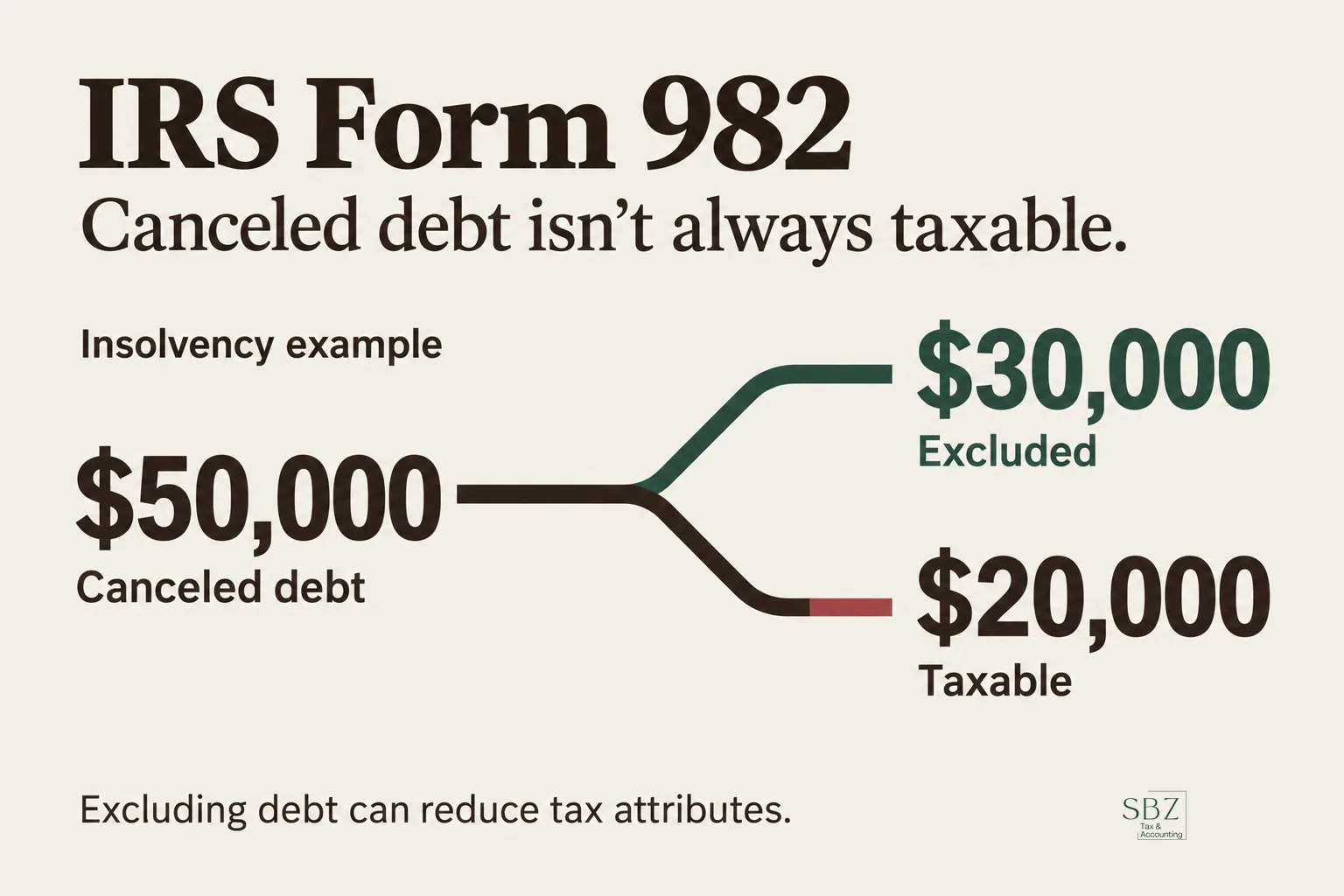
For example, say your liabilities were $200,000 and your assets were worth $170,000. You were insolvent by $30,000. If $50,000 of debt was canceled, only $30,000 can be excluded, and the other $20,000 is taxable.
The IRS does not require a specific worksheet to be filed, but you need one to support the number. The insolvency worksheet lives in IRS Publication 4681, not in the Form 982 instructions. It has you list every asset at fair market value and every liability, including the debt being canceled. Count everything, including retirement accounts and other assets that creditors may not be able to reach.
Keep the completed worksheet with your records. If the IRS asks how you arrived at your excluded amount, that is your support.
What do you actually fill out on Form 982?
You don't need every line. For most people the sequence is:
- Line 1: Check the box for the exclusion you're using.
- Line 2: Enter the total amount of canceled debt you're excluding from income. This can't exceed what the exclusion allows, and for insolvency it's capped at your insolvency amount.
- Part II: Show how the excluded amount reduces your tax attributes, or make the election to reduce the basis of depreciable property first.
- Attach it to your return. Form 982 goes in with your Form 1040 (or the business return that applies) for the year the debt was canceled.
The form instructions walk through each line. The IRS publishes Form 982 and its instructions as free PDFs on IRS.gov, and it's worth working from the current-year versions.
What does the exclusion cost you?
This is the part people miss. The exclusion isn't free. Under Section 108(b), the excluded amount reduces your tax attributes, generally in this order:
- Net operating losses
- General business credits
- Minimum tax credit
- Capital loss carryovers
- Basis of your property
- Passive activity loss and credit carryovers
- Foreign tax credit carryovers
The reductions happen after your tax for the year of the discharge is figured. In effect, you're trading a tax bill now for smaller deductions or credits, or a lower basis, later.
Lower basis matters. If your property's basis is reduced, you may owe more gain when you sell it, or take less depreciation along the way. If you sell business property, Form 4797 is where that gain gets reported. If the debt relates to a rental, Schedule E is where the ongoing income and depreciation show up.
Some taxpayers can elect under Section 108(b)(5) to reduce the basis of depreciable property first, which can protect loss carryovers. Whether that makes sense depends on the numbers, and it's a good question for a professional before you file.
What if you already filed without Form 982?
If you reported canceled debt as income and later realize you qualified for an exclusion, you may be able to fix it. The usual route is an amended return. Form 1040-X walks through when amending makes sense and when it doesn't.
If you haven't filed yet and the deadline has passed, don't wait. The article on what to do if you missed the tax filing deadline covers the order of operations. And if the canceled debt came with a larger back-tax problem, our page on IRS and state tax problem help explains how those cases are typically handled.
How should you prepare before you file?
A few steps make the process much smoother:
- Collect every Form 1099-C you received and check each amount against the lender's records. Errors are common.
- Build the insolvency worksheet with documented values as of the day before the cancellation.
- Gather basis and carryover records for the attributes that might be reduced.
- Check whether any state return follows the federal exclusion. States don't always conform.
Clean books make all of this easier. If your records for a business are behind, monthly bookkeeping is usually the fastest way to get to numbers you can rely on. And if you can see a debt settlement coming, tax planning before the cancellation happens can sometimes change how it's treated.
Next step
If you got a 1099-C and aren't sure whether an exclusion applies, start by calculating insolvency with the Publication 4681 worksheet. That one number often decides everything. Then bring the worksheet, the 1099-C, and last year's return to a professional.
SBZ Tax works with individuals and business owners across the U.S., remotely or in person. You can book a free consultation, call 818-748-2020, or visit the office at 190 Sierra Ct Ste 335, Palmdale, CA 93550.
This article is general information, not tax advice for your specific situation. Talk to a qualified tax professional before filing.
Frequently asked questions
Do I have to file Form 982 if I'm insolvent?
If you want to exclude canceled debt because you were insolvent, yes. The exclusion is claimed on Form 982, attached to your return. Without it, the canceled amount is generally reported as income.
Where do I find the insolvency worksheet for Form 982?
It's in IRS Publication 4681, Canceled Debts, Foreclosures, Repossessions, and Abandonments. You use it to calculate your insolvency amount, but you keep it with your records rather than filing it with the return.
Does excluding canceled debt mean I never pay tax on it?
Not necessarily. The exclusion reduces your tax attributes, such as loss carryovers or property basis, so the tax cost can show up in later years. Any debt canceled beyond your insolvency amount is also still taxable.
Is there a Form 982 PDF I can download?
Yes. The IRS posts Form 982 and its instructions as free PDFs on IRS.gov. Use the version for the tax year the debt was canceled.
Can I e-file Form 982?
Most tax software supports Form 982 when you e-file the return it belongs to. If you file on paper, attach it to your return. Check the current instructions for the year in question.