On this page
- What payroll taxes do California employers have to deal with?
- Which California payroll taxes come out of the employee's paycheck?
- Which California payroll taxes does the employer pay?
- How do you calculate payroll taxes in California?
- What forms and deadlines apply to California payroll?
- Do business owners pay payroll tax on their own pay?
- What happens if payroll taxes are late or wrong?
- What is a practical way to keep payroll clean?
- Frequently asked questions
California Payroll Taxes: What Employers Withhold, Pay, and File
California payroll taxes are the federal payroll taxes every U.S. employer deals with, plus four state taxes that the Employment Development Department (EDD) administers. Two of the state taxes come out of the employee's paycheck and two are paid by the employer on top of wages. Here is how the pieces fit, who pays what, and how to estimate the total.
What payroll taxes do California employers have to deal with?
Payroll taxes fall into two layers.
Federal layer (IRS):
- Federal income tax withholding from employee wages.
- Social Security tax: 6.2% from the employee and a matching 6.2% from the employer, up to an annual wage base the IRS adjusts each year.
- Medicare tax: 1.45% from the employee and 1.45% from the employer, with no wage cap. Employees also owe an extra 0.9% on wages above $200,000, and the employer does not match that part.
- Federal unemployment tax (FUTA), paid only by the employer.
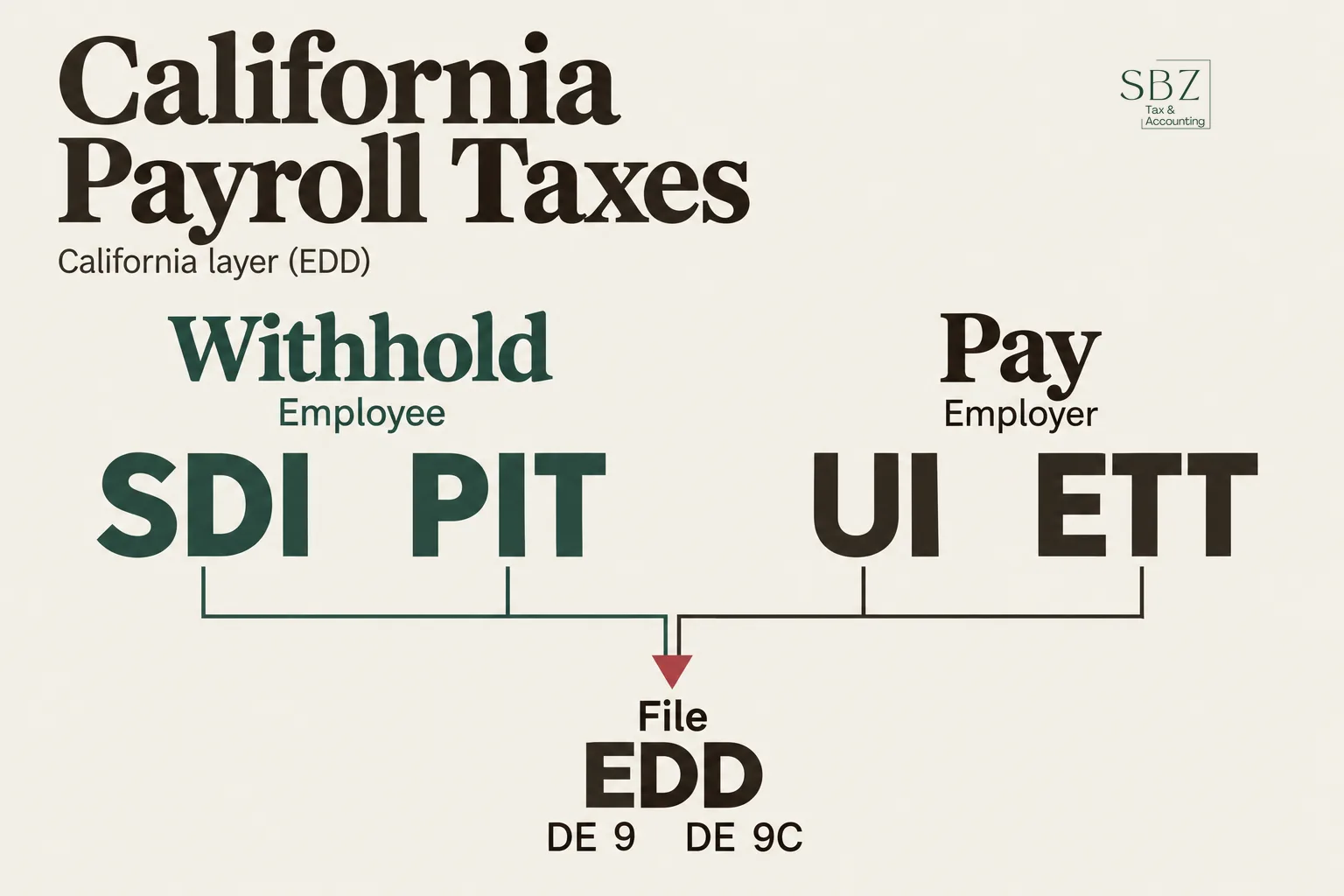
California layer (EDD):
- Unemployment Insurance (UI), employer-paid.
- Employment Training Tax (ETT), employer-paid.
- State Disability Insurance (SDI), withheld from the employee.
- Personal Income Tax (PIT) withholding, withheld from the employee.
In plain terms: you withhold from the employee, you pay your own share on top, and you send both to the right agency on time.
Which California payroll taxes come out of the employee's paycheck?
Two do, both on top of the federal withholding.
SDI funds disability and paid family leave benefits. The rate is set annually. Since 2024 it applies to all wages with no taxable wage ceiling. Check the EDD's current rate before you run payroll for the year.
PIT withholding is California income tax taken from wages based on the employee's Form W-4 and California's Form DE 4. The amount depends on filing status, allowances, and pay frequency, and the EDD publishes withholding tables each year. If you want to see how the underlying state rates work, California tax brackets shows the progressive structure.
Which California payroll taxes does the employer pay?
Two state taxes come from the employer's own pocket. They are not deducted from wages.
Unemployment Insurance (UI) applies to the first $7,000 of wages per employee per year. New employers are generally assigned a starting rate of 3.4% for the first few years. After that, the rate depends on your reserve account, which reflects how many former employees have drawn benefits, and it can move up or down considerably.
Employment Training Tax (ETT) is 0.1% of the first $7,000 of wages per employee per year. It is a small line, but it is easy to miss.
On the federal side, FUTA is 6.0% of the first $7,000 per employee, minus a credit of up to 5.4% for state unemployment taxes paid on time. California is a "credit reduction" state, meaning employers lose part of that credit when the state has an outstanding federal loan balance. That raises the effective FUTA rate above the usual 0.6%, and the amount changes yearly.
How do you calculate payroll taxes in California?
A calculator is only as good as its inputs, so it helps to know the math underneath. Here is a simple example for one employee earning $5,000 in a month, with no earlier wages that year.
| Item | Who pays | Calculation | Amount |
|---|---|---|---|
| Social Security | Employee | 6.2% of $5,000 | $310.00 |
| Social Security | Employer | 6.2% of $5,000 | $310.00 |
| Medicare | Employee | 1.45% of $5,000 | $72.50 |
| Medicare | Employer | 1.45% of $5,000 | $72.50 |
| UI (new employer rate) | Employer | 3.4% of first $7,000 | up to $238.00 for the year |
| ETT | Employer | 0.1% of first $7,000 | up to $7.00 for the year |
Federal income tax, California PIT, and SDI are then added to the employee's withholding using the current tables and rate. Employer FUTA, including the California credit reduction, is added on the employer side.
The takeaway: the employer's cost is typically a bit more than 7.65% of wages on the federal Social Security and Medicare side alone, and the UI, ETT, and FUTA amounts are front-loaded. They hit hardest on the first $7,000 of each employee's pay, then drop off for the rest of the year.
What forms and deadlines apply to California payroll?
You register as an employer with the EDD, typically online through e-Services for Business, before you pay your first employee. Then there are the recurring filings.
- Deposits: Federal deposits follow a monthly or semiweekly schedule, and California deposit timing depends on how much PIT withholding you accumulate.
- Form 941: The IRS quarterly return for withheld income tax, Social Security, and Medicare.
- Form 940: The annual federal unemployment return.
- Form DE 9 and DE 9C: The EDD's quarterly return and wage detail for UI, ETT, SDI, and PIT.
- Forms W-2 and W-3: Year-end wage reporting.
If you pay independent contractors rather than employees, none of this applies to them, but you may owe a different filing. See whether you need to send 1099s to contractors. Classification matters: California applies a strict test for who counts as a contractor, and a misclassified worker can create back payroll tax liability.
Do business owners pay payroll tax on their own pay?
It depends on the structure. A sole proprietor or single-member LLC owner is not an employee and pays self-employment tax through quarterly estimated taxes instead. An S-corp owner who works in the business is an employee of the corporation, so payroll applies to their salary. That is where S-corp reasonable salary rules come in, and it is covered further in our S-corp and business tax services overview.
What happens if payroll taxes are late or wrong?
Payroll taxes are treated as trust fund money because you are holding the employee's share on behalf of the government. Late deposits, missed returns, and unpaid balances draw penalties and interest from both the IRS and the EDD. Responsible individuals can be personally liable for unpaid trust fund amounts, even when the business is a corporation or LLC.
If you are behind, the first step is getting accurate numbers for each quarter, then filing the missing returns and working out a payment plan. Our IRS and state tax problem help page explains how that process usually runs.
What is a practical way to keep payroll clean?
Most payroll problems start with books that do not match payroll records. A few habits prevent the usual ones:
- Keep payroll liabilities in a separate account or a clearly tracked ledger line.
- Reconcile payroll reports to your bank statements every month, which is easier with monthly bookkeeping.
- Compare each quarter's 941 totals to the DE 9 and your W-2 totals before filing.
- Set calendar reminders for deposits and quarterly due dates, not just the filing deadline.
SBZ Tax helps small business owners put this structure in place. If you are weighing outsourced payroll, a fractional CFO can help you decide what fits your headcount and cash flow, and you can see how we scope work on the pricing page.
Frequently asked questions
What are the four California payroll taxes?
They are Unemployment Insurance (UI), Employment Training Tax (ETT), State Disability Insurance (SDI), and Personal Income Tax (PIT) withholding. The employer pays UI and ETT, and the employee pays SDI and PIT through withholding.
Does the employer or the employee pay California SDI?
The employee pays SDI through payroll deductions. The employer withholds it and remits it to the EDD, but it is not an additional employer cost.
How much is the California UI wage base?
California's UI and ETT taxes apply to the first $7,000 of wages paid to each employee in a calendar year. Once an employee passes that amount, no further UI or ETT is due on their wages for that year.
Is there a California payroll tax calculator?
The EDD publishes withholding tables and a payroll tax calculator, and most payroll software calculates these automatically. Using the math in the example above helps you check that the numbers are reasonable.
Do I owe California payroll taxes if I only have one employee?
Yes. California generally treats you as an employer once you pay wages to an employee, so you must register with the EDD and withhold and pay the required taxes, even for a single worker.
This is general information, not tax advice for your specific situation. Rates, wage bases, and thresholds change, so confirm current figures with the IRS and EDD and talk to a qualified professional.
Questions about payroll setup or a notice you have received? Book a free consultation, call SBZ Tax at 818-748-2020, or visit our office at 190 Sierra Ct Ste 335, Palmdale, CA 93550.