On this page
- What is IRS Form 4797 used for?
- Who needs to file Form 4797?
- What are the four parts of Form 4797?
- What is depreciation recapture, and why does it matter?
- Where does the gain go on my tax return?
- Which related forms go with Form 4797?
- What mistakes should I avoid?
- How should I plan before selling business property?
- Frequently asked questions
- Related reading
- Related reading
- Related reading
IRS Form 4797: How to Report the Sale of Business Property
IRS Form 4797, Sales of Business Property, is the form you file to report a gain or loss when you sell, exchange, or otherwise dispose of property used in a trade or business or held to produce rental income. That covers equipment, vehicles, rental buildings, and land. The form also sorts out how much of the gain is taxed as ordinary income and how much gets capital gain treatment.
Here's the short version of how it works, what the instructions expect, and the places people usually get tripped up.
What is IRS Form 4797 used for?
Form 4797 reports dispositions of business assets that you depreciated or could have depreciated. A sale is the usual trigger, but trades, involuntary conversions, and abandonments can also land here.
It does not cover everything you sell. Inventory and property held mainly for sale to customers are reported as ordinary business income. Personal-use property and investment assets such as stocks generally go on Form 8949 and Schedule D instead.
Who needs to file Form 4797?
Anyone who sold business or rental property during the year may need it. That includes sole proprietors who report on Schedule C, landlords, partnerships, and corporations.
Entities file their own Form 4797 with their return. For an S-corp or partnership, the results flow through to the owners on their Schedule K-1. If you run an S-corp, this is one more reason the entity's books need to be clean before year-end. Our S-corp and business tax services page covers how SBZ Tax handles these returns.
What are the four parts of Form 4797?
The form is organized by the type of gain or loss.
| Part | What it reports |
|---|---|
| Part I | Sales of property used in a trade or business and held more than one year (Section 1231 property), plus certain involuntary conversions |
| Part II | Ordinary gains and losses, including property held one year or less and recapture amounts carried from Part III |
| Part III | Gain on property subject to depreciation recapture under Sections 1245 and 1250 (and a few less common ones) |
| Part IV | Recapture of Section 179 and listed-property deductions when business use drops to 50% or less |
You often work through the form out of order. Part III figures how much of your gain is recaptured depreciation, and those results then feed Parts I and II.
What is depreciation recapture, and why does it matter?
Depreciation recapture is the rule that turns part of your gain into ordinary income because you already deducted depreciation against ordinary income. The part people miss is that it applies to depreciation "allowed or allowable," meaning even if you never claimed it, the IRS treats the basis as reduced.
Two sections do most of the work:
- Section 1245 covers personal property such as equipment, machinery, and vehicles. Gain up to the depreciation taken (including any Section 179 expensing) is ordinary income.
- Section 1250 covers real property such as buildings. For most property depreciated on a straight-line basis, there is no ordinary-income recapture. Instead, the gain attributable to depreciation is "unrecaptured Section 1250 gain," which is taxed at a maximum 25% federal rate.
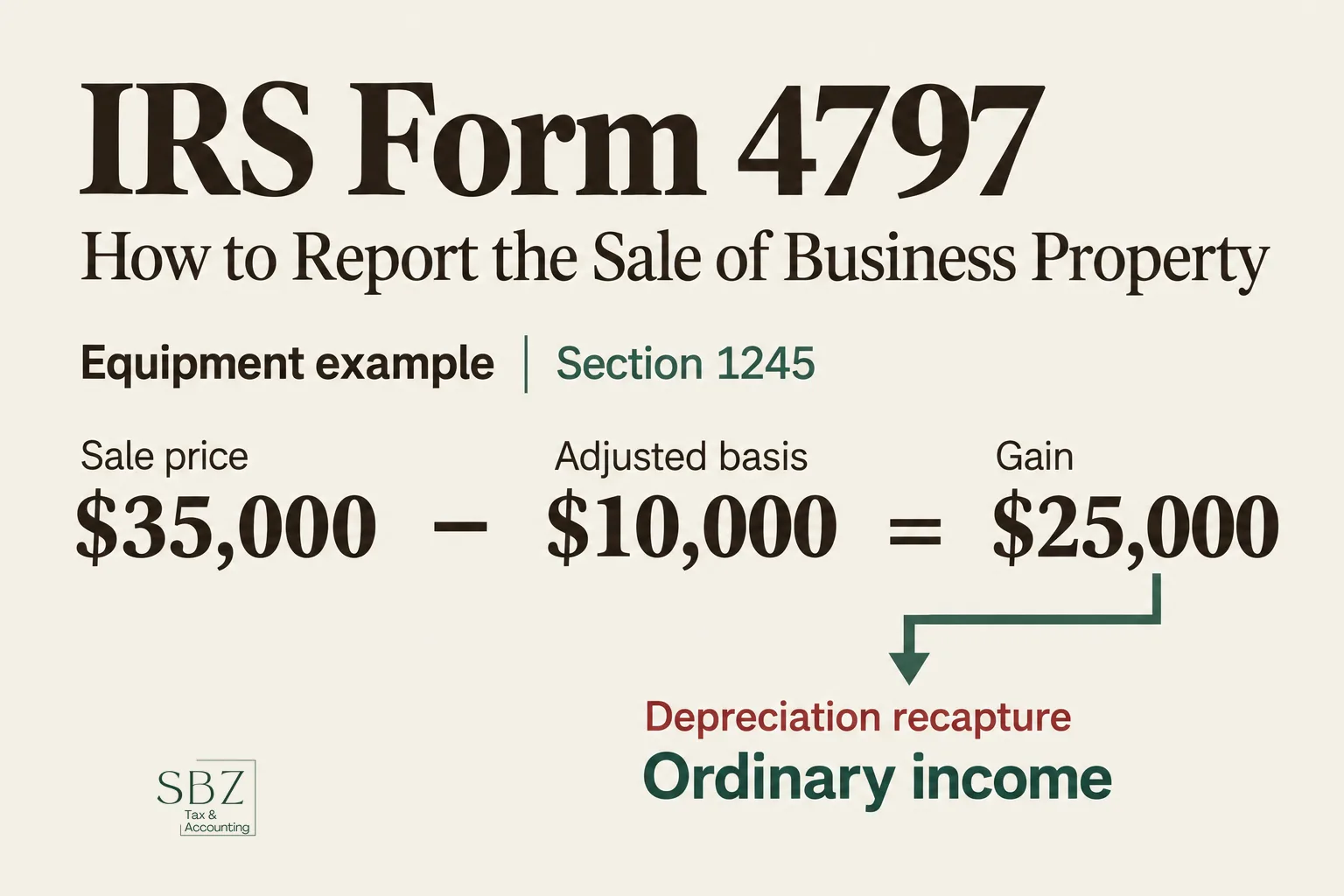
Here's a simple Section 1245 example. A business buys equipment for $50,000, takes $40,000 in depreciation, and sells it for $35,000. The adjusted basis is $10,000, so the gain is $25,000. Because that is less than the $40,000 of depreciation, the entire $25,000 is ordinary income. It would not be a capital gain.
Where does the gain go on my tax return?
After Form 4797 sorts the gain, the results move to other forms:
- Net Section 1231 gain from Part I generally flows to Schedule D as long-term capital gain, with one catch. If you had net Section 1231 losses in the prior five years that were deducted as ordinary losses, an equal amount of the new gain is recharacterized as ordinary income.
- Net Section 1231 loss is treated as an ordinary loss and goes to Part II.
- Ordinary gain or loss from Part II flows to Schedule 1 of Form 1040 for individuals, or to the entity return for pass-through businesses.
Large gains can also bring other taxes. The net investment income tax may apply to certain rental or passive gains, and a big sale can create a need for quarterly estimated payments to avoid estimated tax penalties. If you owe state tax too, the state rules on gains vary, and California, for example, taxes capital gains as ordinary income.
Which related forms go with Form 4797?
Form 4797 rarely travels alone. Depending on the transaction, you may also see:
- Form 4562 for depreciation history and Section 179 deductions
- Form 6252 if you sell on an installment basis and receive payments over several years
- Form 8824 for a like-kind exchange, which now applies only to real property
- Form 4684 for casualty and theft losses on business property
- Form 6251 if the sale creates an alternative minimum tax issue; see IRS Form 6251
Accurate depreciation records are what make all of this possible. Without a clear asset list showing cost, date placed in service, and depreciation taken, calculating adjusted basis becomes guesswork. Good monthly bookkeeping keeps that list current so you aren't reconstructing it at sale time.
What mistakes should I avoid?
A few patterns show up repeatedly:
- Reporting a business asset on Form 8949. Business property used in the business belongs on Form 4797.
- Ignoring depreciation you never claimed. The basis still drops by the allowable amount, which can inflate your gain.
- Missing the holding period. Property held one year or less is ordinary in Part II. More than one year opens up Section 1231 treatment.
- Forgetting the five-year Section 1231 lookback. It can turn what looks like a capital gain into ordinary income.
- Not splitting a combined sale. If you sell a building with land and equipment, the purchase price generally has to be allocated among the assets, and each one is reported separately.
Large or unusual dispositions can also draw attention. If you want context, read what triggers an IRS audit for small business owners.
How should I plan before selling business property?
Timing and structure matter more than the form itself. Many owners explore installment sales, like-kind exchanges, or spreading a gain across tax years before they sign anything. For larger deals, the planning is closer to a pre-sale tax strategy than a filing task, and it is worth discussing before closing. SBZ Tax offers tax planning services for this kind of question.
If you've already sold and aren't sure how it was reported, or you got an IRS notice about a sale, our IRS and state tax problem help can look at what was filed.
Next step: gather your purchase documents, your depreciation schedule, and the closing statement for the sale. Then compare them with the current-year Form 4797 instructions on IRS.gov, since forms and thresholds are updated periodically. If you'd like a second set of eyes, you can book a free consultation, call SBZ Tax at 818-748-2020, or visit our office. We serve clients nationwide, remotely or in person.
This is general information, not tax advice for your specific situation. Talk to a qualified tax professional before making decisions about a sale.
Frequently asked questions
Is Form 4797 the same as Schedule D?
No. Form 4797 reports sales of business property, while Schedule D reports capital assets such as stocks. They connect, though, because net Section 1231 gain from Form 4797 generally carries to Schedule D.
Do I need Form 4797 if I sold a rental property?
Generally yes. Rental real estate is business-type property, so the sale is usually reported on Form 4797, including any unrecaptured Section 1250 gain from depreciation you claimed or could have claimed.
Can I file Form 4797 without depreciation?
Yes, but the form still applies if you sold business property. Because depreciation is "allowed or allowable," your basis may still be reduced by depreciation you did not actually claim.
Where do I find the Form 4797 PDF and instructions?
Both are on IRS.gov. Download the current-year form and its instructions together, and check that you're using the version for the tax year you're filing.
Does a sale at a loss still go on Form 4797?
Yes. A net Section 1231 loss is generally treated as an ordinary loss, which can be more useful than a capital loss. You'd report it on Form 4797 so it flows to the right place on your return.