On this page
- Who has to file IRS Form 8283?
- What counts as a noncash contribution?
- Section A or Section B: which one do you complete?
- What do you need to put on the form?
- When do you need an appraisal?
- What about the charity's side?
- How does this connect to your other deductions?
- What mistakes cause problems?
- Next step
- Frequently asked questions
IRS Form 8283: Noncash Charitable Contributions, Who Files It, and How to Fill It Out
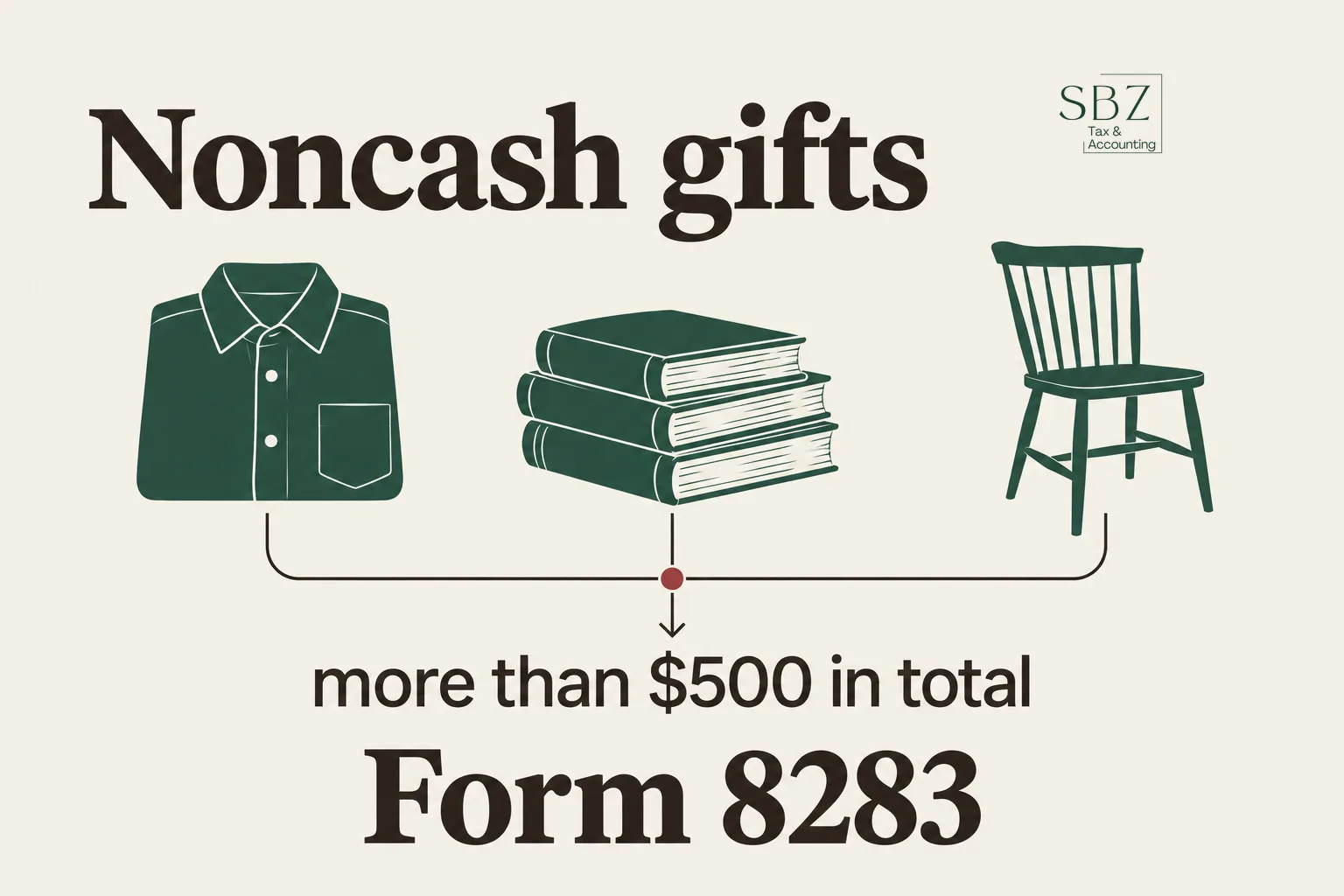
IRS Form 8283 is the form you attach to your tax return to report noncash charitable contributions when your total deduction for those gifts is more than $500. It covers things like clothing, furniture, vehicles, artwork, real estate, and stock, but not cash. The form you need depends on what you gave and what it was worth.
Here's the short version of who files it, which section applies, and where people trip up.
Who has to file IRS Form 8283?
You file Form 8283 if you claim a deduction of more than $500 in total for all noncash gifts made during the year. The $500 test is a combined figure across every donation, not a per-gift threshold. Ten small donations to a thrift store can push you over it.
Because it supports a charitable deduction, the form goes with a return where you itemize on Schedule A. If you take the standard deduction, noncash gifts generally don't change your tax and there's nothing to report. If you're still deciding which route fits, a tax planning conversation before year-end is the cheaper time to look at it.
Businesses file it too. C corporations, partnerships, and S corporations report noncash gifts on Form 8283 under thresholds that differ from the individual rule, so check the current instructions for your entity type.
What counts as a noncash contribution?
Noncash contributions are donations of property rather than money. Common examples:
- Clothing and household goods
- Vehicles, boats, and aircraft
- Publicly traded securities and privately held stock
- Artwork, collectibles, and jewelry
- Real estate and conservation easements
- Business inventory or equipment
Cash, checks, and card payments to a charity go on Schedule A directly. They don't belong on Form 8283.
Section A or Section B: which one do you complete?
The form splits into two sections, and the split comes down mostly to value.
| Section | What goes here |
|---|---|
| Section A | Items or groups of similar items worth $5,000 or less, plus publicly traded securities of any value, and nonpublicly traded stock of $10,000 or less |
| Section B | Items or groups of similar items worth more than $5,000, and nonpublicly traded stock over $10,000 |
"Similar items" is the part people miss. If you gave a charity several pieces of the same kind, such as a set of books or a collection of coins, the IRS looks at them together when deciding whether you cross $5,000. You can't dodge Section B by donating pieces separately in the same year.
What do you need to put on the form?
For Section A, you list each donee organization and its address, a description of what you gave, the date you gave it, and your basis and fair market value. For clothing and household items, you describe the condition. Those items generally need to be in good used condition or better to be deductible, with a narrow exception for a single item over $500 that comes with an appraisal.
Fair market value is what a willing buyer would pay a willing seller for the item in its current condition. A thrift store's resale price is a fair starting point for used goods. Your original cost is not the answer.
For donated vehicles, the charity sends you Form 1098-C, and when you claim more than $500 you attach it to your return. Your deduction is often tied to what the charity actually sold the vehicle for.
When do you need an appraisal?
For Section B, you generally need a qualified appraisal from a qualified appraiser. The appraiser signs Part IV of the form, and the charity signs Part V to acknowledge receipt. You can't complete Section B properly without both signatures.
A few rules decide the details:
- The appraisal generally must be made no earlier than 60 days before the donation and received before the due date of your return, including extensions.
- For a single item or group of similar items over $500,000, you attach the full qualified appraisal to your return.
- Artwork valued at $20,000 or more has its own attachment requirement.
- Publicly traded securities don't need an appraisal because the market price is the value.
If the appraisal is missing or defective, the IRS can disallow the whole deduction, not only the excess. That's why getting the appraiser lined up before the gift matters.
What about the charity's side?
The organization that receives Section B property signs your form, but it isn't off the hook afterward. If it sells or disposes of that property within three years, it files Form 8282 with the IRS and sends you a copy. That matters when your claimed value and the sale price are far apart, because the IRS gets to see both numbers.
Separate from Form 8283, any single gift of $250 or more also needs a written acknowledgment from the charity before you file. Keep it with your records.
How does this connect to your other deductions?
A noncash gift is still limited by your income. Deductions for gifts to public charities are generally capped as a percentage of adjusted gross income, and the cap is different for cash, appreciated property, and gifts to certain private foundations. Excess amounts can usually be carried forward. Current-year percentages and any recent law changes are worth confirming for the tax year you're filing.
Appreciated assets deserve extra thought. Donating stock you've held more than a year can deduct fair market value without recognizing the gain, which is why it comes up in planning ahead of a large sale or liquidity event. Donating business property is different, since depreciation recapture can reduce the deduction, a topic that overlaps with Form 4797 and the sale of business property.
Business owners should also keep gifts apart from ordinary operating costs. Not every gift to a charity is a business expense, as covered in which business expenses are actually tax deductible. If your entity is a partnership, the gift is reported on its Form 1065 and passed through to partners; S corporation owners see the same flow-through, as explained in our overview of S-corp taxes.
What mistakes cause problems?
The common ones are predictable:
- Valuing used goods at what you paid rather than what they're worth now
- Skipping the appraisal on a gift that lands in Section B
- Forgetting to attach Form 1098-C for a vehicle
- Not getting the charity's signature in Part V
- Losing the written acknowledgment
Large or unusual noncash deductions can also draw attention, so thorough records are your protection. Our piece on what triggers an IRS audit for small business owners covers how returns tend to get flagged.
Next step
Before you fill anything in, make a list of every noncash donation for the year with dates, descriptions, and receipts. Total them up. If the total is under $500, you're done; if it's over, sort each item into Section A or Section B and start the appraisal process early for anything that lands in B.
If you want a second set of eyes, SBZ Tax can walk through the numbers with you. You can book a free consultation, call 818-748-2020, or visit the office. This is general information, not tax advice for your specific situation, so talk with a qualified professional before filing.
Frequently asked questions
Do I need Form 8283 for cash donations?
No. Cash, checks, and card gifts are reported on Schedule A directly. Form 8283 is only for property donations when your total noncash deduction exceeds $500.
Does a donation under $500 need Form 8283?
Not if your combined noncash deductions for the year are $500 or less. You still need good records, including a receipt and a description of what you gave.
Is an appraisal required for every donation on Form 8283?
No. Section A items generally don't need an appraisal, and publicly traded securities don't either. Section B property valued over $5,000 usually does, with limited exceptions.
Where do I send Form 8283?
You don't send it separately. It's attached to your income tax return, such as Form 1040, for the year you made the donation.
Can I e-file a return that includes Form 8283?
Yes. Tax software generally handles Form 8283, though a required appraisal or Form 1098-C may need to be attached as a PDF or kept with your records, depending on the item.