On this page
IRS Form 8606: Who Files It, What It Tracks, and How the Pro-Rata Rule Works
IRS Form 8606, Nondeductible IRAs, is the form you file to report after-tax contributions to a traditional IRA, Roth conversions, and certain Roth IRA withdrawals. Its main job is to track your "basis," the money you already paid tax on, so the IRS doesn't tax it a second time. If you do a backdoor Roth or make nondeductible IRA contributions, this form is not optional.
Here's the short version of what it does, when it's required, and where people get tripped up.
Who has to file IRS Form 8606?
You file Form 8606 for any year in which one of these applies:
- You made a nondeductible contribution to a traditional IRA (including the first step of a backdoor Roth).
- You took a distribution from a traditional, SEP, or SIMPLE IRA and have basis from past nondeductible contributions.
- You converted money from a traditional, SEP, or SIMPLE IRA to a Roth IRA.
- You took a distribution from a Roth IRA that isn't a simple return of your own contributions or a qualified distribution reported elsewhere. Check the current instructions for the exceptions.
You don't file it for a deductible traditional IRA contribution or for a regular Roth contribution. If you have no filing requirement but made a nondeductible contribution, you still file Form 8606 on its own with your signature.
What are the three parts of Form 8606?
The form has three sections, and most people only fill out one or two.
Part I covers nondeductible contributions and traditional IRA distributions. It's where you list the year's nondeductible contribution, add the basis you've carried from prior years, and work out how much of any withdrawal is taxable. The total basis you carry forward is the number that matters most over the long run.
Part II covers Roth conversions. It shows the amount you converted, subtracts the basis that's eligible to come out tax-free, and gives you the taxable portion that flows to your Form 1040.
Part III covers distributions from Roth IRAs and figures whether any part is taxable.
The IRS publishes the form and its instructions as a free PDF on irs.gov. Always use the version for the tax year you're filing, since line numbers and limits change.
How does the pro-rata rule work on Form 8606?
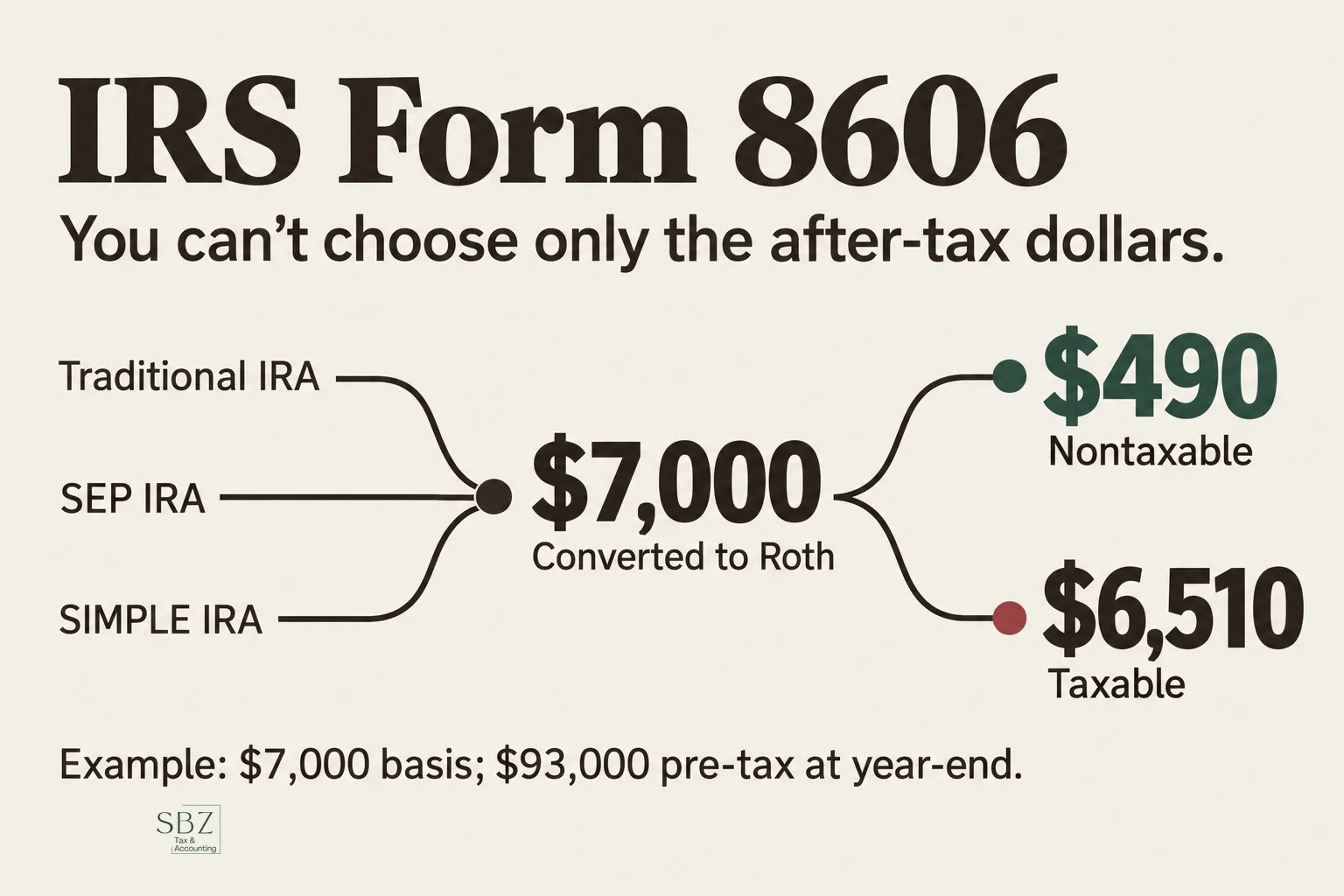
The pro-rata rule says you can't convert only your after-tax dollars. When you convert or withdraw, the IRS treats all of your traditional, SEP, and SIMPLE IRAs as one pot, and the taxable share is based on the balance of that pot on December 31 of the year.
In plain terms, the nontaxable share is your total basis divided by the year-end balance plus whatever you converted or withdrew that year. Here's a simple example:
| Item | Amount |
|---|---|
| Nondeductible contribution this year | $7,000 |
| Other pre-tax IRA balance on Dec. 31 | $93,000 |
| Amount converted to Roth | $7,000 |
| Nontaxable share (7,000 ÷ 100,000) | 7% |
| Nontaxable part of the conversion | $490 |
| Taxable part of the conversion | $6,510 |
The remaining $6,510 of basis stays on the form and carries to next year. Compare that with someone who has no other IRA money: the same $7,000 conversion is almost entirely nontaxable, because nearly all of the pot is after-tax money.
This is why the backdoor Roth works cleanly for some people and creates a surprise tax bill for others. The year-end balance of every pre-tax IRA you own is what drives the result, not the balance at the moment you convert.
What's the penalty for not filing Form 8606?
The penalty for failing to file Form 8606 when it's required is $50 per missed form. Overstating your nondeductible contributions on the form carries a separate $100 penalty. Either can be waived if you show reasonable cause.
The penalty isn't the real cost. Without a Form 8606 on file, the IRS has no record of your basis, and you can end up paying tax on the same dollars twice when you eventually withdraw. Prior-year forms can generally still be filed late, and you may need an amended return if a missing form changed what you reported. If you've fallen behind on several years, our guide on what to do after missing a tax filing deadline covers the order to tackle things.
When and where do you file Form 8606?
Form 8606 attaches to your Form 1040 for the year of the contribution, conversion, or distribution, and it's due when your return is due, including extensions. Married couples each file their own, since IRAs belong to individuals.
A nondeductible contribution for a given year can be made up to the original filing deadline, generally April 15 of the following year, without extensions. Contribution limits change over time. For 2025 the IRA limit is $7,000, or $8,000 if you're 50 or older, so check the current figure before you contribute.
The financial institution sends you a Form 5498 showing contributions and a Form 1099-R showing conversions and distributions. Use those to fill in the form, but don't rely on them to track basis. The custodian doesn't know what you've deducted or contributed elsewhere.
What should you keep track of year to year?
Basis follows you until it's used up, which can be decades. A few habits make that manageable:
- Keep every filed Form 8606, not just the latest one.
- Make sure last year's ending basis matches this year's starting basis.
- Check your year-end IRA balances across all custodians before you convert.
- Remember that a Roth conversion adds taxable income, which can affect estimated tax payments and other income-based thresholds.
Self-employed taxpayers should also keep their IRA planning consistent with what shows up on Schedule C, since deductible retirement contributions and nondeductible ones can end up in the same year. This is the type of coordination that fits under broader tax planning.
Frequently asked questions
Do I need Form 8606 for a backdoor Roth IRA?
Yes. The nondeductible contribution goes in Part I and the conversion goes in Part II. Skipping it can make the conversion look fully taxable.
Can I file Form 8606 late?
Generally yes. You can file missing forms for earlier years, and the $50 penalty may be waived for reasonable cause. If a missed form already led to an IRS notice, IRS tax problem help may be the right starting point.
Does Form 8606 go with my tax return or get mailed separately?
It attaches to your Form 1040. Only if you have no return to file do you send it alone, signed, to the IRS.
Can tax software complete Form 8606 correctly?
Most programs can, if you enter the prior-year basis and the December 31 balances accurately. The form is only as good as those inputs, so verify them against your statements.
What's the next step?
If you've made nondeductible IRA contributions, pull your past returns and confirm a Form 8606 exists for each year. Then gather your December 31 balances for every traditional, SEP, and SIMPLE IRA before you plan any conversion.
SBZ Tax works with individuals and business owners on retirement account reporting and conversion planning, remotely nationwide or in person at our Palmdale office. You can book a free consultation, see pricing, or call 818-748-2020 or visit us at 190 Sierra Ct Ste 335, Palmdale, CA 93550.
This article is general information, not tax advice for your specific situation. Rules and limits change, so talk to a qualified tax professional before acting.