On this page
- Who has to file IRS Form 8594?
- What is the residual method and why does it matter?
- What are the seven asset classes on Form 8594?
- How do you fill out Form 8594 step by step?
- Where do you file Form 8594, and when?
- What happens if you skip it or the numbers don't match?
- What should you do before the deal closes?
- Frequently asked questions
- Related reading
IRS Form 8594: How the Asset Acquisition Statement Works and Who Files It
IRS Form 8594, the Asset Acquisition Statement Under Section 1060, is the form both the buyer and the seller of a business attach to their tax returns to show how the purchase price was divided among the assets that changed hands. It applies when a group of assets that makes up a trade or business is sold and goodwill or going concern value could attach to it. The allocation matters because it drives how much of the sale is taxed as ordinary income, how much as capital gain, and how fast the buyer can recover the cost.
Who has to file IRS Form 8594?
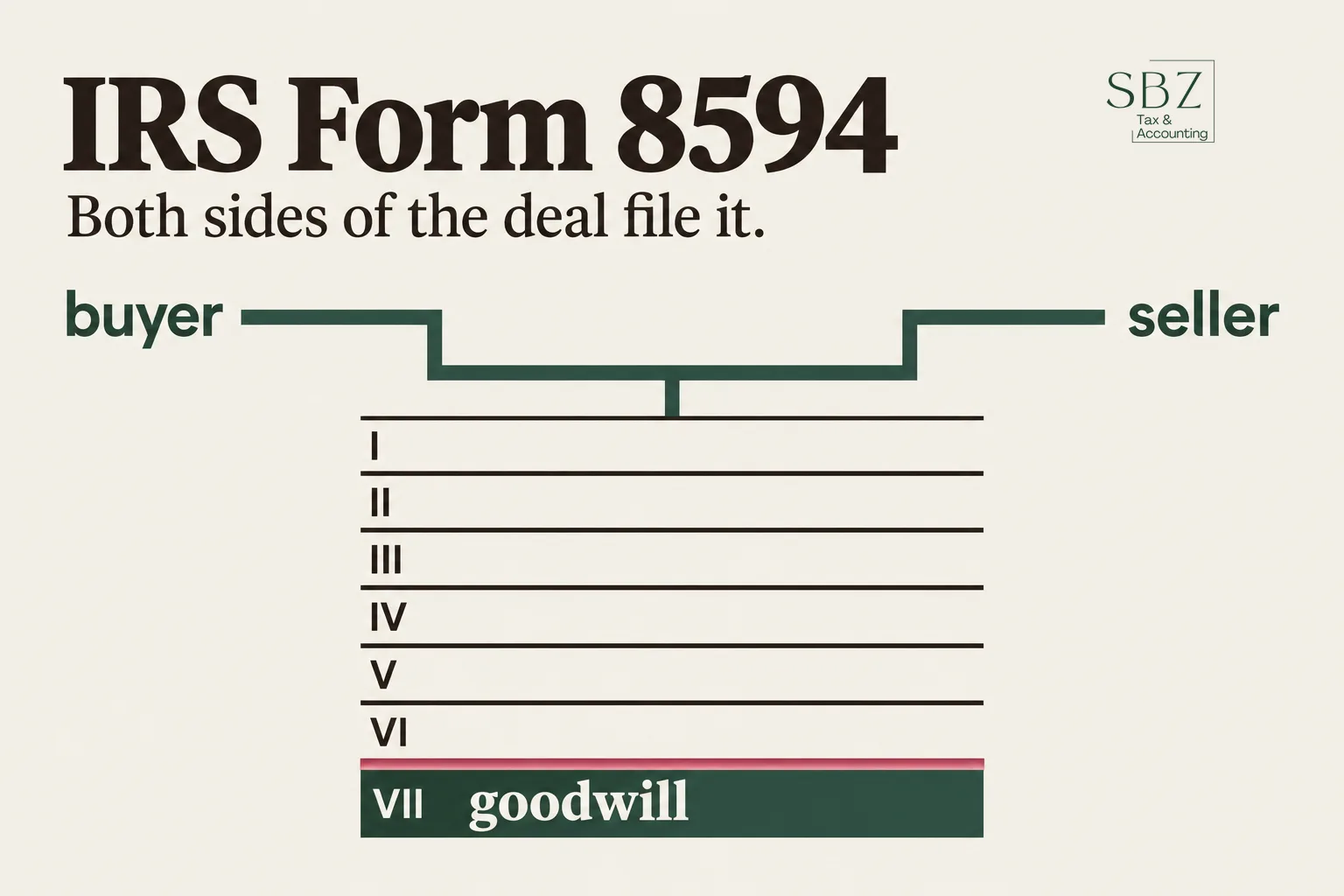
Both sides of the deal file it. Under Section 1060 of the Internal Revenue Code, if you buy or sell a group of assets that constitutes a trade or business, and the buyer's basis in those assets is determined only by the purchase price, each party reports the allocation on Form 8594.
A "group of assets" counts as a trade or business if goodwill or going concern value could attach to it under the circumstances. In plain terms, that covers selling a restaurant, a salon, a consulting practice, a rental operation, or a retail shop with its equipment, inventory, customer list, and name.
It generally does not apply to selling stock in a corporation, because the buyer is acquiring shares, not the underlying assets. It also doesn't apply to selling a single asset, such as one piece of equipment. Special rules apply to some structures, such as a Section 338 election, which uses a different form, so confirm which one fits your deal.
What is the residual method and why does it matter?
The residual method is the allocation system Form 8594 is built around. You start with the total consideration, then assign it to seven classes of assets in a fixed order, giving each class up to its fair market value before moving on to the next. Whatever is left over lands in the last class, which is goodwill and going concern value.
This is where the tax effect lives. Sellers usually prefer more of the price to land in classes taxed at capital gain rates, while buyers usually prefer more to land in assets they can depreciate or amortize quickly. Because the two interests pull against each other, the sales contract often includes an agreed allocation, and the IRS expects both parties' forms to match.
What are the seven asset classes on Form 8594?
| Class | What's in it |
|---|---|
| I | Cash and general deposit accounts (not CDs) |
| II | Actively traded personal property, CDs, foreign currency, U.S. government securities, publicly traded stock |
| III | Assets marked to market at least annually, and debt instruments including accounts receivable |
| IV | Inventory and stock in trade |
| V | All other assets, such as equipment, furniture, vehicles, buildings, and land |
| VI | Section 197 intangibles other than goodwill and going concern value (for example, customer lists, licenses, and covenants not to compete) |
| VII | Goodwill and going concern value |
Classes I through VI take their fair market value first. Class VII gets the remainder. In many small-business sales, Class VII is the largest number on the form.
How do you fill out Form 8594 step by step?
The form is short, but the numbers underneath it take work. The IRS publishes it for free, and you can find the form and its instructions on IRS.gov. Here is the general flow.
- Part I, general information. Enter the names, addresses, and taxpayer identification numbers of both parties, the date of sale, and the total sales price. Indicate whether you are the purchaser or the seller.
- Part II, original statement. For each asset class, report the aggregate fair market value and the portion of the sales price allocated to it. The allocated amounts across all classes should add up to the total price.
- Written allocation question. The form asks whether the parties agreed to an allocation in the contract or another signed document. If they did, that allocation generally binds both parties unless the IRS finds it isn't appropriate.
- Part III, supplemental statement. If the purchase price later changes, for example through an earnout or a price adjustment, you report the change on a supplemental statement filed for the year the change occurs.
If a covenant not to compete or a consulting agreement was part of the deal, the form has a place to report it. Those amounts are treated differently for each side, so get the contract language right before you file.
Where do you file Form 8594, and when?
You attach it to your income tax return for the year the sale took place. That could be a Form 1040 with a Schedule C, a Form 1120-S for an S corporation, a Form 1065 for a partnership, or a corporate return. If you file for a business tax extension, the form travels with the extended return.
The seller also reports the gain on the related returns and schedules. Selling business property commonly involves Form 4797, and it can involve Schedule D as well. The two forms need to tell the same story, because mismatched figures are a common reason for IRS correspondence.
What happens if you skip it or the numbers don't match?
Failing to file a correct Form 8594 can lead to penalties, and a mismatch between the buyer's and seller's forms can invite questions. An agreed allocation in the contract helps, but it isn't a guarantee that the IRS will accept it.
If you already filed without the form, don't ignore it. A correction is usually easier to handle before a notice arrives. If you've received one, IRS and state tax problem help can walk you through the response. Sellers who are also thinking about timing and structure may find our piece on tax planning before a liquidity event useful, since the best time to shape an allocation is before the contract is signed.
What should you do before the deal closes?
Run the allocation as a modeling exercise before you sign. Decide how the purchase price might be split, estimate the tax result for each scenario, and negotiate the allocation schedule into the purchase agreement. Use a real appraisal or a documented basis for fair market values, especially for equipment and intangibles.
Also consider how the business is structured on each side. An entity's classification, such as an S-corp election or an entity classification election, affects who reports what. If you're a partnership, the Form 1065 side of the sale has its own mechanics. Our tax planning services and S-corp and business tax services cover this kind of transaction work, and clean books make the allocation far easier, which is where monthly bookkeeping helps.
This article is general information, not tax advice for your specific situation. Business sale allocations can change your tax result significantly, so talk to a qualified tax professional before you sign.
If you'd like a second set of eyes on a sale or purchase, book a free consultation, call SBZ Tax at 818-748-2020, or visit the office at 190 Sierra Ct Ste 335, Palmdale, CA 93550. We also work with business owners remotely across the U.S.
Frequently asked questions
Do both the buyer and the seller have to file IRS Form 8594?
Yes. Each party attaches its own Form 8594 to its income tax return for the year of the sale. The allocations on the two forms are expected to be consistent.
Is there a deadline for filing IRS Form 8594?
It is filed with your income tax return for the year of the sale, so the due date is the return's due date, including any valid extension. A supplemental statement is filed for the year a purchase price adjustment occurs.
Do I file Form 8594 when I sell stock in my corporation?
Generally not, because a stock sale doesn't transfer the underlying assets. Form 8594 is aimed at asset sales that make up a trade or business, though certain elections can change which form applies.
Where can I get the IRS Form 8594 PDF and instructions?
The IRS posts both the form and its instructions on IRS.gov at no cost. Read the instructions for the current revision before you fill it out.
What if the purchase price changes after the sale?
Report the change on Part III, the supplemental statement, for the tax year in which the increase or decrease takes place. Earnouts and contingent payments are common reasons for this.