On this page
- What is IRS Form 3115 used for?
- What counts as an accounting method, and what doesn't?
- What is the difference between automatic and non-automatic changes?
- What is a Section 481(a) adjustment?
- How does Form 3115 apply to depreciation?
- Who needs to be careful about filing it?
- How do you actually file Form 3115?
- What should you do next?
- Frequently asked questions
- Related reading
- Related reading
IRS Form 3115: What It Is, Who Needs It, and How a Change in Accounting Method Works
IRS Form 3115, Application for Change in Accounting Method, is the form a taxpayer files to get IRS consent to change how they report income or deductions. A business generally cannot just switch methods on its own return. Section 446(e) of the Internal Revenue Code requires IRS approval first, and Form 3115 is how you ask for it.
Here's the short version of who uses it, what it does, and where people get tripped up.
What is IRS Form 3115 used for?
Form 3115 is used for a change in accounting method, meaning the timing rules you use to report income and deductions. It applies to individuals with a Schedule C business, partnerships, S corporations, C corporations, trusts, and estates.
Common examples of method changes:
- Cash method to accrual method, or the reverse
- Changing how inventory is valued or how costs are capitalized
- Correcting an impermissible depreciation method to a permissible one
- Changing how repairs versus capital improvements are treated
- Changing the treatment of a specific item, such as prepaid expenses or advance payments
The common thread is timing. A method change doesn't alter whether something is ever taxed or deducted. It changes the year it's reported.
What counts as an accounting method, and what doesn't?
An accounting method is a consistent practice for treating an item, such as deducting a type of cost when paid versus capitalizing and depreciating it. In plain terms, if you've handled the same item the same way on two or more filed returns, you've probably adopted a method, even if it was the wrong one.
A math or posting error is different. A transposed number or a clerical mistake isn't a method, and you correct it with an amended return. For that route, see our guide to Form 1040-X.
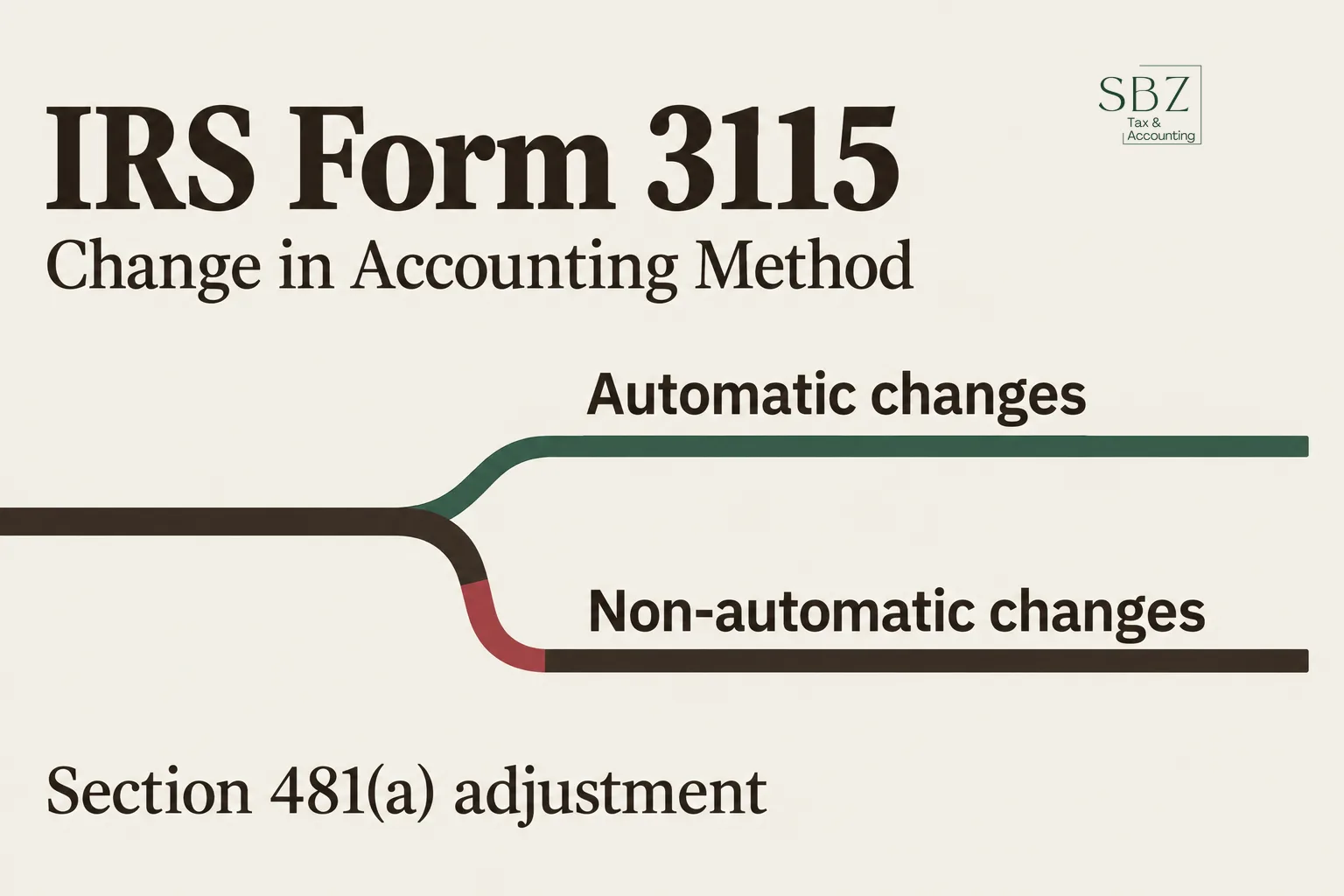
What is the difference between automatic and non-automatic changes?
The IRS splits method changes into two tracks, and the track determines the process.
Automatic changes are listed in the IRS's published revenue procedure on automatic accounting method changes. If your change appears on that list and you meet the eligibility conditions, you don't need to wait for approval. You attach the form to a timely filed return (including extensions) for the year of change and send a copy to the IRS at the address in the form instructions. There is generally no user fee.
Non-automatic changes apply when the change isn't on the automatic list. These go to the IRS national office for a ruling, generally must be filed during the year of change, and carry a user fee. They take longer, and the IRS may ask questions or propose terms.
Which list a change falls under, and the revenue procedure that governs it, gets updated periodically. Check the current instructions and revision of the form on IRS.gov before filing.
What is a Section 481(a) adjustment?
A Section 481(a) adjustment is the catch-up amount that prevents income or deductions from being duplicated or skipped when you change methods. It's calculated as of the start of the year of change, and it appears on Form 3115.
The direction matters:
| Adjustment | Meaning | General treatment |
|---|---|---|
| Positive | The change increases income | Often spread over four tax years |
| Negative | The change decreases income | Often taken entirely in the year of change |
The exact treatment depends on the specific change and the governing procedure, so the numbers should be worked out carefully before filing.
How does Form 3115 apply to depreciation?
Depreciation is one of the most common reasons people search for this form. If a business has been claiming depreciation incorrectly for two or more years, for example using the wrong recovery period or never claiming it at all, the fix is usually a method change rather than an amended return.
The key concept is "allowed or allowable." The IRS treats depreciation as having reduced your basis whether or not you actually claimed it. A Form 3115 lets you recover the missed deductions in the year of change through a negative Section 481(a) adjustment, rather than losing them.
Form 3115 also comes up with cost segregation studies on real property, where a study reclassifies parts of a building into shorter recovery periods. The catch-up depreciation from a study on a building already in service is commonly claimed through a method change. If you're evaluating asset write-offs generally, our explainer on the Section 179 deduction covers a related set of rules, and Form 4797 matters when the property is later sold.
Who needs to be careful about filing it?
A few situations deserve extra attention:
- Entity changes. Changing your tax classification is a different filing. See Form 8832 or Form 2553 for those elections.
- Cash versus accrual. Some small businesses may qualify to use the cash method based on a gross receipts test. Whether you qualify, and what happens if you cross the threshold, is worth confirming with a professional.
- Sole proprietors. Even a simple Schedule C business can need a method change if, for instance, inventory or depreciation was handled inconsistently.
- Recent exams. Some eligibility rules limit automatic changes if a method is already under IRS exam.
Changing a method without filing the form can create trouble if the IRS finds it later. An examiner can impose the change and adjust prior years. If you're already dealing with a notice, see our page on IRS and state tax problem help.
How do you actually file Form 3115?
In general terms, the process looks like this:
- Identify the exact method and the correct designated change number or ruling category.
- Confirm you're eligible for the automatic track, or prepare a non-automatic request.
- Compute the Section 481(a) adjustment from your books as of the start of the year of change.
- Complete the form, have it signed, and attach it to your timely filed original return, including extensions.
- Send the required copy to the IRS address in the instructions.
Clean records make every step easier. If your books aren't reliable, consider fixing that first with consistent monthly bookkeeping. The forms are only as good as the numbers behind them, and a tax planning conversation before year-end is usually when a method change makes the most sense. If you're filing on extension, Form 7004 explains what an extension does and doesn't cover.
What should you do next?
If you suspect you've been using the wrong method, don't change it on this year's return. Gather your prior two or three returns, your depreciation schedules, and a description of how the item has been treated. Then decide whether it's an error to amend or a method to change with Form 3115. A professional can help with that call, and you can book a free consultation with SBZ Tax, call 818-748-2020, or visit our walk-in office. We work with small-business owners and individuals nationwide.
This article is general information, not tax advice for your specific situation. Talk to a qualified tax professional before changing an accounting method.
Frequently asked questions
Is IRS Form 3115 the same as an amended return?
No. An amended return fixes an error on a past return. Form 3115 asks for permission to change a method going forward and handles the catch-up through the Section 481(a) adjustment on the current return.
Do I have to file Form 3115 to change my depreciation method?
Usually, yes, if the existing treatment is a consistent method used for two or more returns. A one-time math error is typically fixed by amending instead.
Is there a fee to file Form 3115?
Automatic changes generally have no user fee. Non-automatic requests do, and the amount changes periodically, so check the current IRS figure before filing.
Where can I find the Form 3115 PDF and instructions?
Both are on IRS.gov. Use the current revision of the form and the matching instructions, since the revision date and procedures change over time.
Can a sole proprietor file Form 3115?
Yes. Any taxpayer with an accounting method, including an individual with a Schedule C business, can file it when a method change is needed.