On this page
- What is Form 8832 used for?
- Does an LLC need to file Form 8832 to be an S corporation?
- When would you file Form 8832 instead of Form 2553?
- What information goes on the form?
- What effective date can you choose?
- What if you filed late?
- Can you change your mind after filing?
- Where and how do you file it?
- What changes after the election takes effect?
- What's a sensible next step?
- Frequently asked questions
- Related reading
IRS Form 8832: What the Entity Classification Election Does and Who Needs to File It
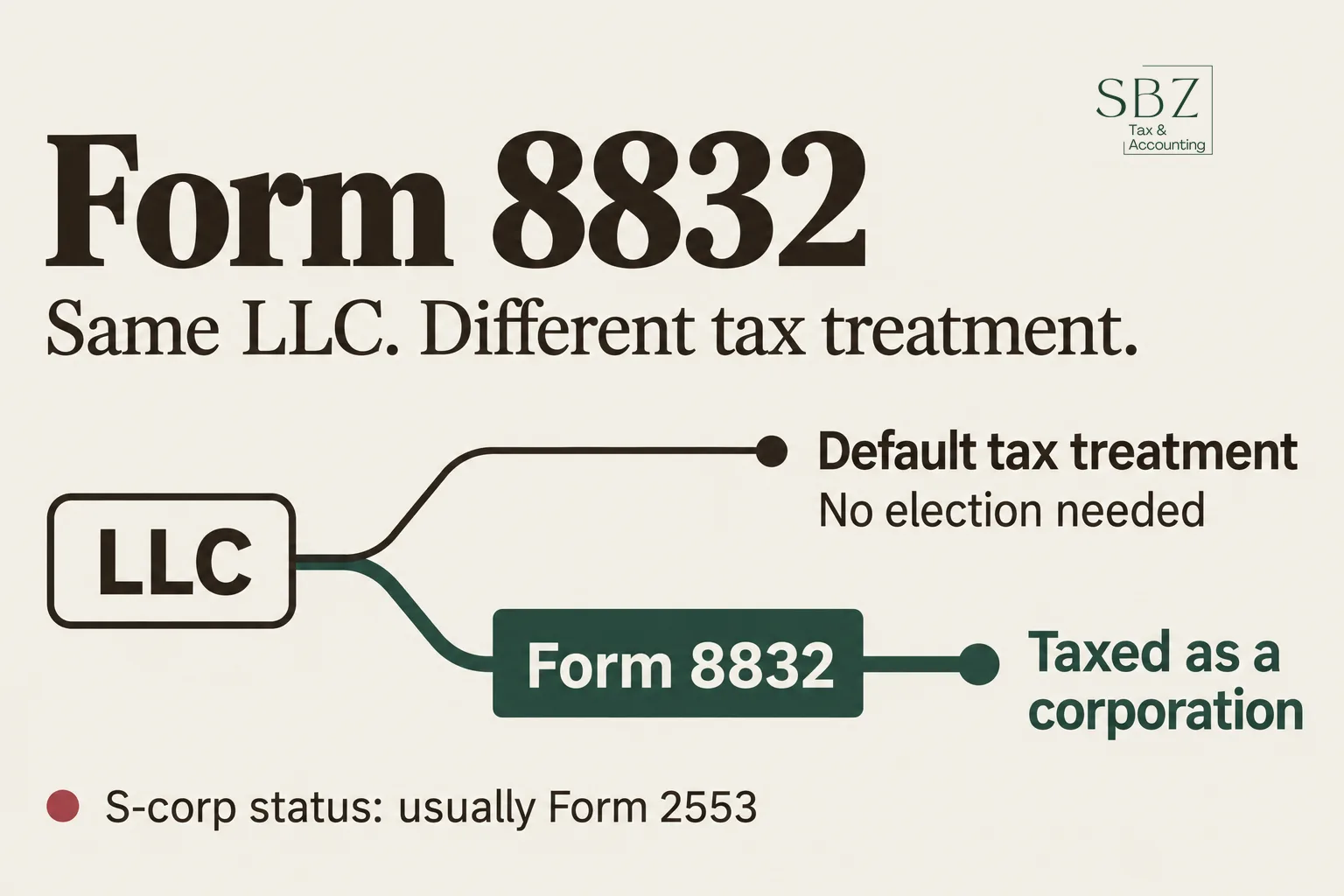
IRS Form 8832, Entity Classification Election, is the form an eligible business entity, most often an LLC, files to tell the IRS how it wants to be taxed: as a corporation, a partnership, or an entity disregarded from its owner. If you are happy with your entity's default tax treatment, you don't file it at all.
Plenty of LLC owners hear "file an 8832" from a formation service or a friend without knowing what it changes. Here's the short version of what it does, when it's required, and when a different form does the same job.
What is Form 8832 used for?
Form 8832 lets an "eligible entity" choose its federal tax classification instead of accepting the default. An eligible entity is generally a business that is not already a corporation under the IRS rules. An LLC is the typical example.
Without an election, the IRS applies these defaults to a domestic LLC:
| Number of owners | Default tax classification |
|---|---|
| One | Disregarded entity (reported on the owner's return, such as Schedule C) |
| Two or more | Partnership (Form 1065) |
Filing Form 8832 overrides the default. The most common reason is to have an LLC taxed as a corporation. A single-member LLC can also use it to move from disregarded status to corporate status, and an LLC already taxed as a corporation can use it to change back.
Does an LLC need to file Form 8832 to be an S corporation?
Usually not. An LLC that files Form 2553 to elect S-corp status is treated as having elected to be classified as an association taxable as a corporation, effective the same date. That deemed election means you generally don't need a separate 8832 for the S-corp route.
This is the part people miss. Filing both is common, and it isn't automatically harmful, but it is often unnecessary. If the dates don't line up, an earlier 8832 effective date can create a stretch of time where the company is taxed as a regular C corporation before the S election begins.
Whether S-corp status makes sense at all depends on profit, payroll, and state rules. Our breakdown of S-corp vs LLC tax differences covers the trade-offs, and how to form an S-corp in California walks through the formation side.
When would you file Form 8832 instead of Form 2553?
You'd file Form 8832 when you want corporate classification without an S election, or when you want to control the order of the two steps. Examples include:
- An LLC that wants to be taxed as a C corporation.
- An LLC that wants corporate status first and plans to make an S election later.
- A multi-member LLC or a single-member LLC changing its classification for other planning reasons.
- An entity that needs to change classification from an association back to a partnership or disregarded entity.
A business formed as a state-law corporation (an "Inc.") is already a corporation for federal purposes and doesn't use Form 8832 to become one. If it wants S status, it files Form 2553 directly.
What information goes on the form?
The form is short, but each field matters. You'll need:
- The entity's name, address, and EIN. An entity with a classification election needs its own EIN, even a single-member LLC that would otherwise use its owner's information.
- Whether this is an initial classification by a newly formed entity or a change in current classification.
- The classification you're electing.
- The effective date of the election.
- Signatures from each member who is an owner at the time of filing, or from an officer, manager, or member authorized to sign for all of them.
Download the current Form 8832 and its instructions as a free PDF from IRS.gov. Use the current revision, because the IRS updates forms and addresses.
What effective date can you choose?
The election can take effect no more than 75 days before the date you file and no more than 12 months after it. If you leave the date blank, the IRS generally treats the election as effective on the date you file.
That 75-day lookback is why timing matters. Filing in March and asking for a January 1 effective date is fine. Filing in June and asking for a January 1 date is not, and the election would normally take effect later than you intended.
What if you filed late?
The IRS offers late-election relief under Rev. Proc. 2009-41. It is generally available when you meet the requirements, including having reasonable cause for missing the deadline and filing within three years and 75 days of the requested effective date. The details are specific, so check the current instructions or ask a professional before relying on it.
Can you change your mind after filing?
Not freely. After you make an election to change classification, you generally cannot change it again for 60 months. There are narrow exceptions, such as an election made by a newly formed entity or certain ownership changes with IRS approval.
This is why the election deserves some thought before you sign. Swapping back and forth because the first choice felt wrong is not an option in most cases.
Where and how do you file it?
Form 8832 is filed with the IRS service center listed in the form instructions. Check the instructions for the current address, because it depends on where your business is located. You can also attach a copy to your federal return for the year of the election, but only if you've actually filed the form with the IRS first. A copy attached to a return does not replace the filing.
Keep proof of mailing, and a copy of what you sent. The IRS generally sends a written acknowledgment, but processing can take a while, so don't assume silence means approval. If a notice never arrives, a follow-up is reasonable.
What changes after the election takes effect?
A corporate election changes how the business is reported and taxed. An LLC taxed as a corporation typically files Form 1120 (or 1120-S if it also has an S election) and may need to run payroll for owner-employees. Owners who work in the business and also hold S status have to think about reasonable salary and how to pay themselves.
State rules are separate. A federal election doesn't remove state obligations such as a California LLC's annual franchise tax. Clean books also matter more once you're a corporation, which is where steady bookkeeping pays off.
What's a sensible next step?
Before filing, confirm your current default classification, decide whether you actually want C-corp or S-corp treatment, and check that the effective date falls inside the 75-day and 12-month window. Then map the election against your tax situation for the year. Tax planning is a better time to work through that than after the form is in the mail.
SBZ Tax works with LLC and S-corp owners nationwide, and you can look at our S-corp and business tax services or book a free consultation. You can also call 818-748-2020 or visit the office at 190 Sierra Ct Ste 335, Palmdale, CA 93550.
This article is general information, not tax advice for your specific situation. Talk to a qualified tax professional before making an entity election.
Frequently asked questions
Is Form 8832 the same as Form 2553?
No. Form 8832 chooses an entity's classification (corporation, partnership, or disregarded). Form 2553 elects S-corporation status. An LLC that files a timely Form 2553 is generally treated as having elected corporate classification at the same time.
Can I e-file Form 8832?
The IRS has traditionally required Form 8832 to be filed on paper, by mail or fax as the instructions direct. Check the current instructions, since filing options can change.
Is there a fee to file Form 8832?
The IRS does not charge a user fee for filing the form itself. Formation companies and preparers may charge for preparing it, so confirm the cost up front.
Does a single-member LLC need Form 8832?
Only if the owner wants the LLC taxed as a corporation. By default, a single-member LLC is disregarded and reports on the owner's return.
What happens if I never filed Form 8832?
Your entity is simply taxed under its default classification, which is usually fine. Trouble arises when the business has been reporting as a corporation without a valid election, in which case it's worth reviewing with a professional, and IRS problem help is available if notices have already arrived.