On this page
- What is IRS Form 2441 used for?
- Who qualifies for the child and dependent care credit?
- Which expenses count?
- How is the credit calculated?
- What does Part III cover if my employer offers dependent care benefits?
- How do I fill out Form 2441?
- What if I paid a nanny directly?
- Does self-employment income count?
- How does this fit with other credits and forms?
- Next step
- Frequently asked questions
- Related reading
- Related reading
IRS Form 2441: How the Child and Dependent Care Credit Works (2025 Instructions)
IRS Form 2441, Child and Dependent Care Expenses, is the form you attach to your Form 1040 to claim a tax credit for what you paid someone to care for a child or dependent so you could work or look for work. It also reports any dependent care benefits your employer gave you. Here is who can use it, what counts, and how the numbers come together.
What is IRS Form 2441 used for?
The form does two jobs. Parts I and II calculate the child and dependent care credit. Part III reports employer-provided dependent care benefits, such as a dependent care flexible spending account (FSA), and works out how much of that money is tax-free.
You file one Form 2441 whether you use one part or both. The credit it produces carries to Schedule 3 of Form 1040, where it reduces your tax.
The credit is nonrefundable. It can bring your tax bill to zero, but it will not generate a refund beyond what you already owe.
Who qualifies for the child and dependent care credit?
You need to meet four tests. Here is the short version:
- You paid for care so you could work or look for work. Care while you were at a job, running your business, or actively job hunting counts.
- The care was for a qualifying person. That is a child under 13 when the care was provided, or a spouse or dependent of any age who could not care for themselves and lived with you for more than half the year.
- You (and your spouse, if filing jointly) had earned income. Wages and net self-employment income count. Investment income and unemployment benefits do not.
- You gave the provider's information. Form 2441 requires the care provider's name, address, and taxpayer identification number.
Married couples filing separately generally cannot claim the credit, with a narrow exception for certain spouses who lived apart. If one spouse was a full-time student or unable to care for themselves, the IRS treats them as having a small amount of earned income each month so the other spouse can still qualify.
Which expenses count?
Care costs count when they let you work. Common examples are a daycare center, a nanny or babysitter, before- and after-school programs, and day camps. Care for an older relative who cannot be left alone, such as an adult day program or in-home aide, can also count.
The part people miss is what does not qualify:
- Overnight camps
- Tuition for kindergarten and above
- Payments to your spouse, to the child's parent, or to your own child under 19
- Expenses for the child's food, clothing, or entertainment when billed separately from care
If a provider bills care and schooling together, only the care portion counts. Ask for an itemized statement.
How is the credit calculated?
You apply a percentage to your eligible expenses, and both the expenses and the percentage are capped. For 2025 returns, the maximum expenses are:
| Qualifying persons | Expense cap |
|---|---|
| One | $3,000 |
| Two or more | $6,000 |
Your eligible amount is also limited to the lower of your earned income or your spouse's earned income. The credit percentage then depends on your adjusted gross income (AGI). It starts at 35% for an AGI of $15,000 or less and steps down by one point for each additional $2,000 of AGI, bottoming out at 20% for an AGI above $43,000.
In plain terms, here is how that looks. Say a family with an AGI of $80,000 paid $8,000 for after-school care for two children. The cap limits eligible expenses to $6,000, and 20% of that is a $1,200 credit.
Legislation signed in 2025 raises the credit percentages starting with tax year 2026, with a higher top rate for lower-income filers, and raises the dependent care FSA limit. Those changes apply to returns filed next year, not to a 2025 return. Check the current instructions for the year you are filing.
What does Part III cover if my employer offers dependent care benefits?
If your W-2 shows an amount in box 10, your employer paid for or reimbursed your dependent care, often through an FSA. Up to $5,000 of those benefits is generally excluded from income for 2025 ($2,500 if married filing separately).
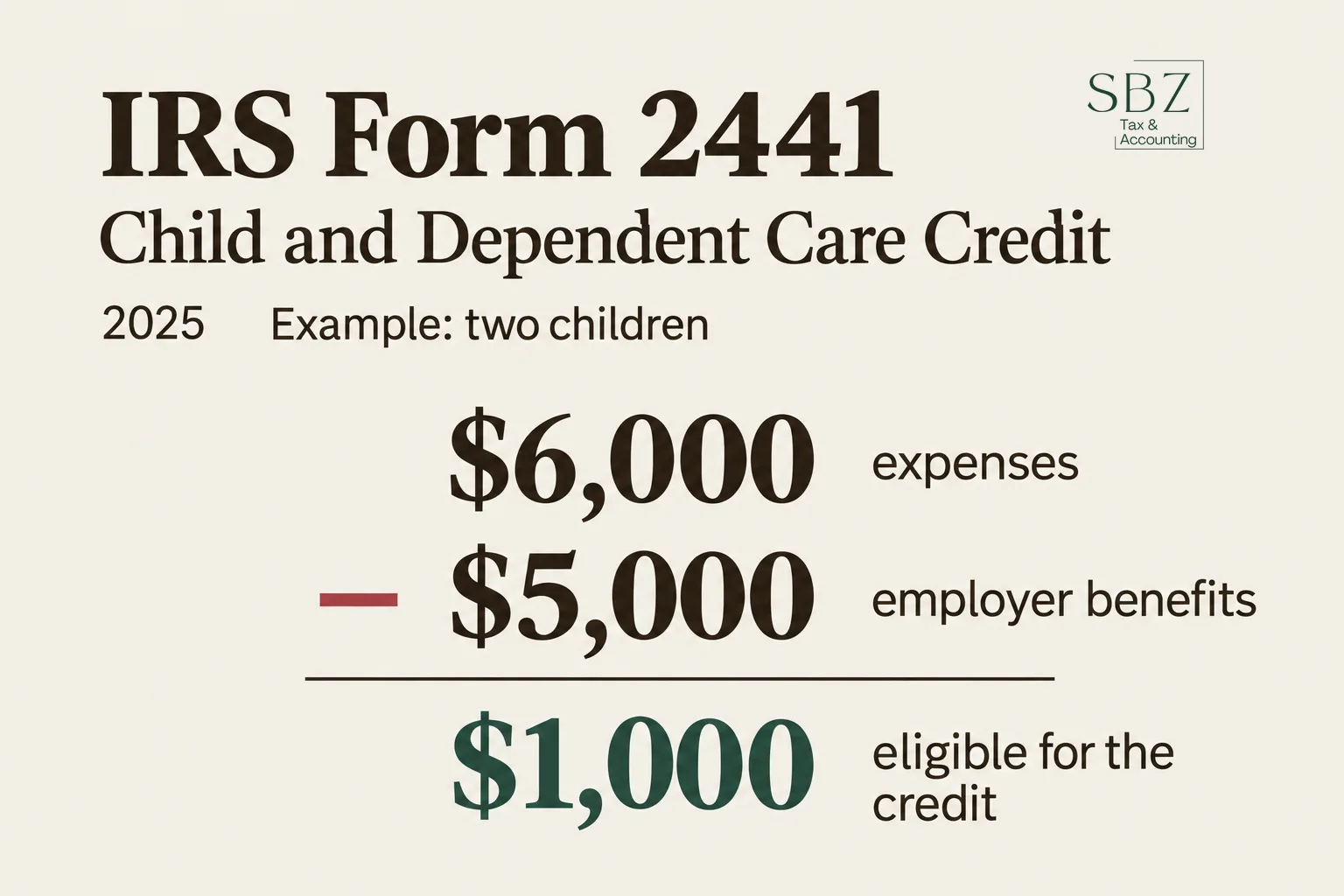
Part III figures how much of the benefit is tax-free and whether any is taxable. It also changes your credit, because money you already excluded cannot be counted twice. If you have two children, $6,000 in expenses, and $5,000 of employer benefits, only $1,000 remains eligible for the credit.
How do I fill out Form 2441?
The form is straightforward if you gather the right records first. The order that works:
- Collect provider details. You need each provider's name, address, and SSN or EIN. Form W-10, which you can ask a provider to complete, is designed for this.
- Total what you paid in 2025. Use payments made for care during the year, not what was billed.
- List your qualifying persons. Enter their names and Social Security numbers, and note the amount of care expenses for each.
- Complete Part III first if you have employer benefits. It reduces the expenses you can use in Part II.
- Calculate the credit and carry it to Schedule 3. The result flows to Form 1040 through Schedule 3.
Tax software will walk you through these steps. The common errors are a missing provider TIN, claiming expenses that exceed what you actually paid, and forgetting to reduce eligible expenses by FSA benefits.
What if I paid a nanny directly?
If you hire someone who works in your home and you control how the work is done, the IRS may treat them as your household employee. That can mean withholding and paying employment taxes, reported on Schedule H. This is separate from the credit, but the wages you pay can still be claimed as care expenses on Form 2441.
The same classification question comes up in business settings. Our guide on whether you need to send 1099s to contractors covers how worker status works there.
Does self-employment income count?
Yes. If you run a business and report net profit on Schedule C, that net earnings figure counts as earned income for the credit. A loss does not count as earned income, so a business that lost money in 2025 can reduce or eliminate the amount you can use.
Self-employed filers also tend to make quarterly estimated payments, and a credit like this one can reduce what you owe at filing. It does not change what you owed during the year, so planning ahead matters. A tax planning conversation before year-end is a better time to confirm your records than the week you file.
How does this fit with other credits and forms?
Form 2441 sits alongside other family-related tax items. If you have an HSA, that is reported on Form 8889. If you or a dependent paid for college, the 1098-T and education credits work separately. If your income is modest, you may also be eligible for the California earned income tax credit at the state level. Each credit has its own rules, so qualifying for one does not decide the others.
Next step
Before you file, gather each provider's name, address, and TIN, a year-end total of what you paid, and your W-2 box 10 amount. If your situation includes self-employment income, an employer FSA, or a care arrangement that might make you a household employer, it is worth having a second set of eyes on the return. SBZ Tax works with individuals and small business owners across the U.S., and you can see how that works on the pricing page or book a free consultation. You can also call 818-748-2020 or visit the office.
This is general information, not tax advice for your specific situation. Talk to a qualified tax professional about your circumstances.
Frequently asked questions
Can I claim Form 2441 if I paid a family member for childcare?
Often yes, with limits. You cannot count payments to your spouse, your child under 19, or anyone you claim as a dependent. Payments to a relative such as a grandparent can qualify if they are not your dependent, and you will need their SSN.
Is the child and dependent care credit refundable?
No. It is a nonrefundable credit, so it can reduce your tax to zero but will not produce a refund beyond that. If your tax liability is small, you may not be able to use the full credit.
Do I need to file Form 2441 if I only have a dependent care FSA?
Yes. If your employer reported dependent care benefits in box 10 of your W-2, you complete Part III of Form 2441, even if you are not claiming the credit.
What is the maximum credit I can get on Form 2441 for 2025?
For 2025, the maximum credit is $1,050 for one qualifying person (35% of $3,000) and $2,100 for two or more (35% of $6,000). Most families receive less, because the percentage drops as AGI rises.
Can I file Form 2441 after the deadline?
Generally yes. You can claim the credit on an amended return if you missed it, usually within three years of the original filing date. If you are behind on filing, see our guide on what to do after missing the tax filing deadline.