On this page
- What Does Form 1098-T Actually Show?
- Which Tax Credits Use This Form?
- How Do You Actually Claim the Education Credit?
- What If the Numbers Don't Match What You Actually Paid?
- Who Claims the Credit — Student or Parent?
- What About Employer Tuition Assistance?
- A Note on Graduate Fellowships
- Frequently Asked Questions
What Is the Tuition Tax Form? Your 1098-T and Education Credits Explained
The tuition tax form is Form 1098-T — an informational document your college or university sends each January showing tuition and fees paid during the previous calendar year. It's the starting point for claiming education tax credits on your federal return, not the final number you'll plug straight into your software.
Understanding what the form actually contains — and what it leaves out — is what separates a correctly claimed credit from a missed one or an audit flag.
What Does Form 1098-T Actually Show?
Two main figures drive the form. Box 1 reports the payments your school received for qualified tuition and fees during the calendar year. Box 5 reports scholarships and grants applied to your account during that same period.
The figure that matters for your credit calculation is generally Box 1 minus Box 5. If your school received $9,000 in tuition payments but credited a $4,000 scholarship, your starting point for eligible expenses is $5,000 — not $9,000.
Two other boxes flag prior-year adjustments. Box 4 reports reductions to amounts billed in a previous year; Box 6 does the same for prior-year scholarships. If either is populated, it may reduce a credit you already claimed, sometimes triggering an amended return.
One limitation worth knowing upfront: the 1098-T only reflects what the school received or credited. It excludes room and board, transportation, and personal expenses — none of which are qualified expenses for the education credits anyway. Keep your own payment records; they'll often tell you more than the form does.
Which Tax Credits Use This Form?
The 1098-T feeds two federal education credits. Both are claimed on Form 8863 and flow through Schedule 3 onto your Form 1040.
American Opportunity Tax Credit (AOTC)
This is the higher-value credit for most families. It covers 100% of the first $2,000 in qualified expenses plus 25% of the next $2,000, for a maximum of $2,500 per eligible student per year. Forty percent of the credit — up to $1,000 — is refundable, meaning you can receive that portion as a refund even if you owe no tax.
The limits: AOTC applies only to the first four years of post-secondary education, and the student must be enrolled at least half-time. The credit phases out between $80,000 and $90,000 of modified AGI for single filers, and between $160,000 and $180,000 for married filing jointly.
Lifetime Learning Credit (LLC)
The LLC is broader in scope but worth less per dollar of spending. It's 20% of up to $10,000 in qualified expenses, for a maximum credit of $2,000 per return — not per student. There's no limit on the number of years you can claim it, so graduate students, part-time learners, and professionals taking continuing education courses all potentially qualify.
The same income phase-outs apply ($80,000 single / $160,000 married filing jointly), and the credit is nonrefundable — it can reduce your tax to zero but not below.
You can't claim both credits for the same student in the same year. For most families with an AOTC-eligible undergraduate, that credit comes first.
How Do You Actually Claim the Education Credit?
Once you have your 1098-T, calculate your net qualifying expenses (Box 1 minus Box 5, adjusted for any out-of-pocket amounts not captured on the form). Enter those figures on Form 8863. The credit transfers to Schedule 3, then to your 1040.
Good tax planning before spring tuition comes due can affect which credit you're eligible for and whether it makes sense to accelerate or defer a payment into the tax year where it's worth more. That timing question — pay in December versus January — is easy to overlook and occasionally worth real money.
What If the Numbers Don't Match What You Actually Paid?
This comes up regularly. Schools sometimes report on a billing cycle that crosses calendar years, so tuition charged in December may appear on the following year's 1098-T. Payments made directly through a parent's bank account (rather than the school's portal) may not be captured at all.
Your own records are what the IRS will look at if they question the credit. Keep receipts, screenshots from the student account portal, and any loan disbursement documentation. If you're dealing with a discrepancy the IRS has already flagged, professional help with IRS issues is worth the conversation before you respond.
Who Claims the Credit — Student or Parent?
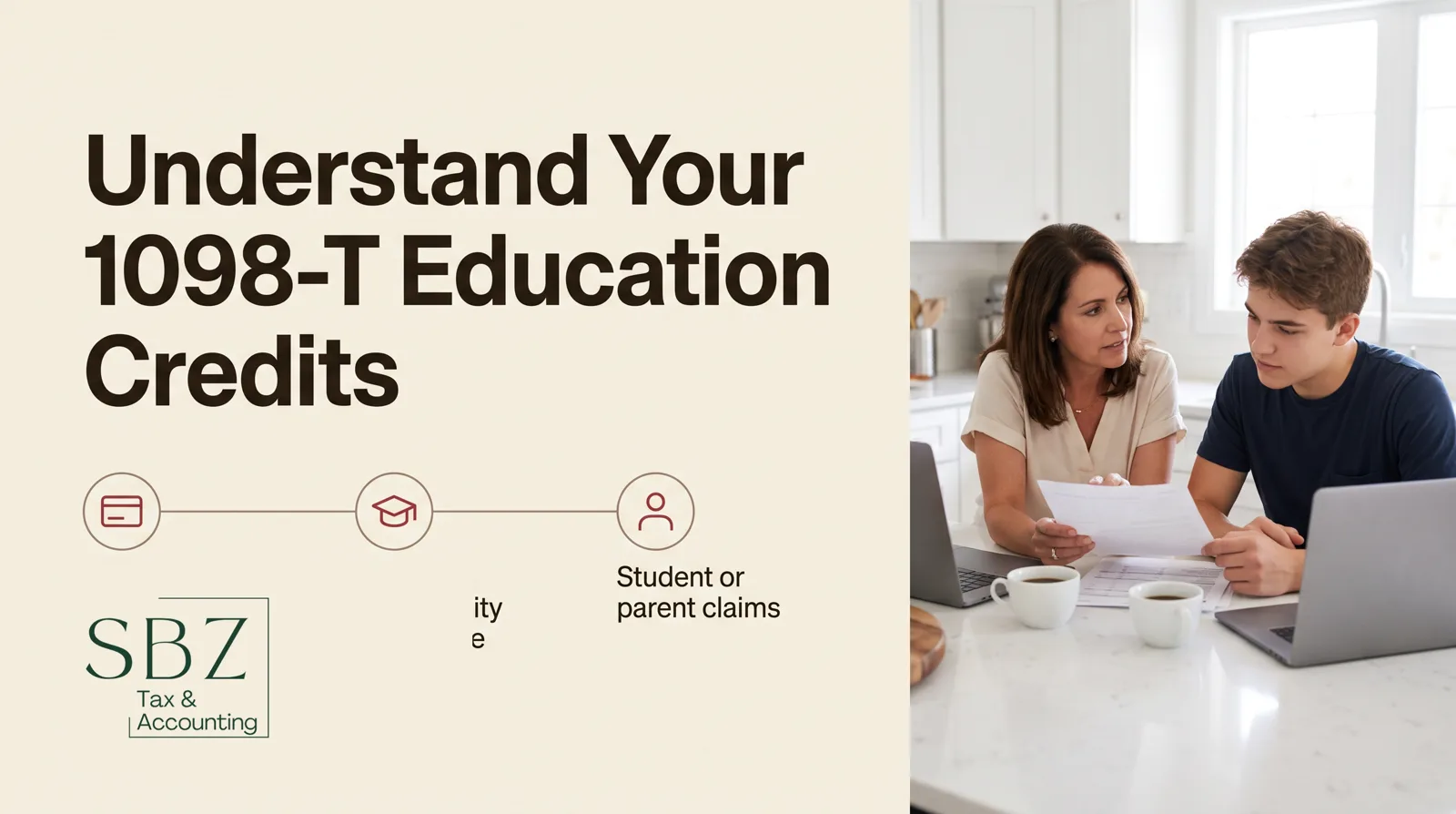
If a parent claims the student as a dependent, the parent claims the credit — even if the student physically made the tuition payment. The student cannot claim the credit on their own return while listed as a dependent on someone else's.
If the student is not a dependent — typical for graduate students or older undergrads who are financially independent — the student claims the credit on their own return.
This distinction affects the math more than people expect. A student with low taxable income may not benefit from a nonrefundable credit. A parent in a higher bracket might, but only if their income falls within the phase-out range. Running the numbers both ways when dependency status is close to the edge is worth doing.
What About Employer Tuition Assistance?
If your employer pays tuition on your behalf, up to $5,250 per year is excluded from your income under Section 127. That's a real benefit — but it reduces your qualifying expenses for the education credit dollar-for-dollar. You can't claim a credit on tuition that was already paid tax-free by your employer.
Amounts above $5,250 appear in your W-2 as wages. That portion can be used toward an education credit if you otherwise qualify.
If you're self-employed and paying for continuing education that directly maintains or improves skills required in your current work, a separate deduction may be available on Schedule C — a different path than the 1098-T credits and one that's worth discussing with someone who handles tax planning for self-employed filers.
A Note on Graduate Fellowships
Graduate students receiving large fellowships sometimes owe tax during the year, not just at filing time. If a fellowship covers more than your qualified tuition and fees, the excess is generally taxable income to you. That can create estimated tax payment obligations throughout the year. An unexpected bill in April is common the first time a grad student deals with this. Getting ahead of it is straightforward once you know to look for it.
If you want to review your situation before filing, you can see what working together looks like or book a free consult to start.
Frequently asked questions
Do I need to attach my 1098-T to my tax return?
No. Form 1098-T is informational — you don't send it with your return. You use the figures from it to complete Form 8863, then keep the original in your records in case of a future inquiry.
What if I never received a 1098-T?
Some schools aren't required to issue them — foreign institutions and certain vocational programs are exempt. You can still claim an education credit if you have documentation of what you paid. Contact your school's bursar office if you expected a form and didn't get one.
Can graduate students claim education tax credits?
Graduate students can claim the Lifetime Learning Credit if their income falls within the phase-out range and they're enrolled at an eligible institution. The AOTC is limited to the first four years of post-secondary education, so most graduate students don't qualify for that one.
What if my AOTC exceeds my tax liability?
Up to $1,000 of the AOTC is refundable — you can receive that amount as a refund even if you owe nothing. The remainder reduces your tax to zero but not below.
Can I use a 529 distribution and an education credit in the same year?
Yes, but not for the same expenses. If a 529 distribution covers a tuition payment, those expenses can't also count toward an education credit. You'll need to allocate qualifying expenses between the two to avoid double-dipping — a common place where a professional review earns its cost.
This article is general educational information, not tax advice for your specific situation. Education credits have income limits, eligibility rules, and coordination requirements that vary by circumstances. Talk to a qualified tax professional before filing.