On this page
- What is IRS Form 8582 used for?
- What counts as a passive activity?
- Who has to file Form 8582?
- How does the $25,000 rental loss allowance work?
- How does Form 8582 actually flow through your return?
- What happens to disallowed losses?
- Does a real estate professional file Form 8582?
- What mistakes come up most often?
- Where to go from here
- Frequently asked questions
- Related reading
- Related reading
IRS Form 8582: Passive Activity Loss Limitations Explained
IRS Form 8582 is the form that calculates how much of your passive activity losses you can deduct on this year's return and how much gets pushed to a future year. If you own rental property or hold an interest in a business you don't work in day to day, and those activities lost money, this form decides what actually reduces your taxable income.
Here's the short version of how it works, who has to file it, and the parts people tend to miss.
What is IRS Form 8582 used for?
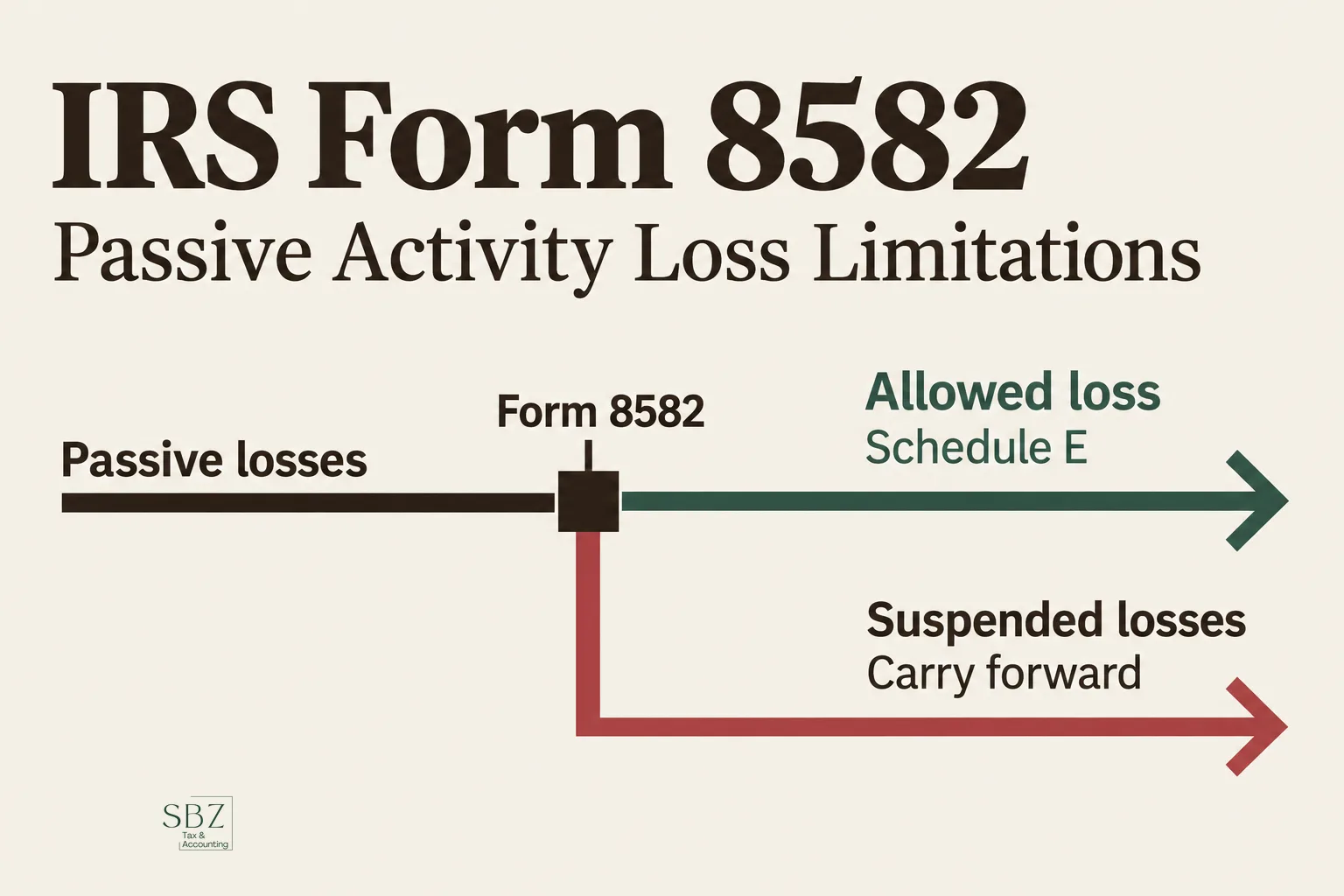
Form 8582 is titled "Passive Activity Loss Limitations." Its job is to apply the passive activity loss rules, which say that losses from passive activities can generally only offset income from other passive activities. They can't offset wages, business profit, interest, or most other income.
Anything you can't use this year is "suspended" and carried forward. The form tracks that carryforward so it follows you from year to year until you have passive income to absorb it or you dispose of the activity.
What counts as a passive activity?
Two types of activity are passive under the tax code:
- A trade or business in which you don't materially participate. A limited partnership interest or a minority stake in an LLC you don't work in are common examples.
- Rental activities. Rental real estate is passive by default, even if you put in significant time, unless you qualify as a real estate professional.
Material participation is a fact-based test. The IRS lists seven ways to meet it, and the best known is working more than 500 hours in the activity during the year. If you meet a test, the activity is nonpassive and doesn't belong on Form 8582. If you're also running a sole proprietorship, Schedule C is where that income and loss are reported, and those results are normally nonpassive.
Who has to file Form 8582?
Generally, you file it when you have a net loss from passive activities, or prior-year suspended losses, that you need to apply or track. Many landlords never see it because their software generates it automatically in the background.
There is a narrow exception for some small rental owners. If your only passive activities are rental real estate in which you actively participate, you have no prior-year suspended losses, your loss is within the special allowance, and your income is under the phase-out threshold, you may be able to skip the form. The exact conditions are in the form's instructions, so check the current version before assuming you qualify.
How does the $25,000 rental loss allowance work?
The part people miss is that there is a carve-out for small landlords. If you "actively participate" in rental real estate, you can deduct up to $25,000 of rental losses against non-passive income, such as wages.
Active participation is a lower bar than material participation. It generally means you own at least 10% of the property and make management decisions like approving tenants, setting rent, or authorizing repairs. Hiring a property manager doesn't automatically disqualify you if you still make those calls.
The allowance phases out as income rises:
| Modified adjusted gross income (MAGI) | Special allowance |
|---|---|
| $100,000 or less | Up to $25,000 |
| $100,001 to $149,999 | $25,000 reduced by 50% of MAGI over $100,000 |
| $150,000 or more | $0 |
Married taxpayers filing separately who lived with their spouse at any point in the year get no allowance. These thresholds are set by statute and are not indexed for inflation, but confirm them against the current year's instructions. For landlords weighing what else they can claim, our guide on what rental owners can deduct covers the expense side.
How does Form 8582 actually flow through your return?
The form is built from worksheets. You list each passive activity, with its current-year income or loss and any prior-year unallowed loss, and the form works out the allowed amount. The allowed loss is then carried to the schedule where the activity lives, most often Schedule E for rentals and partnership or S-corporation income.
If you receive a K-1 from an S-corporation or partnership where you aren't a material participant, that income or loss lands in the same passive pool. Passive income from one activity can absorb passive losses from another, which is why tracking each activity separately matters.
Form 8582 comes after two other limits in the loss ordering: your tax basis and your at-risk amount. A loss has to clear those first before the passive rules apply.
What happens to disallowed losses?
They carry forward indefinitely. Each year the unused amount is added to your passive losses and tested again.
Suspended losses are released in a few situations. The big one is when you dispose of your entire interest in the activity in a fully taxable transaction to an unrelated party. At that point the accumulated losses can generally be deducted against any type of income. Because a sale also creates gain, it's worth looking at how the two interact, including capital gains treatment, before you list a property.
Does a real estate professional file Form 8582?
Not for rentals in which they materially participate. A taxpayer who qualifies as a real estate professional can treat rental activities as nonpassive. The general requirements are more than 750 hours a year in real property trades or businesses in which they materially participate, and more than half of their total personal-service time spent in those trades.
The status gets scrutinized, and the IRS expects a contemporaneous log of hours rather than a reconstruction later. Clean bookkeeping and a time record are what hold up under review. Qualifying also does not remove other limits, such as the excess business loss rules.
What mistakes come up most often?
A few patterns repeat:
- Forgetting prior-year carryforwards. Switching software or preparers can drop suspended losses that were tracked the year before.
- Mixing up active participation and material participation. They are different tests with different consequences.
- Misreading the income phase-out. MAGI for this purpose is calculated before the passive losses themselves.
- Not tracking per activity. When a property is sold, you need the history of that specific activity to release its losses.
Where to go from here
If you have rental or pass-through losses, start by collecting last year's return and any Form 8582 carryforward amounts, then total this year's income and expenses by activity. From there, a tax planning conversation can help you see how the passive rules interact with the rest of your return before year-end rather than after.
SBZ Tax works with property owners and business investors across the U.S. You can book a free consultation, call 818-748-2020, or visit the office at 190 Sierra Ct Ste 335, Palmdale, CA 93550. This is general information, not tax advice for your specific situation. Talk to a qualified tax professional about your facts.
Frequently asked questions
Do I have to attach Form 8582 to my return?
If you have passive activity losses or suspended carryforwards that need to be applied, generally yes. Tax software usually includes it automatically when the numbers require it.
Can passive losses offset my wages?
Generally no. Passive losses offset only passive income, with the main exception being the rental real estate allowance of up to $25,000 for taxpayers who actively participate and fall under the income limits.
What happens to my suspended losses if I sell the property?
If you sell your entire interest in a fully taxable transaction to an unrelated party, the suspended losses are generally released and can be deducted against other income. Partial sales, gifts, and sales to related parties follow different rules.
Is a short-term rental treated as passive?
Not always. If the average guest stay is seven days or less, the activity may not count as a rental activity under these rules, and the result depends on whether you materially participate. The classification is fact-specific, so review it before filing.
Where can I find the official instructions?
The IRS publishes Form 8582 and its instructions on irs.gov, along with Publication 925, which covers passive activity and at-risk rules in detail. Always use the version for the tax year you're filing.