
On this page
- Should I still file if I can't pay?
- What does it cost to leave a balance unpaid?
- What are my options when I can't pay in full?
- What if I have an unpaid business or payroll balance?
- What happens if I ignore the notices?
- Can I get the penalties reduced?
- What's the best order to do this in?
- Frequently asked questions
File your return on time, pay as much as you can now, and contact the IRS about a payment arrangement before it starts collection. Not paying is expensive, but not filing is worse, and the options for an unpaid balance are better when you act early. Here is how to sort the choices, especially if the debt involves a business, a partnership K-1, or a large one-time gain.
Should I still file if I can't pay?
Yes. The failure-to-file penalty is much steeper than the failure-to-pay penalty. As a rule, failure to file runs 5% of the unpaid tax per month, while failure to pay runs 0.5% per month, and each is capped at 25%. When both apply in the same month, the combined penalty is reduced.
An unfiled return also removes your best options. The IRS generally won't approve a payment plan or an offer in compromise until your required returns are filed. If you're already late, see what to do if you missed the tax filing deadline.
If the issue is that you aren't ready to file, an extension (for example, Form 7004 for business returns) extends the time to file. It does not extend the time to pay, so interest and the failure-to-pay penalty still accrue on whatever you haven't paid by the original due date.
What does it cost to leave a balance unpaid?
Two things accrue on an unpaid balance: the failure-to-pay penalty and interest. Interest is set quarterly at the federal short-term rate plus 3 percentage points and compounds daily. The rate changes, so check the IRS figure for the current quarter rather than relying on an old number.
The failure-to-pay penalty can drop to 0.25% per month while you're in an approved installment agreement, provided your return was filed on time. That is one concrete reason to set up a plan quickly rather than let the balance sit.
Underpayment on estimated taxes is a separate penalty. If it's part of your bill, read how estimated tax penalties work and how to avoid them, and set up quarterly estimates so the problem doesn't repeat.
What are my options when I can't pay in full?
Here are the main routes, roughly in order of how often they fit.
| Option | Best fit | Key point |
|---|---|---|
| Short-term payment extension | You can pay in full within a few months | Up to 180 additional days; penalties and interest continue |
| Installment agreement | You can pay over time | Monthly payments; the IRS files a lien in some cases |
| Currently not collectible (hardship) | Paying would leave you without basic living or business expenses | Collection pauses; interest continues |
| Offer in compromise | You genuinely can't pay the full amount | Settles for less, with strict eligibility |
How does an installment agreement work?
An installment agreement lets you pay the balance in monthly installments. Many individuals who owe $50,000 or less in combined tax, penalties and interest can apply online. Balances up to $50,000 with a repayment period of 72 months or less can qualify for a streamlined agreement with minimal financial documentation. Larger balances usually require a financial statement.
You can also request one by mail on Form 9465. Business balances follow different thresholds, so confirm the current rules for your entity type. A user fee applies, and it is generally lower if you apply online and pay by direct debit.
California balances owed to the FTB have a separate process. See how to set up a California tax payment plan.
What if I truly can't make payments?
If paying would leave you unable to cover basic living or business operating expenses, you can ask to be placed in currently-not-collectible status. The IRS reviews your finances, typically through a collection information statement such as Form 433-F. Collection stops while the status holds, but interest and penalties keep accruing, and the IRS can revisit your situation later.
Is an offer in compromise realistic?
An offer in compromise (Form 656, with a financial statement) settles the debt for less than you owe. It is available mainly when the IRS concludes it is unlikely to collect the full amount from your income and assets. Most people who ask about it don't meet that standard, and the IRS can only accept an offer from someone who is current on filings and estimated payments.
Treat it as a result of your numbers, not a goal. Beware of anyone who promises a settlement before reviewing your finances.
What if I have an unpaid business or payroll balance?
Payroll tax debt is the most dangerous kind. Withheld employee taxes are held in trust for the government, and the IRS can assess the Trust Fund Recovery Penalty (IRC §6672) against individuals responsible for not paying them. That can make you personally liable even if the business is an S-corp or LLC.
If you owe income tax through an S-corp or partnership, the first step is confirming the books are accurate. Clean records show what is owed and what you can afford. Our bookkeeping services and S-corp tax services cover that groundwork.
What happens if I ignore the notices?
The IRS sends a series of notices, and the later ones carry deadlines. Ignoring them can lead to a federal tax lien, which is a public claim against your property, or a levy, which seizes bank accounts, wages or receivables.
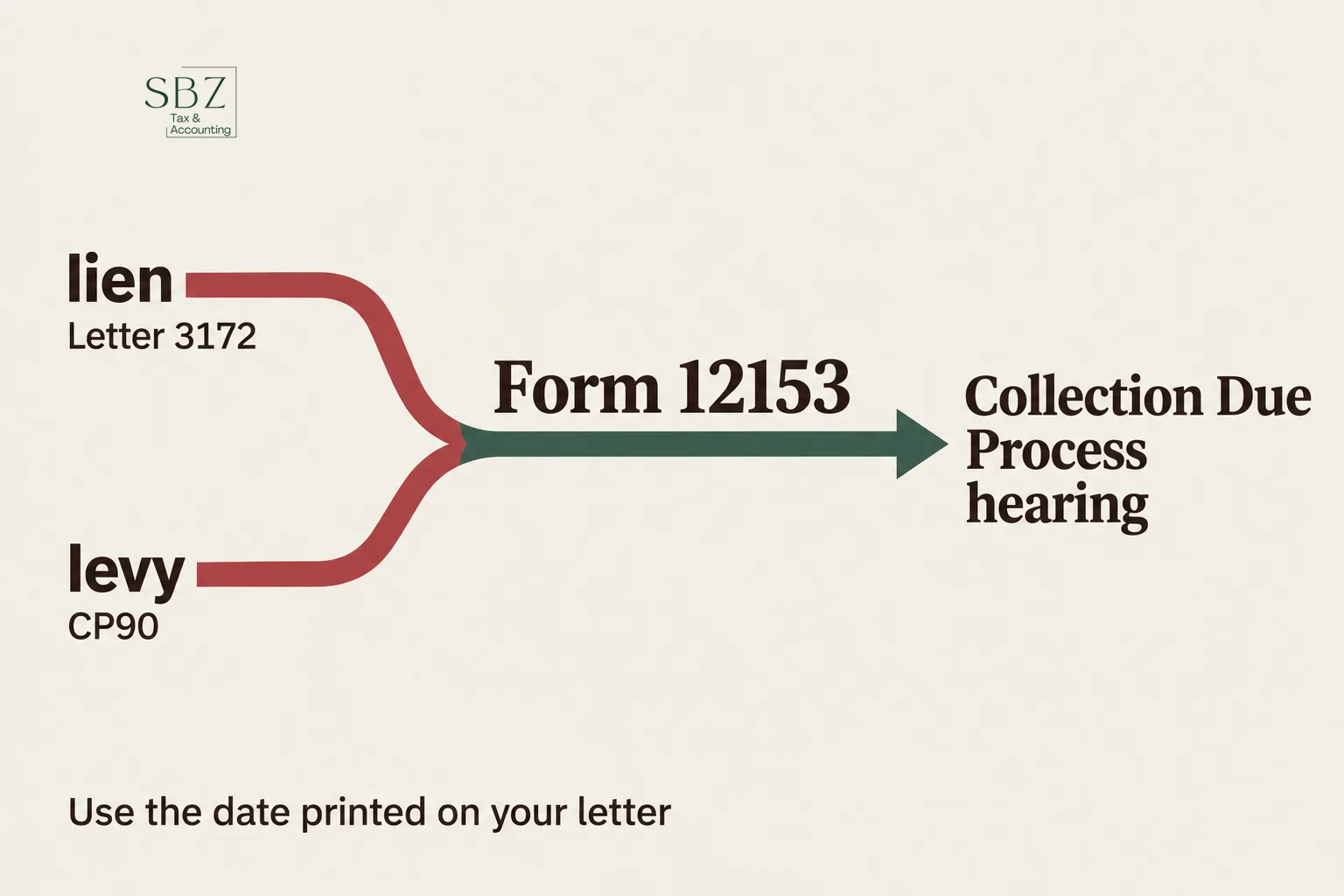
You generally have 30 days from a final notice of intent to levy or a notice of your right to a hearing to request a Collection Due Process hearing on Form 12153. If the IRS rejects a proposed agreement or tries to take action you disagree with, Form 9423 starts the collection appeals process. Mark those deadlines the day the notice arrives.
Can I get the penalties reduced?
Possibly. The IRS can abate penalties for reasonable cause, and a first-time abatement may be available if your compliance history is clean for the prior three years. Abatement removes penalties, not tax or interest on the tax itself. Request it in writing or by phone after you've filed and made arrangements.
What's the best order to do this in?
- File every missing return, even without payment.
- Pay whatever you reasonably can now. Every dollar stops penalty and interest on that amount.
- Gather your income, expenses and account balances for the financial statement.
- Apply for the payment option that fits, and keep up with estimated taxes and new filings while you're in it.
- Respond to notices before their deadlines.
If the balance is large, a lien is on the table, or the debt involves entity returns, get help sorting it out. SBZ Tax offers IRS and state tax problem help and tax planning to prevent a repeat. You can book a free consultation, call 818-748-2020, or visit the office at 190 Sierra Ct Ste 335, Palmdale, CA 93550. We also work with clients remotely nationwide.
This is general information, not tax advice for your specific situation. Talk to a qualified tax professional before choosing a resolution path.
Frequently asked questions
Can the IRS take my bank account if I owe and can't pay?
Yes, after it issues the required notices and the deadlines pass, the IRS can levy bank accounts. Filing, responding to notices and arranging a payment plan typically keeps that from happening.
Does the IRS charge a fee for a payment plan?
Yes. A user fee applies, and it is generally lower if you apply online and pay by direct debit. Check the current fee on the IRS site before applying.
Should I put my tax bill on a credit card?
It can work in the short term, but processing fees and card interest often exceed the IRS cost of a payment plan. Compare the total cost before choosing it.
Will a payment plan stop penalties and interest?
No. Interest continues on the unpaid balance, and the failure-to-pay penalty continues too, though at a reduced rate for those who filed on time and are in an approved installment agreement.
Do I need a professional to set up a payment plan?
Not always. Simple individual balances can often be handled online. Business balances, large amounts, liens and levies are where professional help is most useful.