On this page
- Why does bookkeeping matter beyond tax season?
- What records should I actually keep?
- Cash or accrual: which accounting method should I use?
- How do I separate business and personal finances?
- What should I be doing every month?
- When does DIY bookkeeping stop making sense?
- Frequently asked questions
- Related reading
Bookkeeping Basics for Antelope Valley Small Businesses
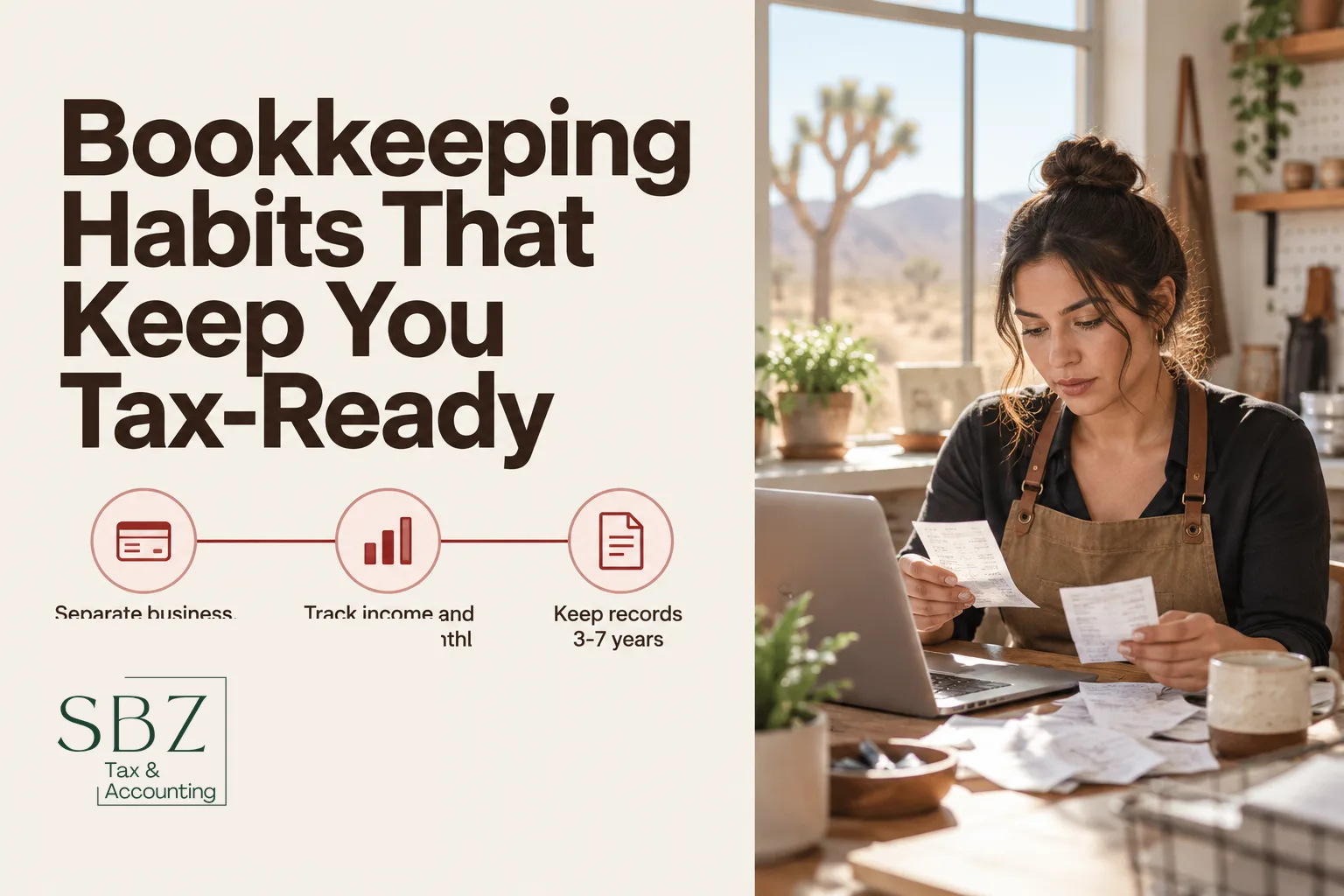
Good bookkeeping comes down to one discipline: recording money in and money out, consistently, in a place you can find it later. For small business owners in Lancaster, Palmdale, and across the Antelope Valley, that consistency is what turns a stressful tax season into a manageable annual filing.
Why does bookkeeping matter beyond tax season?
The obvious answer is taxes — you need numbers to file a return. The less obvious answer is that clean books are how you actually run a business. They tell you whether a busy month was profitable, whether a client is worth keeping, and whether your expenses are creeping in ways you haven't noticed.
From a compliance standpoint, the IRS requires records that support what you report. If you're ever audited, the question isn't whether your return was correct — it's whether you can prove it. The general rule: keep records for at least three years from the date you filed, longer if there's a question of substantial underreporting.
California's Franchise Tax Board has its own audit window, so a four-year retention default is a safer practice for Antelope Valley business owners.
What records should I actually keep?
You don't need a filing cabinet full of paper. You need a system that captures:
- Income: invoices paid, point-of-sale receipts, 1099-NEC forms received
- Expenses: vendor bills, receipts, bank and credit card statements
- Payroll records: if you have employees or pay contractors
- Mileage: if you use a personal vehicle for business (the IRS accepts a contemporaneous log)
- Asset purchases: anything that lasts more than a year may need to be depreciated rather than expensed immediately
The receipts people lose most often are small ones — gas, office supplies, client meals. A practical habit: photograph them the day you buy. Most accounting apps (QuickBooks, Wave, FreshBooks) can ingest photos directly.
One commonly missed obligation: if you pay any contractor or freelancer $600 or more in a calendar year, you're required to issue them a 1099-NEC by January 31. That means you need their name, address, and taxpayer ID on file before you pay them — not after.
Cash or accrual: which accounting method should I use?
Cash accounting records income when you receive it and expenses when you pay them. Accrual accounting records income when it's earned and expenses when they're incurred, even if the money hasn't moved yet.
Most small businesses start on cash basis because it mirrors your bank account and is simpler to maintain. The IRS requires accrual for certain businesses above a revenue threshold, but the majority of small businesses have a choice. The practical tip: pick one method and stay consistent — switching requires IRS approval via Form 3115 and creates complexity you don't want.
If you're unsure which fits your business model, good tax planning starts with this decision.
How do I separate business and personal finances?
Open a dedicated business checking account and use it exclusively for business income and expenses. This is the single highest-leverage bookkeeping move a small business owner can make.
Commingled accounts create two problems. First, you waste hours every year sorting out which transactions were business. Second, mixing funds weakens your position if the IRS or FTB ever questions your deductions. A business credit card adds another layer of separation and creates a clean paper trail — pay it from your business account.
If you're structured as an LLC or S-corp, keeping finances separate also protects the liability shield your entity was designed to provide. S-corp owners in particular have payroll obligations on top of income taxes, which makes clean bookkeeping non-negotiable from day one.
What should I be doing every month?
Monthly bookkeeping doesn't take more than an hour if you stay current. The short list:
Reconcile your bank accounts. Match every transaction in your accounting software to your bank statement. Discrepancies are much easier to catch one month at a time than twelve.
Categorize expenses. Every transaction gets a category — rent, utilities, advertising, meals, professional services. This is what populates your Schedule C or business return at year-end.
Review accounts receivable. Know who owes you and how old the balance is. A 90-day-old invoice is a cash flow problem, not just a bookkeeping entry.
Estimate your tax liability. Self-employed individuals and business owners generally owe quarterly estimated taxes — April, June, September, and January. Clean monthly books make this straightforward. See the guide on quarterly estimated taxes for Antelope Valley self-employed for the mechanics.
Set aside tax reserves. A common starting point is 25–30% of net profit held in a separate savings account. The right number depends on your entity type, income, and deductions — including write-offs you may be missing.
When does DIY bookkeeping stop making sense?
DIY works when volume is manageable and transactions are simple. It stops working when:
- You're spending more than a few hours a week on it
- You're consistently behind and scrambling at tax time
- You have employees, inventory, or multiple revenue streams
- You're not confident the numbers are right
At that point, the question isn't whether to get help — it's what kind. Monthly bookkeeping services handle ongoing categorization and reconciliation so your books stay current year-round. For businesses that want strategic financial oversight, fractional CFO services go a layer deeper — cash flow modeling, forecasting, and financial decision support without the cost of a full-time hire.
If you want to know what professional bookkeeping support actually costs, the pricing page breaks it down. And if you'd rather talk through your situation first, you can book a free consultation.
This is general information, not tax advice tailored to your specific situation. A qualified tax professional can help you apply these principles to your business.
Frequently asked questions
Do I need accounting software, or can I use a spreadsheet?
A spreadsheet works at the very start, but most businesses outgrow it quickly. Accounting software automates bank feeds, generates reports, and makes tax prep significantly faster. The cost is usually worth it once you have more than a handful of transactions each month.
How long do I need to keep business records?
The IRS standard is three years from the filing date for most returns. California's FTB recommends four years. If income was substantially underreported, the federal window extends to six years. Employment tax records should be kept for at least four years after the tax is due or paid.
What's the difference between bookkeeping and accounting?
Bookkeeping is the day-to-day recording and categorization of transactions. Accounting is the interpretation of that data — preparing financial statements, analyzing trends, and advising on strategy. A bookkeeper keeps the records; an accountant uses them to guide decisions and prepare returns.
Can I deduct my bookkeeping fees?
Yes. Fees paid for bookkeeping, tax preparation, and accounting services are generally deductible as a business expense. Keep the invoices.
What if I'm already behind on my books?
Catch-up bookkeeping is more common than you'd think. The practical order: gather bank and credit card statements for the missing period, categorize transactions from oldest to newest, then reconcile. Many businesses find it easier to hire someone for catch-up work and then maintain going forward — clean books from a known date are far easier to sustain than perpetual catch-up.