On this page
- What Is the Property Tax Rate in California?
- How Is Your Assessed Value Determined?
- When Does Your Assessment Reset to Market Value?
- What Is a Supplemental Tax Bill?
- When Are California Property Taxes Due?
- What Exemptions Are Available?
- Can You Appeal Your Assessment?
- Are California Property Taxes Deductible?
- Frequently asked questions
How California Property Taxes Work: Rates, Reassessments, and What Drives Your Bill
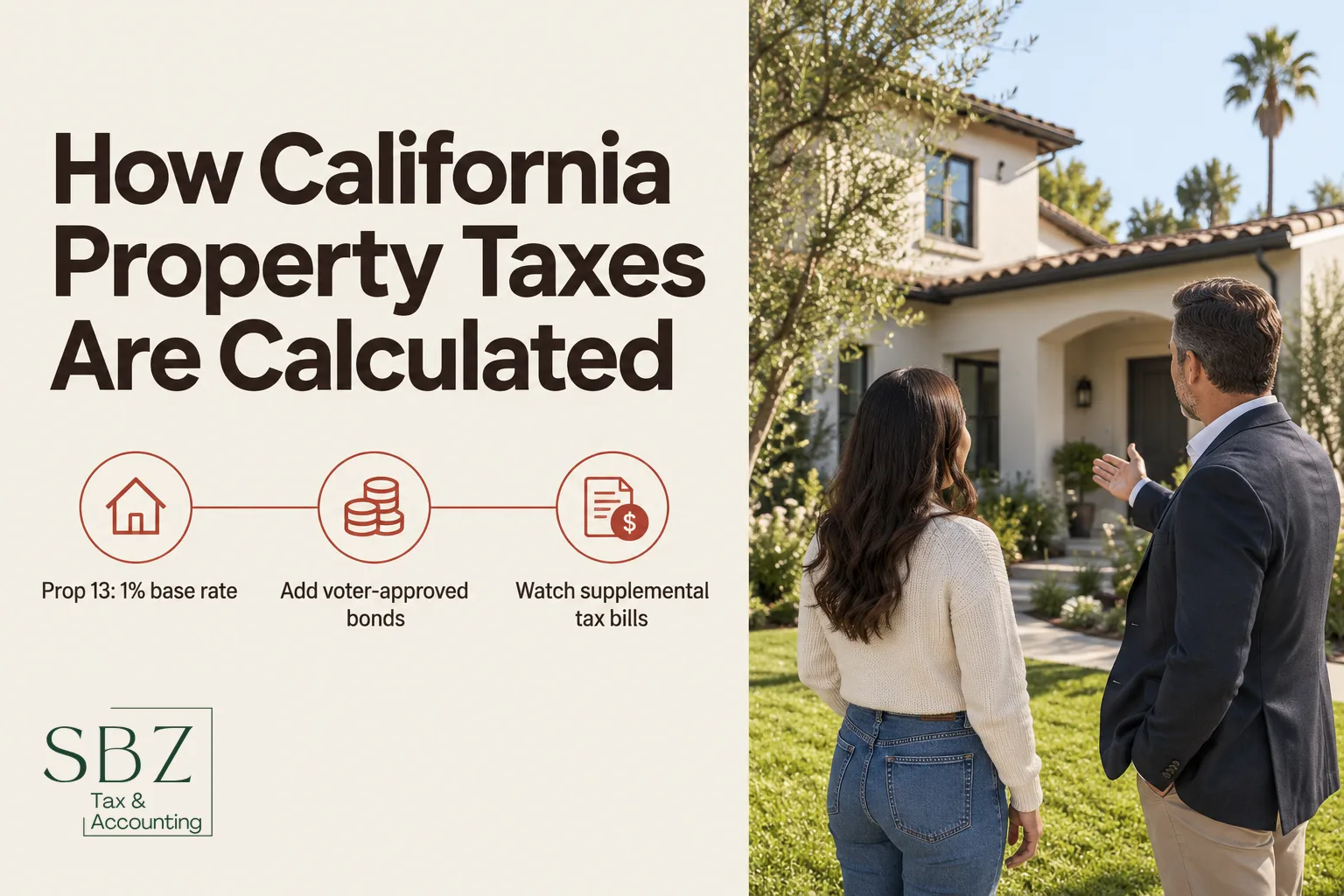
California property taxes are capped at 1% of your property's assessed value under Proposition 13, but most homeowners pay more than that once local bond measures and special assessments are layered on top. Here's how the system actually works.
What Is the Property Tax Rate in California?
The baseline is 1% of assessed value — a constitutional cap established by Proposition 13 in 1978. Counties cannot exceed it for general taxation. Your effective rate, however, is almost always higher.
On top of the 1%, county assessors add voter-approved bonds, school district levies, and special district fees. In Los Angeles County, the total effective rate for most parcels typically lands between 1.15% and 1.25%, depending on the specific tax rate area.
Mello-Roos districts (Community Facilities Districts) are particularly common in newer developments. If you're buying in a newer neighborhood in Palmdale or Lancaster, check the tax rate area before closing — Mello-Roos charges can add several hundred dollars annually to your base tax bill.
How Is Your Assessed Value Determined?
When you purchase a property, the purchase price becomes your base year value. From that point, the county can increase your assessed value by no more than 2% per year — or the rate of inflation, whichever is lower.
This creates a significant long-term benefit for long-term owners. A homeowner who bought in 1998 for $250,000 carries an assessed value far below today's market, even after 25+ years of 2% annual adjustments. The Los Angeles County Assessor maintains and publishes these values each year. For a closer look at the methodology, how property assessments work in Los Angeles County covers the process in detail.
When Does Your Assessment Reset to Market Value?
A change in ownership triggers a full reassessment to current market value. For most buyers, that event is the purchase itself — your new base year value becomes the purchase price, and the 2% cap restarts from there.
Significant new construction also triggers a partial reassessment, but only for the added improvement. The existing structure's assessed value is unaffected.
Two situations allow reassessment to be avoided or limited:
Parent-to-child transfers (Proposition 19): Since February 2021, a parent can transfer a primary residence to a child without triggering a full reassessment — but only if the child uses it as their primary residence, and only up to $1 million above the parent's current assessed value. Investment properties and vacation homes no longer qualify for this exclusion under Prop 19.
Senior base year transfers: Homeowners 55 and older can now transfer their assessed value to a replacement home anywhere in California, up to three times in a lifetime. This replaced the more limited Propositions 60 and 90.
What Is a Supplemental Tax Bill?
When you buy a property or complete new construction, the county issues a supplemental bill separate from your regular annual tax bill. It covers the difference between the old and new assessed values, prorated for the portion of the fiscal year remaining.
If you close escrow in January, expect a supplemental bill covering January through June. These arrive months after closing and catch buyers off guard. Budget for it — and if you're working with an Antelope Valley property, the supplemental timeline in Los Angeles County is worth understanding before close.
When Are California Property Taxes Due?
Property taxes are billed in two installments:
| Installment | Due Date | Delinquent After |
|---|---|---|
| First | November 1 | December 10 |
| Second | February 1 | April 10 |
The penalty for late payment is 10% of the installment, plus a $10 cost on the second installment. If the second installment remains unpaid past June 30, the property enters the tax delinquent process.
Many lenders collect through an impound account and pay the county on your behalf. It's worth confirming annually that the payments were actually made on time — impound errors do happen.
What Exemptions Are Available?
The most common is the Homeowner's Exemption, which reduces your assessed value by $7,000. At a 1% rate that's $70 in annual savings — modest, but it compounds over time and is automatic once you apply. You apply through your county assessor's office, and it renews automatically unless ownership changes.
Other exemptions include:
- Disabled veteran's exemption — for qualifying veterans and surviving spouses, with a more generous amount for those with 100% disability ratings
- Church and charitable organization exemptions — for qualifying non-profit properties
- Welfare exemption — for property owned and operated by qualifying non-profits
Deadlines for filing exemption claims vary by county, so don't wait until tax time to look into them.
Can You Appeal Your Assessment?
Yes. If you believe the county's assessed value exceeds the property's actual market value, you can file an appeal with the Assessment Appeals Board. In Los Angeles County, the filing window is generally July 2 through November 30 of the assessment year.
You'll need documentation: recent comparable sales, a licensed appraisal, or evidence of a factual error in the county's records. A successful appeal results in a refund or credit. For investment or commercial property owners, the potential savings often justify professional help with tax planning and the appeal process itself.
Are California Property Taxes Deductible?
On a federal return, California property taxes fall under the State and Local Tax (SALT) deduction — currently capped at $10,000 per year for individuals and married-filing-jointly filers. Homeowners in higher-value areas or those with multiple properties will frequently hit that cap.
For business-owned property, the rules are more favorable. Property taxes on real property used in a business are generally fully deductible as an ordinary business expense, not subject to the SALT cap. That distinction matters for investors and business owners thinking through how to hold real estate.
If you're a landlord navigating what you can write off, what Lancaster landlords can deduct covers the income-side deductions that often offset property tax costs. And if you run a business from home, the home office deduction rules are worth understanding alongside your property tax picture.
Property taxes are also one piece of the larger picture for self-employed owners and small business operators. If your books are keeping pace with what you owe, that's a good sign — if not, monthly bookkeeping services or a broader conversation with business tax services can help you stay organized.
This is general information, not tax advice for your specific situation. Property tax rules, exemption deadlines, and appeal procedures vary by county and change over time. Consult a tax professional about your circumstances.
Frequently asked questions
What percentage of a home's value is property tax in California?
The base rate is 1% of assessed value under Proposition 13. Most homeowners pay between 1.15% and 1.25% after local bond measures are added — the exact rate depends on your tax rate area.
Does buying a home reset my property taxes in California?
Yes. A purchase triggers a change-in-ownership reassessment, and your new base year value becomes the purchase price. From there, annual increases are capped at 2% per year under Proposition 13.
What is a supplemental property tax bill?
A supplemental bill is issued after a property purchase or new construction. It covers the difference between the prior and new assessed values, prorated for the remainder of the tax year. It's separate from your regular annual bill and arrives months after closing.
Can I lower my property tax assessment in California?
Yes, through an appeal to your county's Assessment Appeals Board. You'll need evidence that the assessed value exceeds market value — comparable sales or an appraisal are common supporting documents. In Los Angeles County, the appeal window generally runs July 2 through November 30.
Are California property taxes deductible on my federal return?
Yes, as part of the SALT deduction — but that deduction is capped at $10,000 per year for individuals. Business-owned property used in a trade or business is a different story: those taxes are generally fully deductible as a business expense with no SALT cap.