On this page
- Does an LLC pay self-employment tax?
- How is self-employment tax calculated for an LLC?
- Is there a minimum income before it applies?
- How does it work for a multi-member LLC?
- Can an LLC reduce self-employment tax with an S-corp election?
- When do you pay self-employment tax during the year?
- What lowers the amount subject to self-employment tax?
- What about California LLCs?
- What should you do next?
- Frequently asked questions
LLC Self-Employment Tax: Who Pays It, How It's Calculated, and Ways It Changes
Yes, most LLC owners pay self-employment tax. The LLC itself doesn't owe it, but the owners do, at a combined rate of 15.3% on net earnings, unless the LLC has elected to be taxed as an S corporation. How much you pay depends on how the LLC is classified for federal tax purposes, not on the fact that it's an LLC.
Here's the short version of how it works and where the rules shift.
Does an LLC pay self-employment tax?
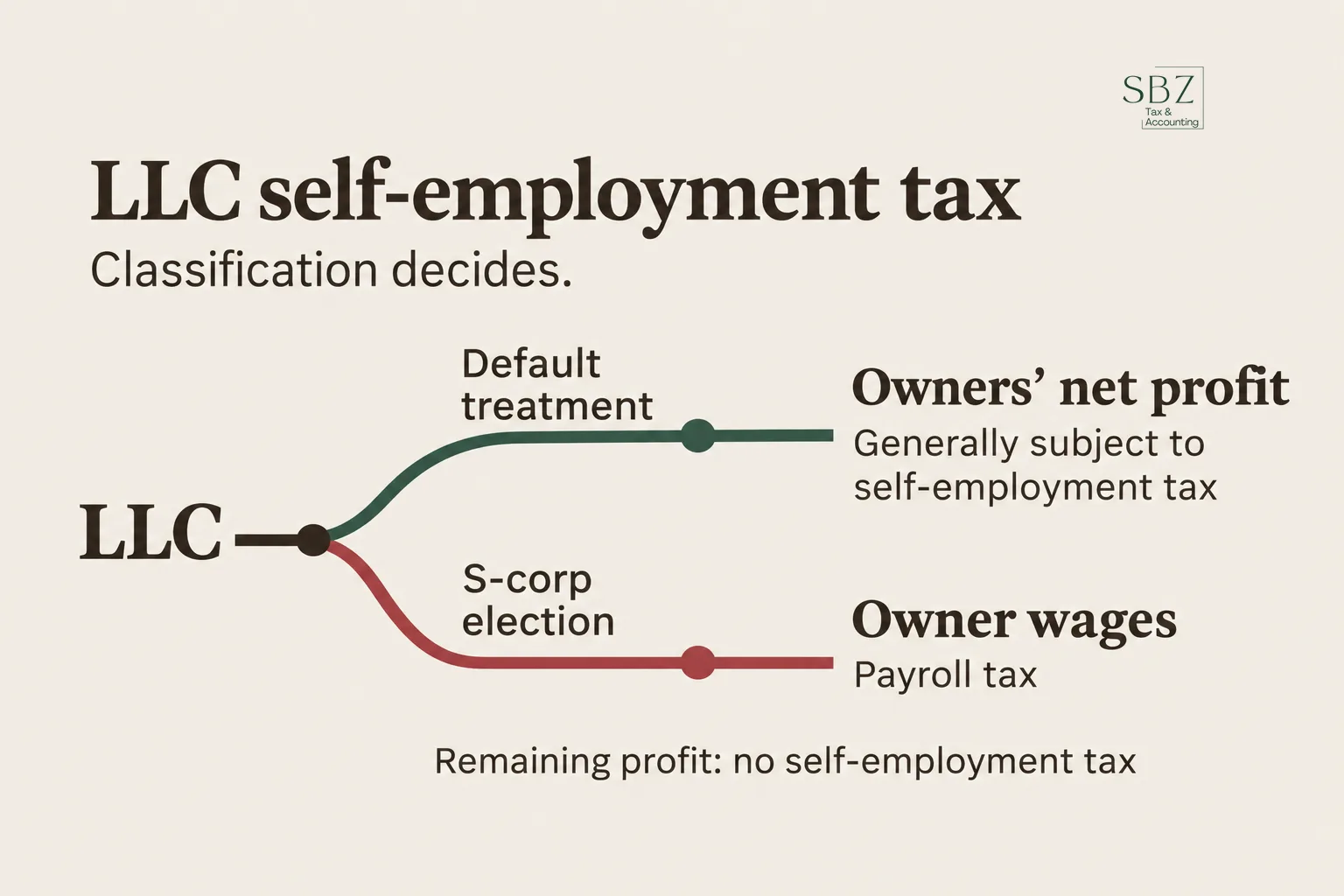
An LLC is a state-law entity, and the IRS doesn't tax it as an "LLC." It sorts every LLC into a tax classification, and that classification decides whether self-employment tax applies.
- Single-member LLC (default): treated as a disregarded entity. You report income on Schedule C and pay self-employment tax on the net profit.
- Multi-member LLC (default): taxed as a partnership. Each member's share of profit is generally subject to self-employment tax.
- LLC taxed as an S corporation: owners who work in the business are employees. Payroll tax applies to their wages, not to the remaining profit.
- LLC taxed as a C corporation: self-employment tax doesn't apply, though other tax consequences do.
If you've never made an election, you're almost certainly in one of the first two buckets.
How is self-employment tax calculated for an LLC?
Self-employment tax is the self-employed version of Social Security and Medicare tax. The rate is 15.3%: 12.4% for Social Security and 2.9% for Medicare.
You don't apply that rate to your full profit. You first multiply net earnings by 92.35%, which approximates the employer-side adjustment. The result is your base for the tax. You calculate it on Schedule SE and carry the total to your Form 1040.
Two details people miss:
- The Social Security portion has an annual cap. Earnings above the wage base stop being subject to the 12.4% piece. The figure changes yearly, so check the current number.
- Medicare has no cap. An Additional Medicare Tax of 0.9% applies to earnings above certain thresholds, which depend on filing status.
You also get to deduct half of your self-employment tax when figuring adjusted gross income. It reduces income tax, not the self-employment tax itself.
Is there a minimum income before it applies?
Yes. If your net earnings from self-employment are under $400 for the year, you generally don't owe the tax or file Schedule SE. Above that, it applies from the first dollar.
This is why a side-business LLC with modest profit still creates a self-employment tax bill. The Schedule C guide walks through how that profit gets figured in the first place.
How does it work for a multi-member LLC?
A multi-member LLC files Form 1065, and each member receives a Schedule K-1. The K-1 reports your share of income, and Schedule SE picks up the self-employment portion.
Guaranteed payments to members for services are typically subject to self-employment tax too. Rules for members who act as passive investors can differ, and the details depend on the operating agreement and how involved each member is. That's a question for a professional looking at your actual facts.
Can an LLC reduce self-employment tax with an S-corp election?
Sometimes. Many S-corp owners reduce self-employment-type tax because only wages run through payroll, while remaining profit passes through as a distribution. The LLC makes this election by filing Form 2553 (and, depending on timing, sometimes Form 8832 as well).
The catch is that it isn't free money. You must pay yourself a reasonable salary, run payroll, and file additional returns. The reasonable salary rules matter because the IRS looks hard at owners who take tiny wages and large distributions.
The election tends to make sense only when profit is high enough to cover the added cost and compliance. For a side-by-side comparison, see S-corp vs LLC: the real tax differences. If you're weighing it, SBZ Tax's S-corp and business tax services cover the election, payroll setup, and ongoing filings.
When do you pay self-employment tax during the year?
Nobody withholds it for you, so it generally gets paid through quarterly estimated payments. These cover both income tax and self-employment tax. Missing them can trigger penalties even if you pay everything at filing time.
Our guide to quarterly estimated taxes for the self-employed covers due dates and how to size payments, and estimated tax penalties explains what a shortfall costs.
What lowers the amount subject to self-employment tax?
Self-employment tax is based on net profit, so legitimate business deductions reduce it directly. That makes clean records more valuable than any trick.
- Track every ordinary and necessary expense. The list of deductible business expenses is a good checklist.
- Claim the home office deduction only if you meet the requirements.
- Keep books current so profit is accurate. Monthly bookkeeping is usually what separates a stressful tax season from a routine one.
Note that some income-tax breaks, like the deduction for half of self-employment tax, don't reduce the self-employment tax itself.
What about California LLCs?
California adds its own layer, including the annual LLC tax and a fee based on gross receipts. Those are separate from self-employment tax, which is a federal tax. For the state-level costs, read California LLC franchise tax explained.
What should you do next?
Start by confirming how your LLC is classified, because everything else follows from that. Then check that your estimated payments cover both income tax and self-employment tax, and that your books show true net profit.
If profit has grown and you're wondering whether a different structure fits, a conversation with a professional beats guessing. SBZ Tax works with business owners across the U.S. remotely and from its office at 190 Sierra Ct Ste 335, Palmdale, CA 93550. You can call 818-748-2020, stop by, or book a free consultation. Our tax planning services are built for exactly this question.
This article is general information, not tax advice for your specific situation. Talk to a qualified tax professional before making decisions.
Frequently asked questions
Do single-member LLCs pay self-employment tax?
Generally yes. A single-member LLC is a disregarded entity by default, so you report profit on Schedule C and pay self-employment tax on net earnings using Schedule SE.
Do LLC owners pay self-employment tax on distributions?
It depends on classification. In a default sole-proprietor or partnership LLC, your share of profit is taxed whether or not you withdraw it. In an S-corp LLC, distributions generally aren't subject to self-employment tax, but wages are subject to payroll tax.
Is the LLC self-employment tax rate 15.3%?
Yes, for earnings up to the Social Security wage base: 12.4% Social Security plus 2.9% Medicare. Above the base, only the Medicare portion applies, plus the 0.9% Additional Medicare Tax at higher incomes.
Can I avoid self-employment tax with an LLC?
An LLC alone doesn't avoid it. Electing S-corp status can change how income is taxed, but it requires reasonable wages and added compliance, so it's worth reviewing with a professional first.
Do I pay self-employment tax if my LLC lost money?
No. Self-employment tax is based on net earnings, so a net loss generally means no self-employment tax for that business. The loss can still affect your income tax return.