
On this page
- How Property Taxes Are Calculated
- Is Your Assessed Value Actually Correct?
- What Exemptions Are You Missing?
- How to File a Property Tax Appeal
- How Does This Work in California?
- A Note for Texas Property Owners
- How Property Taxes Interact With Your Tax Return
- What's a Realistic Outcome?
- Frequently asked questions
Can I Lower My Property Taxes? What to Know Before You Appeal
Yes — most property owners have at least one realistic path to lower their property tax bill, whether through a formal assessment appeal, an exemption they've overlooked, or a factual error sitting unchallenged in their county records. The process isn't guaranteed, but it's more accessible than most people assume.
How Property Taxes Are Calculated
Property taxes come from two numbers: the assessed value of your property and the local tax rate. Your county assessor sets the assessed value, typically using recent comparable sales, an income approach for rental properties, or a cost approach for newer construction.
The tax rate is set by your local government — county, city, school district, and special districts all get a share. You have very little leverage over the rate. Where you have leverage is the assessed value.
Is Your Assessed Value Actually Correct?
Start here before anything else. Request your property's assessment card from your county assessor's office — most publish them online. Look for factual errors: wrong square footage, incorrect lot size, bedrooms the house doesn't have. These mistakes are the easiest wins and often don't require a formal hearing to fix.
If the facts look right but the number still seems high, compare it against recent sales of similar properties in your neighborhood. Counties use mass appraisal models that can over-assess individual properties when the model doesn't account for specific conditions — deferred maintenance, a busy street, an irregular lot.
What Exemptions Are You Missing?
Exemptions are the part people miss most often. Common ones worth checking:
- Homestead exemption — reduces the taxable value of your primary residence; available in most states, with especially generous versions in Texas, Florida, and Georgia.
- Senior exemption — many counties offer reduced assessments or frozen taxable values for homeowners 65 and older.
- Veteran and disability exemptions — widely available nationwide; income thresholds and eligibility rules vary by state.
- Agricultural-use exemptions — if any portion of your land qualifies, you may be taxed at an agricultural rate rather than full market value.
The critical detail: exemptions usually aren't automatic. You have to apply. If you moved in the last few years and forgot to refile a homestead exemption on the new property, you've likely been overpaying.
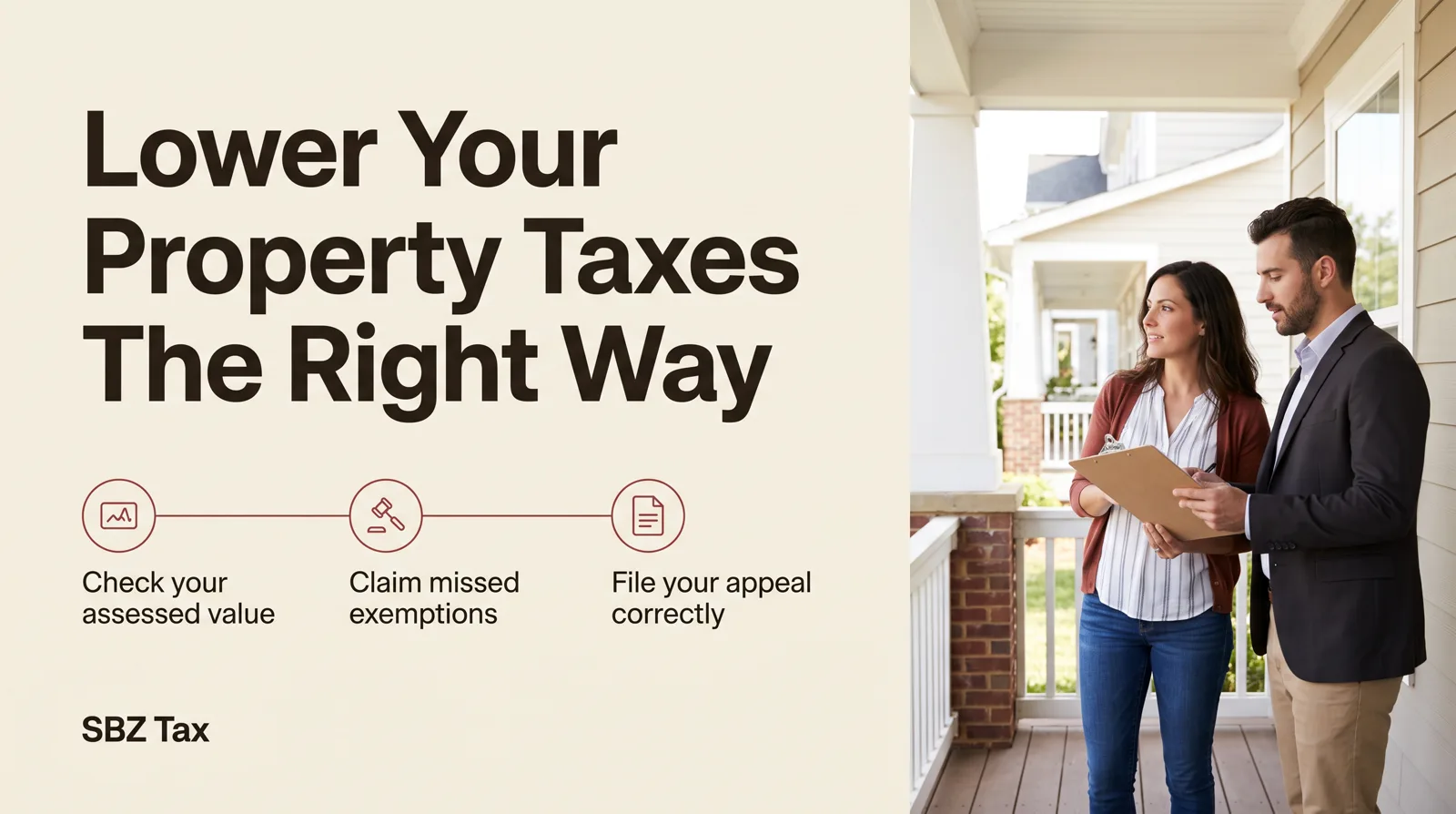
How to File a Property Tax Appeal
The process varies by state and county, but the general sequence holds nearly everywhere.
Know your deadline. Most jurisdictions require you to file within 30 to 90 days of receiving your assessment notice. Miss the window and you wait until next year.
Gather comparable sales. Find three to five properties similar to yours — same neighborhood, similar size and condition — that sold recently for less than your assessment implies. County GIS maps and public deed records are free starting points.
File for an informal review first. Most appeals start with an informal meeting at the assessor's office, not a formal hearing. A significant share of disputes resolve at this stage. If not, you escalate to a local board of equalization or appeals board.
Know when a professional helps. Property tax consultants often work on contingency, taking a percentage of your savings. For higher-value or commercial properties, that arrangement is worth running the math on. For most homeowners, the informal review is a few hours of time, not a legal proceeding.
How Does This Work in California?
California's Prop 13 caps assessed value increases at 2% per year as long as you own the property, which means longtime owners often pay taxes well below what the market would otherwise support.
Where California owners still have room to appeal: if you purchased recently and the purchase price was used as your base-year value, or if the market has fallen and your assessed value now exceeds what the property would actually sell for. That second scenario triggers what's called a Prop 8 temporary decline-in-value reduction, and it's worth requesting if values in your area have dropped since you bought.
For anyone in Los Angeles County specifically, the guide to lowering your property taxes in Los Angeles County covers the county-specific process, including how to file with the Assessment Appeals Board. And if you want to understand the mechanics behind how assessed values are set in the first place, how California property taxes work is the right place to start.
A Note for Texas Property Owners
Texas runs some of the highest property tax rates in the country — a direct tradeoff for having no state income tax. The upside is one of the most accessible protest systems in the U.S. You can formally contest your appraised value each year, and most counties process informal protests quickly.
If you own your primary residence in Texas, make sure you've applied for the homestead exemption. As of 2023, Proposition 4 increased the school district homestead exemption to $100,000 off your appraised value — check the current figure with your county appraisal district, since thresholds can change.
How Property Taxes Interact With Your Tax Return
Property taxes aren't purely a local issue — they touch your federal return in a few ways worth understanding.
Homeowners who itemize can deduct state and local property taxes (along with state income or sales taxes) up to a combined $10,000 cap under current law, on Schedule A. That limit, set by the Tax Cuts and Jobs Act, means many owners in high-tax states don't get the full deduction.
Business owners who use a dedicated home office can deduct a proportional share of property taxes as a business expense — separate from the itemized deduction, and not subject to the $10,000 cap. More on how that works in how to deduct a home office on your taxes.
Landlords deduct property taxes as a rental expense on Schedule E — and there are additional write-offs worth knowing about, covered in depth for what Lancaster landlords can deduct on their taxes. Real estate professionals have further deduction opportunities detailed in tax deductions for real estate agents in California.
If you want to see how property taxes fit into your overall picture — whether the standard deduction or itemizing makes more sense, or how rental income changes the math — that's where tax planning pays off.
What's a Realistic Outcome?
An appeal won't always succeed. If comparable sales support your assessed value and there are no factual errors, the appeals board has no basis to reduce it. But the cost of trying — a few hours and a filing fee many counties waive — is low enough that it's almost always worth a look before your deadline passes.
The higher-probability move for most owners: check for exemptions you may have missed. That path requires less evidence gathering and can deliver a permanent reduction on every future bill.
This article is general information, not tax or legal advice for your specific situation. Property tax rules vary significantly by state and county — talk to a professional about anything with real dollars at stake.
Frequently asked questions
How often can I appeal my property taxes?
Most jurisdictions allow one appeal per year, within a filing window that opens after your assessment notice arrives. Some states allow continuous protests; others run fixed cycles. Check your county assessor's website for your local timeline.
Can filing a property tax appeal cause my assessment to go up?
In most states, no — the review is capped at your current assessment. The exception: if the assessor discovers unreported improvements during the process. If you've made unpermitted additions, it's worth understanding your local rules before filing.
Do I need a lawyer or consultant to appeal my property taxes?
Not for a standard residential appeal. Most homeowners handle the informal review stage on their own. Professionals who work on contingency make the most sense for commercial properties or higher-value homes where the potential savings are large.
Is a property tax appeal the same as a homestead exemption?
No, these are separate. An appeal challenges your assessed value. An exemption reduces the taxable portion of that value. Both lower your bill, and you can pursue both independently.
Where do I start if I think I'm overpaying?
Pull your property record from your county assessor's office and check for factual errors first. Then look up the exemptions available in your state and confirm you've applied for every one you qualify for. If you'd like a second set of eyes on how property taxes fit your overall tax picture, book a free consultation to talk it through.