On this page
- What Qualifies as Grounds for an Appeal?
- What Are the Filing Deadlines?
- How Does the Appeal Process Actually Work?
- What Evidence Actually Wins Appeals?
- If Your Appeal Is Approved, What Changes?
- Does a Lower Assessment Affect Your Income Taxes?
- Is It Worth Filing?
- Frequently asked questions
- Related reading
- Related reading
Los Angeles Property Tax Appeals: How the Process Works and When It's Worth Filing
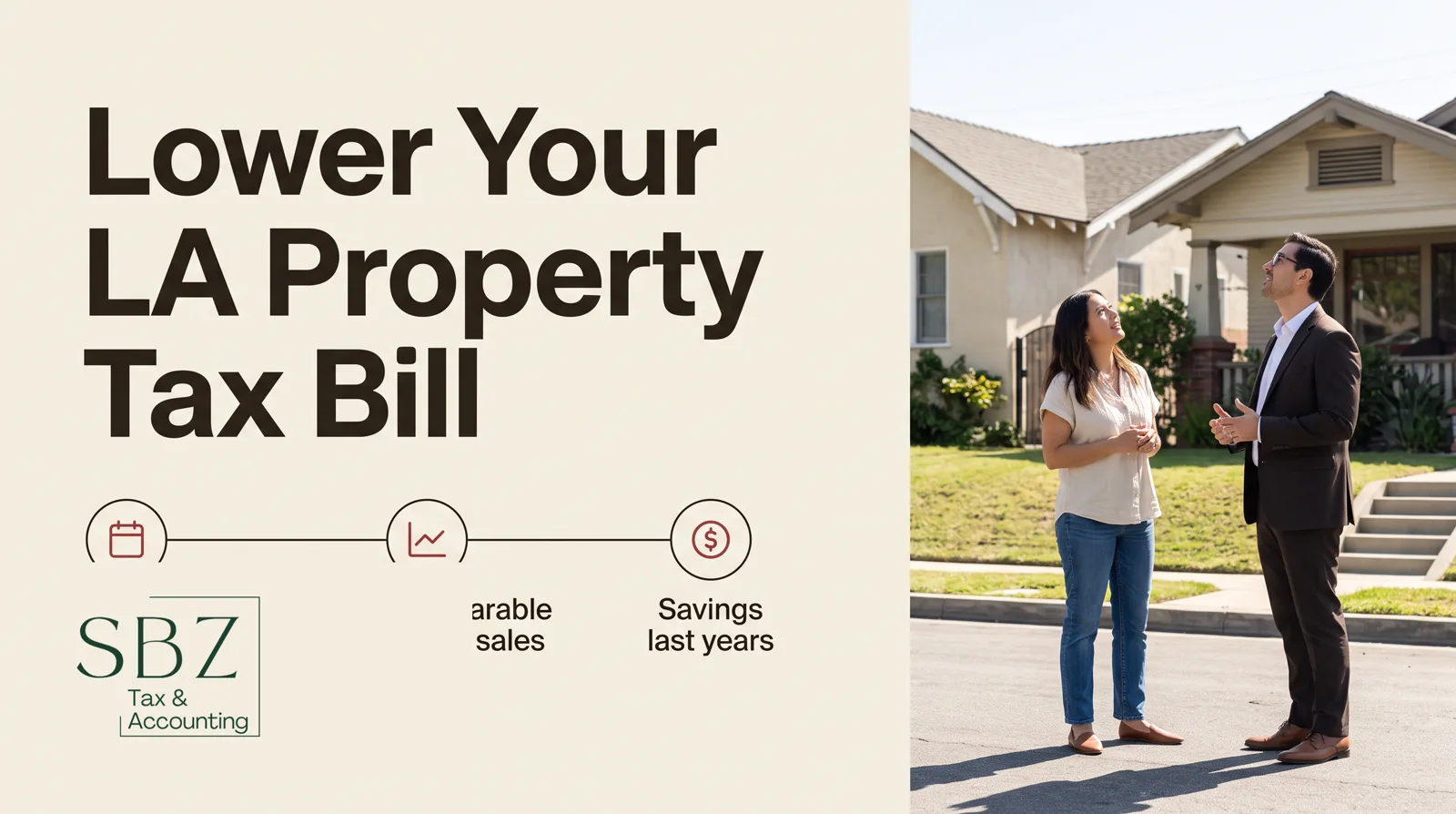
You can formally challenge your Los Angeles County property tax assessment if you believe the Assessor's valuation exceeds your property's actual market value — and a successful appeal can reduce your bill for multiple years, not just one.
Proposition 13 caps annual increases at 2%, but that base-year assessment can still be wrong. Properties get re-assessed at purchase, after major improvements, and when values decline — each of those events is a point where the Assessor can get the number wrong.
Here's how the appeal process works, what it takes to build a case, and how to decide whether filing makes sense for your situation.
What Qualifies as Grounds for an Appeal?
The Los Angeles County Assessment Appeals Board (AAB) accepts challenges on one main basis: your assessed value exceeds the property's full cash value as of January 1 of the tax year.
In practice, that usually means one of two things:
- Decline in value (Proposition 8): Your property's current market value has dropped below its assessed value. This is the most common successful appeal scenario when the market softens.
- Base-year error: The Assessor used incorrect comparables, included property that shouldn't have been assessed, or made a factual error when setting the value at the time of purchase or new construction.
Understanding how the Assessor arrives at your number in the first place makes your appeal stronger — how property assessments work in Los Angeles County walks through that process. For a broader look at the statewide framework, how California property taxes work provides useful context.
What Are the Filing Deadlines?
This is the part people miss most often.
For the regular assessment roll — the value that drives your annual property tax bill — the appeal window runs July 2 through November 30. Miss that window and you wait until the following year.
For supplemental assessments, which are triggered by a change in ownership or new construction, you have 60 days from the date on the supplemental notice. That's a separate deadline from the regular roll, and it catches a lot of property owners off guard.
File using the "Application for Changed Assessment" (Form AAB-4) with the Los Angeles County Assessment Appeals Board. There's a filing fee; as of recent years it ranges from $30 to a few hundred dollars depending on the assessment type. Verify the current fee schedule on the AAB's website before filing, since those figures change.
How Does the Appeal Process Actually Work?
Once your application is accepted, you have two paths: an informal review with the Assessor's office, or a formal hearing before the AAB.
Informal review first. Many appeals resolve before reaching a board hearing. After you file, the Assessor's office typically contacts you to discuss your evidence. If they agree the value is off, they can adjust it administratively — faster and simpler than a full hearing.
Formal hearing if needed. If the informal review doesn't produce a resolution, your case goes to a three-member AAB panel. You present evidence, the Assessor presents theirs, the board decides. Hearings are quasi-judicial: structured, recorded, and decided on submitted evidence. You can represent yourself or hire a licensed tax agent or attorney.
The burden of proof rests with you. You must show, with documentation, that the assessed value exceeds fair market value. The board doesn't split the difference as a default.
What Evidence Actually Wins Appeals?
The strongest appeals are built on comparable sales data, not a feeling that your assessment seems high.
Gather:
- Recent comparable sales — properties similar in size, condition, location, and use that sold near January 1 at prices lower than your assessed value
- An independent appraisal — not required, but it significantly strengthens your position when the gap between assessed and market value is large
- Property condition documentation — deferred maintenance, structural issues, or Assessor errors (wrong square footage, incorrect lot size)
- Income data for rental properties — a capitalized income approach is sometimes more favorable than comparable sales for income-producing real estate
For rental property owners, reducing assessed value is one piece of the tax picture. What Lancaster landlords can deduct on their taxes covers the deduction side, and tax deductions for real estate agents in California is useful if you're a real estate professional who also owns investment property.
If Your Appeal Is Approved, What Changes?
The board sets a new assessed value, and the Assessor recalculates your bill. You receive a refund or credit for any overpayment.
For Proposition 8 (decline-in-value) reductions, the adjustment is temporary. The Assessor reviews your value annually and can restore the higher base-year value once the market recovers — without a new hearing on your end. Watch your annual assessment notice; if the value gets restored and you believe it's premature, you can appeal again.
For base-year errors, corrections tend to be more durable.
Does a Lower Assessment Affect Your Income Taxes?
Not directly, but there's a ripple effect worth knowing.
Property taxes are deductible for income tax purposes when the property is used in a business or as a rental. A successful appeal that lowers your property tax bill reduces that deduction proportionally — so the net benefit is slightly smaller than the face-value savings.
If you hold multiple properties or use real estate in a business, working through the full picture with a tax professional is worth the time. Tax planning services and fractional CFO support can help you model the real after-tax impact, especially when you're weighing appeal costs against projected savings.
For more on reducing your overall property tax burden beyond the formal appeal process, how to lower your property taxes in Los Angeles County covers several angles worth considering.
Is It Worth Filing?
Run the math before you decide.
If your assessed value is $700,000 and fair market value is closer to $580,000, the potential annual savings at California's roughly 1.1% effective rate is around $1,300 per year. If a Prop 8 reduction holds for two or three years, that adds up fast.
The cost side: filing fees, your time preparing evidence, and potentially an independent appraisal (often $300–$700). If the assessed-vs-market gap is small, the math may not pencil out. If it's significant — particularly on commercial or investment property — it usually does.
Property owners across Los Angeles County who want help thinking through their overall tax position can find our team at our Palmdale office, and we also serve Lancaster and communities throughout the region, with remote service available nationwide. Book a free consultation if you want a second set of eyes on the numbers before you file.
Frequently asked questions
Can I appeal my property taxes every year?
Yes. You can file a new Application for Changed Assessment each year during the July 2 – November 30 window. If your property's market value remains lower than its assessed value in subsequent years, you can file again — prior appeals don't limit your ability to refile.
Do I need an attorney or tax agent to appeal?
No — you can represent yourself at an AAB hearing. An attorney or licensed tax agent can help when the amount at stake is large, the case involves complex valuation arguments, or you're not comfortable presenting evidence in a quasi-judicial setting. Agents typically charge a fee or a percentage of the tax savings.
How long does the process take?
Informal Assessor reviews can resolve in a few months. For formal hearings, California law gives the board two years to schedule your case, though many are heard sooner. File early in the window and expect the process to potentially extend into the following year.
Will filing an appeal cause my taxes to go up?
No. The Assessment Appeals Board cannot increase your assessment above the amount shown on your original notice. Filing carries no downside risk on the assessed value itself.
What if my assessment increased because I remodeled?
New construction and additions trigger a supplemental assessment separate from the regular roll. If you believe the Assessor overvalued the improvement, you can appeal the supplemental assessment within 60 days of receiving that notice — that deadline is separate from the July–November window for regular assessments.
This article is general information about the Los Angeles County property tax appeal process. It is not legal or tax advice for your specific situation. Assessment procedures, deadlines, and fee schedules change — confirm current requirements with the LA County Assessment Appeals Board before filing.