On this page
- What does the Los Angeles County Assessor actually do?
- Who collects the tax, then?
- How is my assessed value calculated?
- What causes the Assessor to reassess my property?
- How do I look up a parcel on the Assessor's website?
- What if my assessed value looks too high?
- Do I qualify for a homeowners' exemption?
- What does the Assessor mean for business owners?
- Can I deduct property taxes on my federal return?
- Frequently asked questions
- What should I do next?
Los Angeles County Tax Assessor: What the Assessor Does, and What It Doesn't
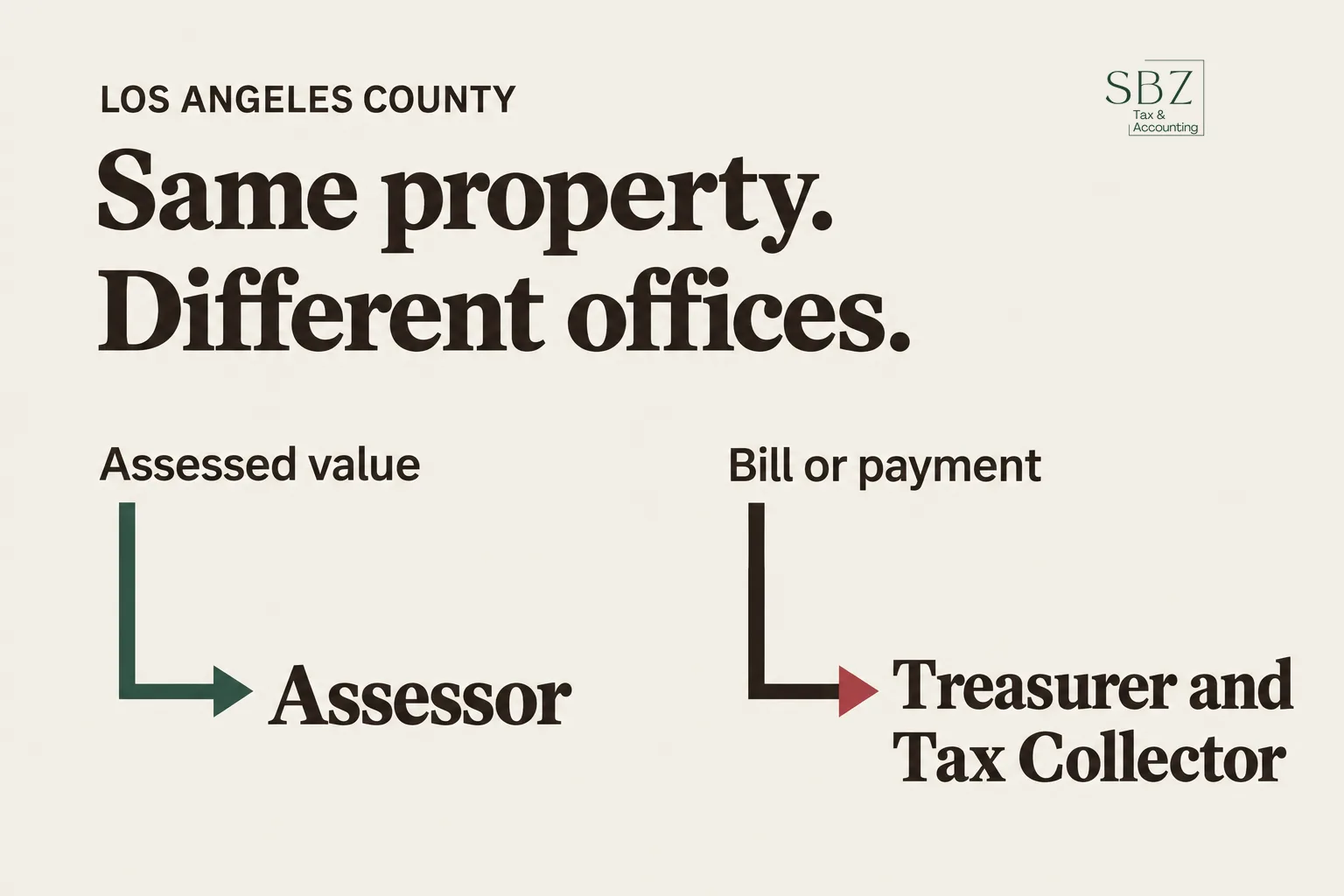
The Los Angeles County Assessor decides what your property is worth for tax purposes, but it does not send or collect your property tax bill. The Treasurer and Tax Collector handles billing and payment. Mixing up the two offices is the most common reason people call the wrong one and lose time.
Here's the short version of who does what, how to look up your own parcel, and what to do if the number on your assessment looks wrong.
What does the Los Angeles County Assessor actually do?
The Assessor's job is to find every taxable property in the county, identify its owner, and place a value on it. That value is called the assessed value. It is the figure the tax rate gets applied to.
The Assessor does not set tax rates, and it does not decide how much your bill is. Rates come from voter-approved measures and local agencies, and the base rate is capped by Proposition 13. For a deeper walk-through of the valuation side, see our guide on how property assessments work in Los Angeles County.
Who collects the tax, then?
The Los Angeles County Treasurer and Tax Collector issues the tax bills, takes payments, and handles delinquencies. If your question is "how do I pay," "I lost my bill," or "did my payment post," that's the office to contact.
Secured property tax bills generally come in two installments, and missing either one adds penalties. We cover the dates and what late payment costs in California property tax due dates.
How is my assessed value calculated?
Under Proposition 13, California property is assessed at its purchase price (the base-year value) and then allowed to increase by no more than 2% a year, even if the market rises faster. The tax is generally 1% of assessed value, plus local voter-approved charges.
That's why two similar homes on the same street can carry very different bills. The neighbor who bought in 2005 is working from an old base value. The owner who bought last year is working from a recent price. The part people miss is that your assessed value is not your market value, and it usually trails it.
What causes the Assessor to reassess my property?
Reassessment is triggered mainly by two events:
- A change in ownership. A sale, certain transfers, and some changes to trust or entity ownership can reset the base-year value to current market value.
- New construction. Adding square footage, a guesthouse, or a pool can add value to the roll for the new work.
A change in ownership usually comes with a supplemental assessment, which produces a separate bill on top of your regular one. Many people are surprised by it after closing. Rules for transfers between family members changed under Proposition 19, so check the current rules before assuming a parent-to-child transfer keeps the old value. Our overview of California property tax assessment rules and triggers covers these in more detail.
How do I look up a parcel on the Assessor's website?
The Assessor runs an online property search on its website. You can search by street address or by Assessor's Identification Number (AIN), the 10-digit parcel number. It shows details such as the assessed value, land and improvement split, year built, square footage, and recorded characteristics.
Check these details against reality. A wrong bedroom count, a square footage figure that's too high, or a missing exemption is easier to fix than a disagreement over market value. Also note that the Assessor's records are for tax purposes. They are not an appraisal, and they sometimes lag behind recent changes.
What if my assessed value looks too high?
There are two separate routes, and the right one depends on the problem.
Informal review with the Assessor. If you believe the Assessor's record is wrong or your property's market value has dropped below its assessed value, you can ask for a review. Under Proposition 8, a property can be temporarily assessed at its lower market value when values decline. The Assessor can adjust that value without a formal hearing.
Formal appeal. If the review doesn't resolve it, you can file an application with the county's Assessment Appeals Board. Filing windows are set by the county and are strict, so confirm the current dates before you plan around them. The process, evidence, and odds are laid out in Los Angeles property tax appeals, and can I lower my property taxes? covers the broader options.
An appeal only addresses value. It doesn't change tax rates or special assessments, and it won't help if your value is already lower than market.
Do I qualify for a homeowners' exemption?
If the property is your primary residence as of January 1, you can file for the homeowners' exemption with the Assessor. It reduces assessed value by a fixed amount, which means a modest annual savings. It is not a large number, but it's free and many owners miss it, especially after buying.
Other exemptions exist for veterans with qualifying disabilities and for certain other situations. Eligibility rules and amounts change, so confirm current figures with the Assessor before relying on any of them.
What does the Assessor mean for business owners?
The Assessor also values business personal property, such as equipment, furniture, computers, and leasehold improvements. Many businesses must file an annual Business Property Statement (Form BOE-571-L), generally due April 1, once their taxable property meets the county's filing threshold or they receive a request. Late filing can bring penalties.
This is where clean records pay off. If your fixed asset list is out of date, you can end up reporting property you disposed of, or leaving off property you bought. Good monthly bookkeeping makes that statement a ten-minute task instead of a scramble.
Can I deduct property taxes on my federal return?
Often yes, if you itemize, but there are limits. Only the value-based portion of the bill counts. Flat fees and special assessments for things like trash or lighting generally don't. The state and local tax (SALT) deduction is also capped, and the cap has changed recently, so check the current limit for the year you're filing.
Rental and business property is treated differently, since the taxes are an expense of the activity. How you structure that matters, which is one reason property owners bring it up in tax planning conversations.
Frequently asked questions
Is the Los Angeles County Assessor the same as the tax collector?
No. The Assessor determines the assessed value of each property. The Treasurer and Tax Collector issues the bill and accepts payment.
Can I search any property's assessed value?
Generally yes. Assessor records for property in the county are public, and the Assessor's online search lets you look up a parcel by address or AIN.
Why did my property taxes go up if the Assessor can only raise value 2% a year?
The 2% limit applies to the base value on an existing assessment. Your bill can still rise from a reassessment after a sale or new construction, a supplemental bill, or new voter-approved charges added to the base rate.
How do I challenge my assessment?
Start by checking the Assessor's record for errors and asking for an informal review. If that doesn't resolve it, you can file a formal application with the Assessment Appeals Board within the county's filing window.
What should I do next?
Pull up your parcel on the Assessor's site, confirm the basic facts, and check whether your exemptions are in place. Then compare your bill to your assessment before deciding whether a review or appeal is worth your time.
If you own rental property, run a business with equipment on the books, or got a supplemental bill you didn't expect, SBZ Tax can walk you through how it fits into your return. Call 818-748-2020, book a free consultation, or stop by the office at 190 Sierra Ct Ste 335, Palmdale, CA 93550. We're local if you're in Palmdale, and we work with clients across Los Angeles County and remotely nationwide.
This article is general information, not tax advice for your specific situation. Talk with a qualified professional before making decisions based on it.