On this page
- What is IRS Form 3520?
- Who has to file Form 3520?
- Do I have to report a foreign gift or inheritance?
- When is Form 3520 due, and where does it go?
- What is Form 3520-A, and how is it different?
- What are the penalties for not filing Form 3520?
- How does Form 3520 relate to the FBAR and Form 8938?
- What should I do if I missed a Form 3520 filing?
- Frequently asked questions
IRS Form 3520: Who Has to File It, What It Reports, and When It's Due
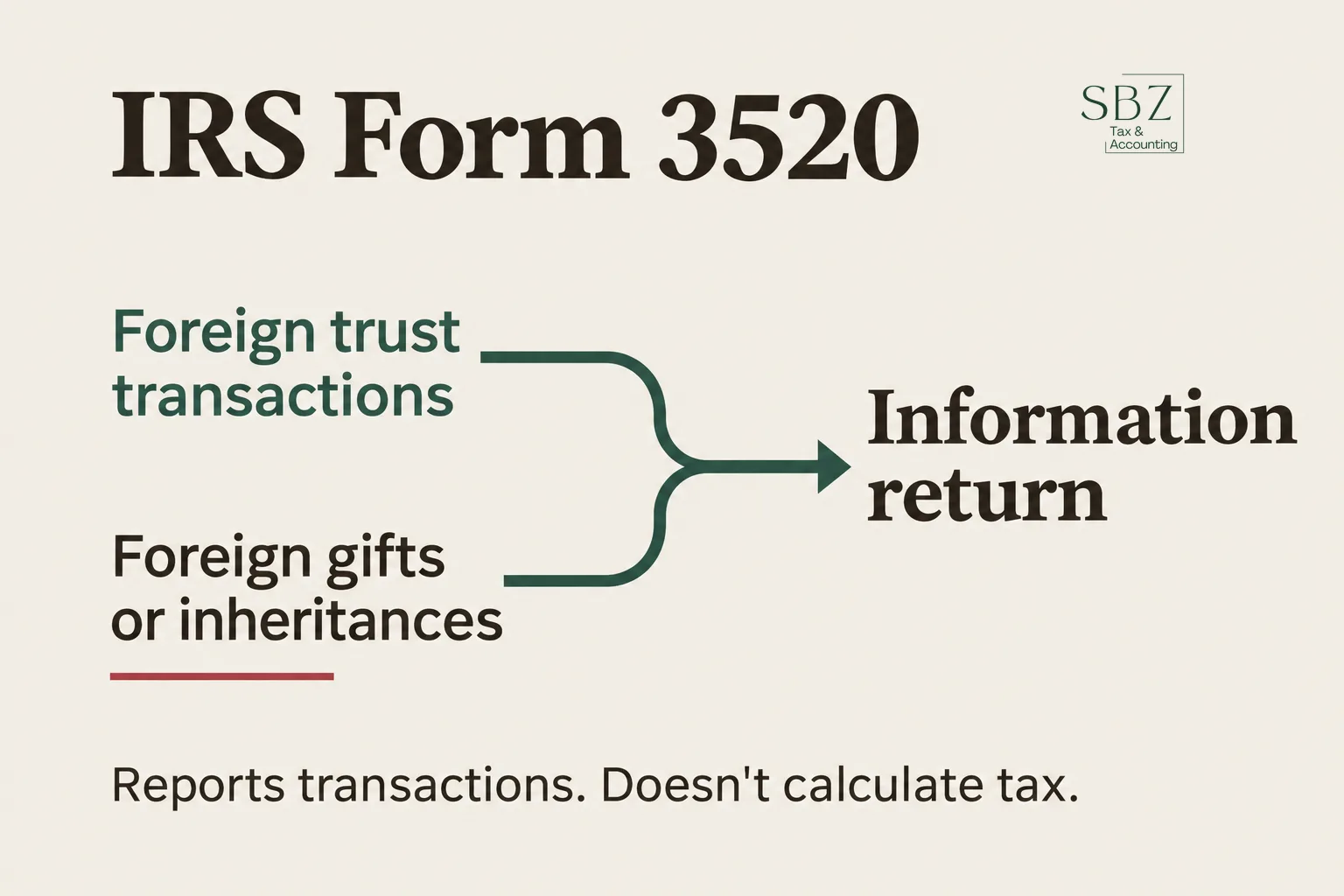
IRS Form 3520 is an information return that U.S. taxpayers file to report certain transactions with foreign trusts and to report large gifts or bequests received from foreign persons. It doesn't calculate tax. It tells the IRS that the transaction happened, and the penalties for leaving it out can be steep.
Here's the short version of who needs it, what goes on it, and what to do if you've missed it.
What is IRS Form 3520?
The full title is "Annual Return To Report Transactions With Foreign Trusts and Receipt of Certain Foreign Gifts." It covers two separate situations that happen to share one form: dealings with foreign trusts, and gifts or inheritances from abroad.
A U.S. person can be a citizen, a resident alien, a domestic partnership, a domestic corporation, or a domestic estate or trust. The form is filed by the person with the reporting obligation, not by the foreign trust or the foreign donor.
Who has to file Form 3520?
You generally file if, during the tax year, any of these apply to you:
- You created a foreign trust, or transferred money or property to one.
- You received a distribution from a foreign trust, directly or indirectly.
- You are treated as the owner of any part of a foreign trust under the grantor trust rules.
- You received gifts or bequests from foreign persons above the reporting thresholds.
Several of these overlap with other filings. A U.S. owner of a foreign trust may also have Form 3520-A and foreign-account reporting to think about, which is why these cases rarely get handled in isolation.
Do I have to report a foreign gift or inheritance?
Only if it crosses the threshold. A gift or inheritance from a foreign person is generally not taxable income to the recipient, but it can still be reportable.
The two thresholds that matter most:
| Source of the gift or bequest | Reporting threshold (aggregate for the year) |
|---|---|
| Nonresident alien individual or foreign estate | More than $100,000 |
| Foreign corporation or foreign partnership | A smaller amount, adjusted annually for inflation |
The corporation and partnership figure changes every year, so check the current Form 3520 instructions rather than relying on a number from an older article. Gifts from related foreign persons can be combined for the threshold test, and the form asks for details on any single gift above a smaller per-gift amount.
This is the part people miss: a family inheritance from a relative abroad can trigger a filing even though no tax is owed. If you're a U.S. person and a parent overseas leaves you money, the question isn't "do I owe tax?" but "does this need to be reported?"
When is Form 3520 due, and where does it go?
Form 3520 is due on the same date as your income tax return for the year, including extensions. For most individuals that's April 15, extended to October 15 if you file an extension. If you need more time on the income tax return, see how a tax extension works for businesses and note that individual extensions are handled differently.
Two details trip people up. The form is filed separately from your income tax return, not attached to it, and it goes to the IRS service center listed in the current instructions. Check the instructions for the mailing address and whether any electronic filing option is available for the year you're filing. Keep proof of mailing.
What is Form 3520-A, and how is it different?
Form 3520-A is the annual information return of a foreign trust with a U.S. owner. The foreign trust itself is responsible for filing it, though the U.S. owner is the one exposed to the penalty if it isn't filed.
| | Form 3520 | Form 3520-A |
|---|---|---|
| Filed by | The U.S. person (owner, transferor, or recipient) | The foreign trust (for a trust with a U.S. owner) |
| Due date | Same as your income tax return, with extensions | 15th day of the 3rd month after the trust's tax year ends |
| Extension | Follows your return extension | Six-month extension available with Form 7004 |
The U.S. owner also generally attaches a copy of the foreign grantor trust owner statement to their own Form 3520 if the trust doesn't file 3520-A. Confirm the current rules in the form instructions.
What are the penalties for not filing Form 3520?
The penalties are not based on tax owed, which is why they feel out of proportion. In general terms:
- Foreign trust reporting failures: an initial penalty can be the greater of $10,000 or a percentage of the amounts involved, with continuing penalties if the failure isn't corrected after IRS notice.
- Foreign distributions: a percentage of the distribution, often cited at 35%.
- Foreign gifts: 5% of the gift per month it goes unreported, capped at 25%.
- Missing Form 3520-A: a percentage of the trust assets treated as owned by the U.S. person.
Exact percentages and caps are set in the instructions and the Internal Revenue Code, so verify the current figures. The IRS can waive penalties for reasonable cause, but the burden is on the taxpayer, and "I didn't know" is a hard argument to win by itself.
How does Form 3520 relate to the FBAR and Form 8938?
They're separate obligations that sometimes apply to the same facts. Form 3520 reports trust transactions and foreign gifts. The FBAR reports certain foreign financial accounts, and Form 8938 reports specified foreign financial assets above certain thresholds. If you receive an inheritance and keep the money in a foreign bank account, you may have more than one form in play.
If foreign taxes were paid on the same income, Form 1116 may also come into it. Large gifts in the other direction, from you to someone else, are a different filing, covered in the gift tax return guide.
What should I do if I missed a Form 3520 filing?
Don't ignore it, and don't assume it will go away. A rough order of operations:
- Gather the trust documents, distribution records, or gift details, including dates and amounts in both foreign currency and U.S. dollars.
- Figure out which years are affected. Each year is its own filing.
- Talk to a professional before filing, because how you come forward can affect the penalty outcome.
- If you receive a penalty notice, respond within the deadline stated. IRS and state tax problem help covers what that process looks like.
SBZ Tax works with individuals and families whose situations cross borders, from our Palmdale office and remotely nationwide. If you'd like to talk through a trust, a foreign inheritance, or a late filing, call 818-748-2020, visit us at 190 Sierra Ct Ste 335, Palmdale, CA 93550, or book a free consultation. Ongoing planning for these situations falls under tax planning, and you can see pricing up front.
This is general information, not tax advice for your specific situation. Talk to a qualified tax professional before filing.
Frequently asked questions
Is a foreign inheritance taxable in the U.S.?
Generally no, a gift or inheritance is not income to the recipient under federal law. But it may still need to be reported on Form 3520 if it exceeds the threshold, and any income the inherited assets later earn is taxable in the usual way.
Can I e-file Form 3520?
Form 3520 has historically been filed on paper and mailed separately from your return. Check the current instructions each year, because electronic filing options can change.
Who files Form 3520-A?
The foreign trust files it, for a trust that has a U.S. owner. Because the U.S. owner bears the penalty if it's missing, many owners make sure it's filed on the trust's behalf.
Does a small foreign gift from a relative need to be reported?
Not if the total from nonresident alien individuals and foreign estates for the year stays at or below $100,000. Gifts from foreign corporations or partnerships have a lower threshold, so check the current figure.
Can penalties for late Form 3520 be removed?
They can be, if you show reasonable cause and not willful neglect. Approval isn't automatic, so documentation and timing matter.