On this page
Gift Tax Return (Form 709): Who Has to File It and When It's Due
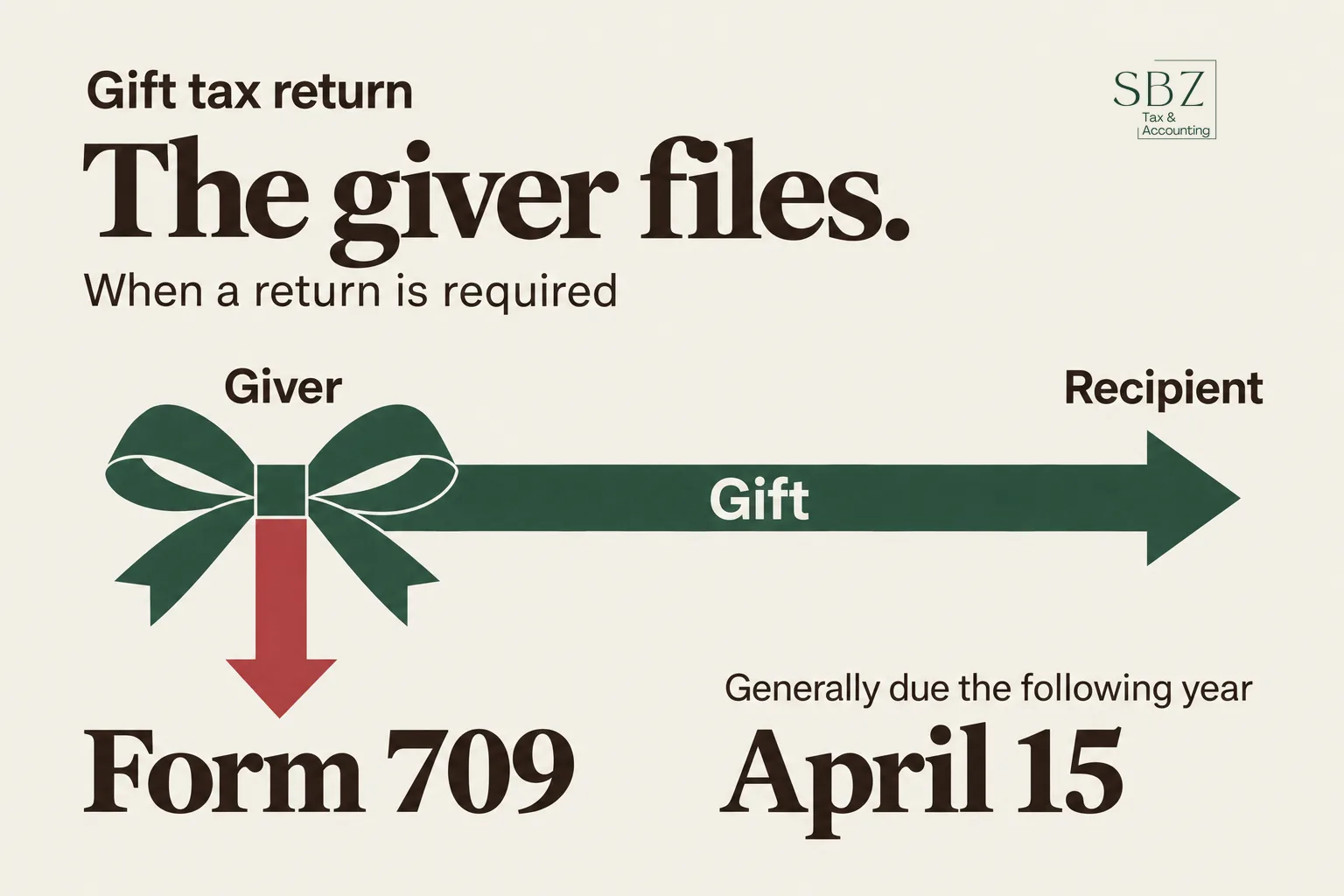
A gift tax return is IRS Form 709, and the person who gives the gift files it, not the person who receives it. You generally need one when you give any single person more than the annual exclusion in a year, or when you do certain other things, like splitting gifts with a spouse. Most people who file never owe a dollar of gift tax.
Here's the short version of how it works, who has to file, and what actually matters.
What is a gift tax return?
A gift tax return, Form 709 (United States Gift (and Generation-Skipping Transfer) Tax Return), reports taxable gifts you made during the calendar year. It's an information return first and a tax bill almost never.
The reason is the lifetime exemption. Gifts above the annual exclusion don't trigger tax right away. They're tracked against a large lifetime amount, and tax is owed only after that total is used up. Form 709 is how the IRS keeps that running tally.
The part people miss: the recipient reports nothing. A gift is not income to the person who receives it, so it doesn't go on their Form 1040.
Who has to file a gift tax return?
You generally must file Form 709 if any of these apply for the year:
- You gave one person more than the annual exclusion in gifts of a present interest.
- You and your spouse want to split gifts, meaning treat a gift from one of you as made half by each.
- You gave a gift of a future interest, such as a gift in trust that the recipient can't use right away, of any amount.
- You gave your spouse something that isn't covered by the unlimited marital deduction, such as certain terminable interests, or more than the annual limit to a spouse who isn't a U.S. citizen.
The annual exclusion is set by the IRS and is adjusted for inflation periodically. For 2025 and 2026 it is $19,000 per recipient. Because annual limits change, confirm the current figure on the IRS site before you file.
The exclusion is per recipient, not per year in total. You can give $19,000 each to as many people as you like without a filing requirement on that basis.
What counts as a gift?
Any transfer of money or property where you don't receive full value in return. Cash, stock, real estate, a car, forgiving a loan, or adding someone to the title of a property can all be gifts.
A few things are not taxable gifts and don't need to be reported on Form 709 for that reason:
- Gifts to a U.S.-citizen spouse (unlimited marital deduction)
- Gifts to a qualifying charity
- Tuition you pay directly to a school for someone else
- Medical expenses you pay directly to the provider for someone else
The "directly" part matters. If you hand a relative cash and they pay tuition, that's an ordinary gift. If you pay the school yourself, it generally isn't.
What's on Form 709?
Form 709 asks for each gift's date, recipient, description, and value, along with your election choices. It then applies the annual exclusion and any gift splitting, and tracks the taxable remainder against your lifetime exemption.
Valuation is where returns get complicated. Cash is easy. Closely held business interests, real estate, and anything without a clear market price usually need a qualified appraisal, and the IRS expects adequate disclosure for those gifts.
Two elections come up often:
- Gift splitting. Married couples can treat a gift from one spouse as made half by each, effectively doubling the exclusion. Both spouses must consent, and the return is required even if the gift is under the doubled amount.
- 529 plan front-loading. You can elect to spread a large 529 contribution over five years of annual exclusions. That election is made on Form 709.
Is there a lifetime limit, and will I owe tax?
There is a lifetime estate and gift tax exemption, and for 2026 it is $15 million per person, indexed for inflation after that. Gifts above the annual exclusion reduce that amount, and gift tax comes due only when the lifetime total is exhausted.
So filing a gift tax return typically just records a use of exemption. If you're well under the limit, you'll file and owe nothing. For households with larger estates, how and when gifts are made is part of broader tax planning, and it's worth looking at before the gift rather than after.
California has no state gift tax. This is a federal filing.
When is a gift tax return due?
Form 709 is due April 15 of the year after the gift. A gift made in 2026 is reported on a return due in April 2027. If that date falls on a weekend or holiday, the deadline moves to the next business day.
An extension of time to file your income tax return (Form 4868) also extends the time to file Form 709. There's also a separate extension request for Form 709 on its own, Form 8892. Neither extends the time to pay any gift tax actually owed. For the income side of extensions, see our guide to the California tax extension.
If you miss the date, file as soon as you can. Penalties are generally tied to unpaid tax, so a late return with no tax due is usually low-stakes, but don't let it sit. Our post on what to do if you missed the filing deadline covers the order to handle it in, and an IRS notice is much easier to resolve when you respond quickly.
Do I need a professional to file it?
Not always. A simple return with cash gifts and a clear exclusion can be done by the donor. But valuation, gift splitting, trusts, and business-interest transfers are where mistakes happen, and an incorrect return can leave the statute of limitations open on the gift.
If you're handling an estate, a related filing may come up too, such as Form 1041 for the estate or trust. SBZ Tax works with individuals and families on these filings, including private-client matters that need discretion, and you can see how we price work on the pricing page.
Frequently asked questions
Does the person receiving a gift have to file a gift tax return?
No. The giver files Form 709. The recipient generally reports nothing on their income tax return, since a gift isn't taxable income to them.
Do I have to file a gift tax return if I gave less than $19,000?
Usually not, if the gifts to each person are under the annual exclusion and are present-interest gifts. Exceptions include gift splitting with a spouse and gifts of future interests, which require a return regardless of amount.
Do I have to pay gift tax when I file?
Rarely. Taxable gifts reduce your lifetime exemption first, and tax is owed only after that is used up.
Can a married couple file one gift tax return together?
No. Form 709 is filed per individual, with no joint version. Each spouse who made gifts files their own, and spouses who split gifts each report the split.
Is there a gift tax return for gifts to my spouse?
Gifts to a U.S.-citizen spouse are generally unlimited and not taxable, so no return is typically needed. Gifts to a spouse who isn't a citizen have a lower annual limit.
This article is general information, not tax advice for your specific situation. Gift and estate rules depend on your facts, so talk to a qualified professional before you give or file. If you'd like a second set of eyes, call SBZ Tax at 818-748-2020, book a free consultation, or visit our office at 190 Sierra Ct Ste 335, Palmdale, CA 93550.