On this page
- What is the sales tax rate in LA County?
- How is the LA County sales tax rate built?
- Why does the rate differ from city to city?
- How do you find the exact rate for an address?
- Who has to collect and report LA County sales tax?
- What about purchases where no sales tax was charged?
- What are the common sales tax mistakes for small businesses?
- Is sales tax the same as property tax or income tax?
- What's the next step if you sell taxable goods in LA County?
- Frequently asked questions
LA County Sales Tax: Current Rate, What It's Made Of, and Who Collects It
The base sales tax rate in Los Angeles County is 9.75% as of this writing, and a number of cities add more on top, so your actual rate depends on where the sale happens. Tax rates change when voters approve new measures, so confirm the current figure before you rely on it for pricing or filing. Here's how the rate is built, how to look up the exact one, and what it means if you sell taxable goods.
What is the sales tax rate in LA County?
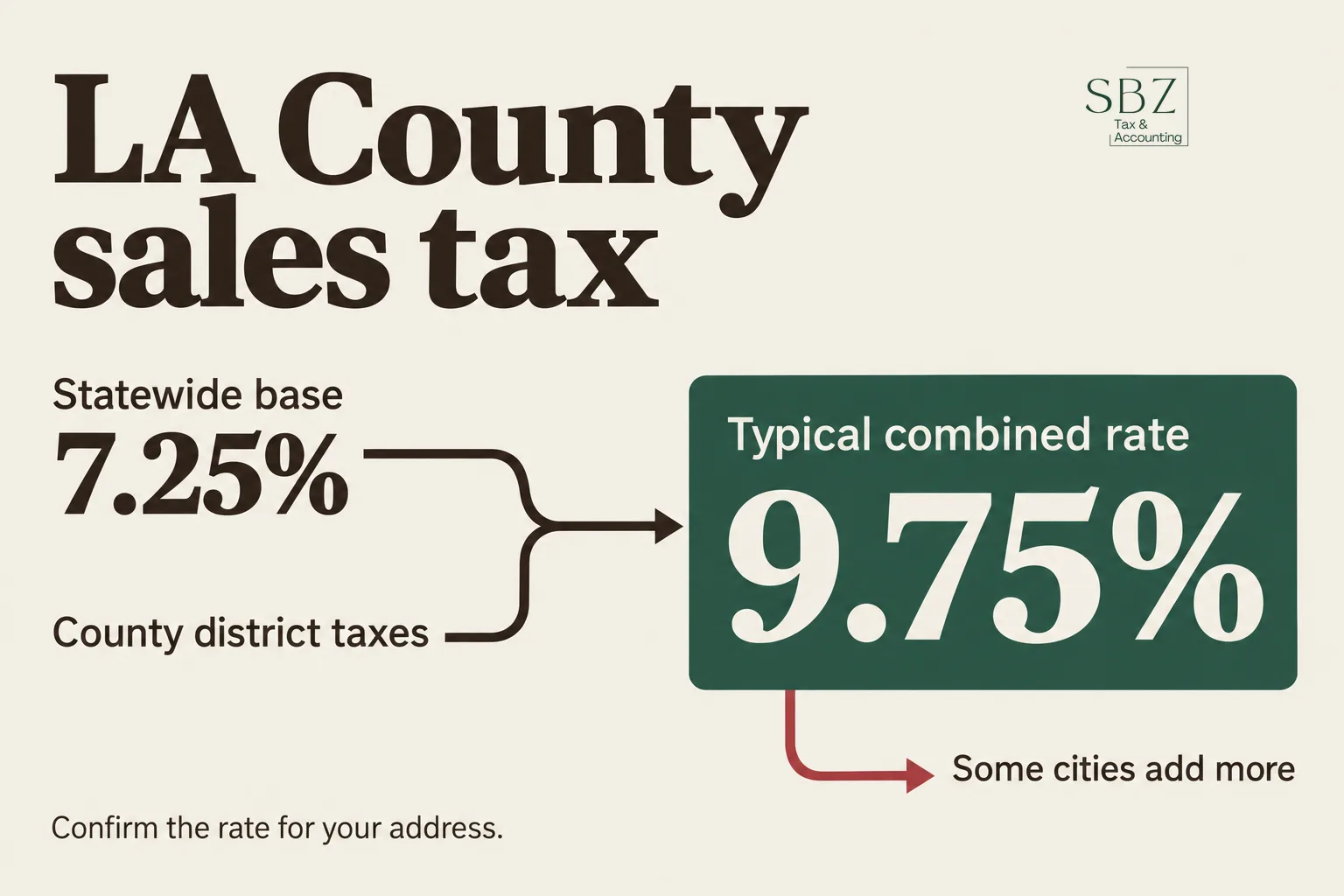
For most of the county, the combined rate is 9.75%. That figure covers the statewide base rate plus several county transit and services measures voters approved over the years.
Some cities sit above that number because they passed their own local add-on. Rates in the 10% to 11% range exist in parts of the county, so "LA County sales tax" is really a family of rates, not one number. The rate that applies is the one for the location where the sale is sourced, which usually means the district where the buyer takes delivery or where the retail location sits.
How is the LA County sales tax rate built?
The combined rate is a stack. The statewide base is 7.25%, and the county layers district taxes on top.
| Piece | Approximate rate |
|---|---|
| Statewide base rate (state and local uniform portions) | 7.25% |
| Transit and transportation measures (Prop A, Prop C, Measure R, Measure M) | 0.50% each |
| Homelessness services measure (Measure A, replacing the older Measure H) | 0.50% |
| Typical county combined rate | 9.75% |
Treat the individual district pieces as a general picture, not a filing reference. The California Department of Tax and Fee Administration (CDTFA) publishes the official breakdown by jurisdiction, and that is the source to cite on a return.
Why does the rate differ from city to city?
Cities and special districts can ask voters to approve extra local sales tax, called a district tax or transactions and use tax. When one passes, everything sold inside that boundary carries the higher rate.
The part people miss is that the boundary is the tax district, not the mailing address. Two neighboring addresses can carry different rates, and a business with a mailing address in one city can sit inside another city's tax district. If you're in the Antelope Valley, our guides for tax services in Palmdale and tax services in Lancaster cover how local rules touch a small business. For the San Fernando Valley and westside areas, the same logic applies in places like Glendale and Calabasas.
How do you find the exact rate for an address?
The CDTFA offers a free online lookup where you enter a street address and get the combined rate for that spot. Use it for any sale tied to a specific location, including deliveries.
Keep a screenshot or printout of the lookup with your records, dated. If a rate changes mid-year, you'll want proof of which rate you applied and when. Rates generally change on the first day of a calendar quarter, which is a good habit to build a quarterly rate check around.
Who has to collect and report LA County sales tax?
Retailers selling tangible goods in California generally need a seller's permit from the CDTFA. The permit authorizes you to collect sales tax from customers, and the tax you collect is held for the state, not kept as revenue.
Many services are not subject to sales tax, but the line isn't always intuitive. A shop that sells goods and also charges for labor may owe tax on only part of the invoice, depending on how the charges are stated. If you aren't sure whether your product or service is taxable, ask before you collect, because over-collecting and under-collecting both create problems.
Filing frequency (monthly, quarterly, or yearly) is assigned by the CDTFA based on your expected taxable sales. Returns are due even in a period with no sales.
What about purchases where no sales tax was charged?
If you buy taxable items from an out-of-state seller who doesn't charge California tax, you may owe use tax at the rate for your location. It's the companion to sales tax, and it applies to business equipment as often as consumer purchases. Our explainer on California use tax walks through who owes it and how to report it.
What are the common sales tax mistakes for small businesses?
A few show up repeatedly:
- Using the wrong rate. Applying a flat 9.75% to every sale when some deliveries land in higher-rate districts.
- Mixing sales tax into revenue. Collected tax belongs in a liability account, not income. Clean monthly bookkeeping keeps this straight.
- Missing a filing. Late returns generate penalties and interest, and unpaid sales tax can become a serious collection matter. If that has already happened, see our overview of IRS and state tax problem help.
- Ignoring other local taxes. Lodging, for example, is covered separately. See what transient occupancy tax is in California.
Is sales tax the same as property tax or income tax?
No. Sales tax is charged at the point of sale and administered by the CDTFA. Property tax is assessed on real estate value, and income tax is based on what you earn. If you landed here while researching a property question, the Los Angeles County tax assessor article explains what that office does and doesn't handle.
What's the next step if you sell taxable goods in LA County?
Start in this order: confirm you hold a seller's permit, look up the rate for each place you sell or deliver, and set up a separate account for collected tax. Then mark your filing due dates on a calendar, and reconcile your sales records to your returns each period.
If you'd like a second set of eyes on how your sales tax is set up, the tax planning services page shows how we work, or you can book a free consultation. SBZ Tax is at 190 Sierra Ct Ste 335, Palmdale, CA 93550, and you can call 818-748-2020 or stop by. Remote service is available nationwide. This article is general information, not tax advice for your specific situation, so talk to a qualified professional about yours.
Frequently asked questions
What is the sales tax in LA County right now?
Most of Los Angeles County has a combined rate of 9.75%, though some cities charge more. Check the CDTFA's address lookup for the exact rate, since rates can change.
Is LA County sales tax the same in every city?
No. Cities and special districts can add their own voter-approved tax, so rates vary by location. The applicable rate depends on the tax district where the sale is sourced.
Do I need a seller's permit to collect sales tax in LA County?
Generally yes, if you regularly sell taxable tangible goods in California. The permit comes from the CDTFA, which also assigns your filing schedule.
Do I owe sales tax if I sell online to LA County customers?
Often yes. California taxes sales delivered to buyers here, and the rate generally follows the delivery location. Thresholds and marketplace rules can change who is responsible for collecting, so confirm your situation.
What happens if I don't file a sales tax return?
The CDTFA can assess penalties and interest, and it can pursue collection of the unpaid balance. Filing on time, even with zero sales, avoids most of that exposure.