On this page
- Do I have to report self-employment income if I didn't get a 1099?
- Why might I not have received a 1099?
- How do I figure out what I earned?
- How do I actually file it?
- What is self-employment tax, and why does it surprise people?
- Do I need to make estimated tax payments?
- What if the IRS has a 1099 I don't have?
- What if I already filed without reporting this income?
- What's the best next step?
- Frequently asked questions
Filing Taxes Self-Employed With No 1099: What You Report and How
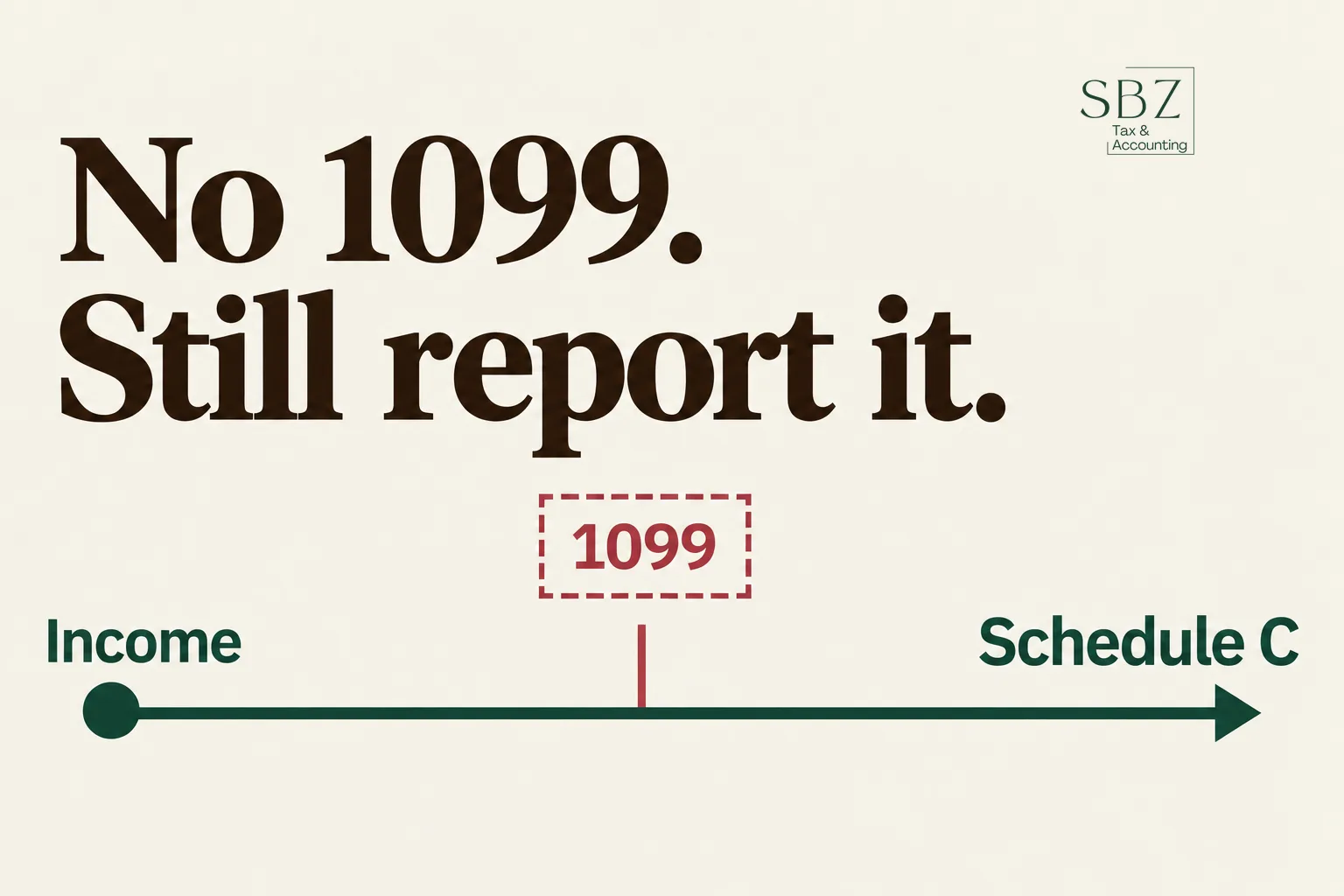
Yes, you still file and report every dollar of self-employment income, even if no client ever sent you a 1099. A 1099 is an information return the payer files. It isn't what makes the income taxable.
The short version: total up what you were actually paid, subtract legitimate business expenses on Schedule C, and pay income tax plus self-employment tax on the net. The rest of this article walks through how.
Do I have to report self-employment income if I didn't get a 1099?
You do. Income from self-employment is taxable when you earn it, whether it arrives as cash, a check, a transfer, or a payment app deposit.
The 1099 only tells the IRS what a payer says they paid you. Plenty of legitimate situations produce no form: a client paid under the reporting threshold, a payer skipped the paperwork, or you were paid by individuals rather than businesses. None of those change your reporting duty.
Filing is generally required once your net self-employment earnings reach $400 for the year, even if you owe no regular income tax. Thresholds for filing and for payers issuing forms are adjusted from time to time, so confirm the current figures for the tax year you're filing.
Why might I not have received a 1099?
There are a few common reasons, and most are harmless:
- The payment was below the payer's reporting threshold. Payers only have to issue certain 1099s once payments cross a set dollar amount, and that amount has changed in recent years.
- The payer wasn't a business. Neighbors, private customers, and families paying for a service typically don't file 1099s.
- You were paid through a platform that reports differently. Payment apps and marketplaces may send a Form 1099-K, or nothing, depending on volume.
- The payer simply didn't file. That's their compliance problem, but the income is still yours to report.
If you expected a form and it never came, ask the payer once, in writing. Don't wait on it to file. If you have a missing form from a client you worked for, you can still file using your own records.
How do I figure out what I earned?
Build the number from your own records, not from forms. Start with the places money actually landed.
- Bank and card statements. Pull every deposit for the year from each account you use for business, and personal accounts too if client money ended up there.
- Payment apps. Export the annual history from each one you used.
- Invoices and contracts. These show what you billed, which helps you spot anything that was paid in a way you forgot about.
- Cash. If you took cash, you need a log. A simple dated list of customer, amount, and what the work was is enough.
Then separate business income from non-income deposits such as transfers between your own accounts, loan proceeds, or refunds. Mixing personal and business money makes this step slower and error-prone, which is a big reason many self-employed people eventually move to monthly bookkeeping.
How do I actually file it?
Self-employment income goes on Schedule C (Profit or Loss From Business), which attaches to your Form 1040. If you want the line-by-line mechanics, our guide to the Schedule C tax form covers what each section asks.
In plain terms, the flow looks like this:
- Enter your gross receipts on Schedule C. No 1099 is required to do this.
- Subtract your ordinary and necessary business expenses. See what business expenses are actually tax deductible for the categories that usually apply.
- The result is your net profit, which flows to your Form 1040.
- Schedule SE calculates self-employment tax on that net profit.
If you work from home and meet the requirements, the home office deduction may apply too. The walkthrough on Form 8829 explains how it's calculated.
What is self-employment tax, and why does it surprise people?
Self-employment tax is how you pay Social Security and Medicare as your own employer and employee. The rate is 15.3% applied to 92.35% of your net self-employment earnings, with the Social Security portion subject to an annual wage cap.
It's separate from income tax, and it's often the larger shock for people filing their first self-employed return. Half of it is deductible in figuring your adjusted gross income, which softens the blow slightly, but it doesn't disappear.
Do I need to make estimated tax payments?
Often, yes. No employer is withholding from your income, so the IRS generally expects you to pay as you go through quarterly estimates if you expect to owe a meaningful amount at filing.
If you skipped them this year, you may owe an underpayment penalty on top of the tax. It's a calculation, not a punishment for being new, and there are safe-harbor rules that limit it. For the schedule and how to size each payment, see quarterly estimated taxes for the self-employed and estimated tax penalties and how to avoid them.
What if the IRS has a 1099 I don't have?
This is the part people miss. The IRS can have a form that you never received, or that you lost. If a payer did file a 1099-NEC or 1099-K in your name, the IRS matches it against your return. Leave that income off and you may get a notice proposing additional tax.
You can check by requesting your account and wage and income information through an IRS transcript request. It's a smart step before filing if you worked with several clients and aren't sure who reported what.
If the figures on a form are wrong, ask the payer for a corrected version. If they won't, report what's true and keep documentation showing why.
What if I already filed without reporting this income?
If you left self-employment income off a return you've already filed, you generally fix it by amending. Our explainer on Form 1040-X covers when amending makes sense and how to do it. Correcting it yourself is usually a better position than waiting for a notice, and if one has already arrived, IRS tax problem help is the right place to start.
Underreporting also draws attention. Consistent, documented reporting is part of staying out of the pile; see what triggers an IRS audit for small business owners.
What's the best next step?
If you're staring at a year of deposits and no forms, work in this order: gather every statement and payment app export, separate business income from non-income deposits, total your receipts, then list your expenses with receipts or statement lines to back them.
Once that's done, the return itself is straightforward. If you'd rather not do it alone, SBZ Tax works with self-employed taxpayers across the U.S., and you can see how our services are priced or book a free consultation. You can also call 818-748-2020 or visit our office at 190 Sierra Ct Ste 335, Palmdale, CA 93550.
This article is general information, not tax advice for your specific situation. Talk to a qualified tax professional before making decisions about your return.
Frequently asked questions
Do I need a 1099 to file my taxes as self-employed?
No. You file using your own records of income and expenses. A 1099 is just a payer's report of what they paid you.
What happens if I don't report income that has no 1099?
You risk additional tax, interest, and possible penalties if the IRS finds it later. Unreported income can surface through bank records, third-party reports, or a client's own deductions.
Can I deduct expenses if I have no 1099?
Yes. Business expenses are deductible based on whether they're ordinary and necessary for your work, not on whether you received a form. You need records, such as receipts or statements, to support them.
What if I only earned a small amount from side work?
It's still reportable. If your net self-employment earnings reach the filing threshold, you generally owe self-employment tax and must file, even with a small total.
Can a payer send me a 1099 after I've filed?
It can happen, and a corrected or late form may show a different amount than you reported. If it does, compare it to your records and amend your return if your original numbers were wrong.