On this page
- Are moving expenses a tax deduction in 2025 and 2026?
- Who can still deduct moving expenses?
- What moving costs counted before the suspension?
- Can a self-employed person deduct moving expenses?
- What if I work from home after the move?
- Does it change anything if I'm selling my old home?
- Does California allow a moving expense deduction?
- What should I do with my moving receipts?
- Frequently asked questions
- What's the next step?
Moving Expenses Tax Deduction: Who Can Still Claim It
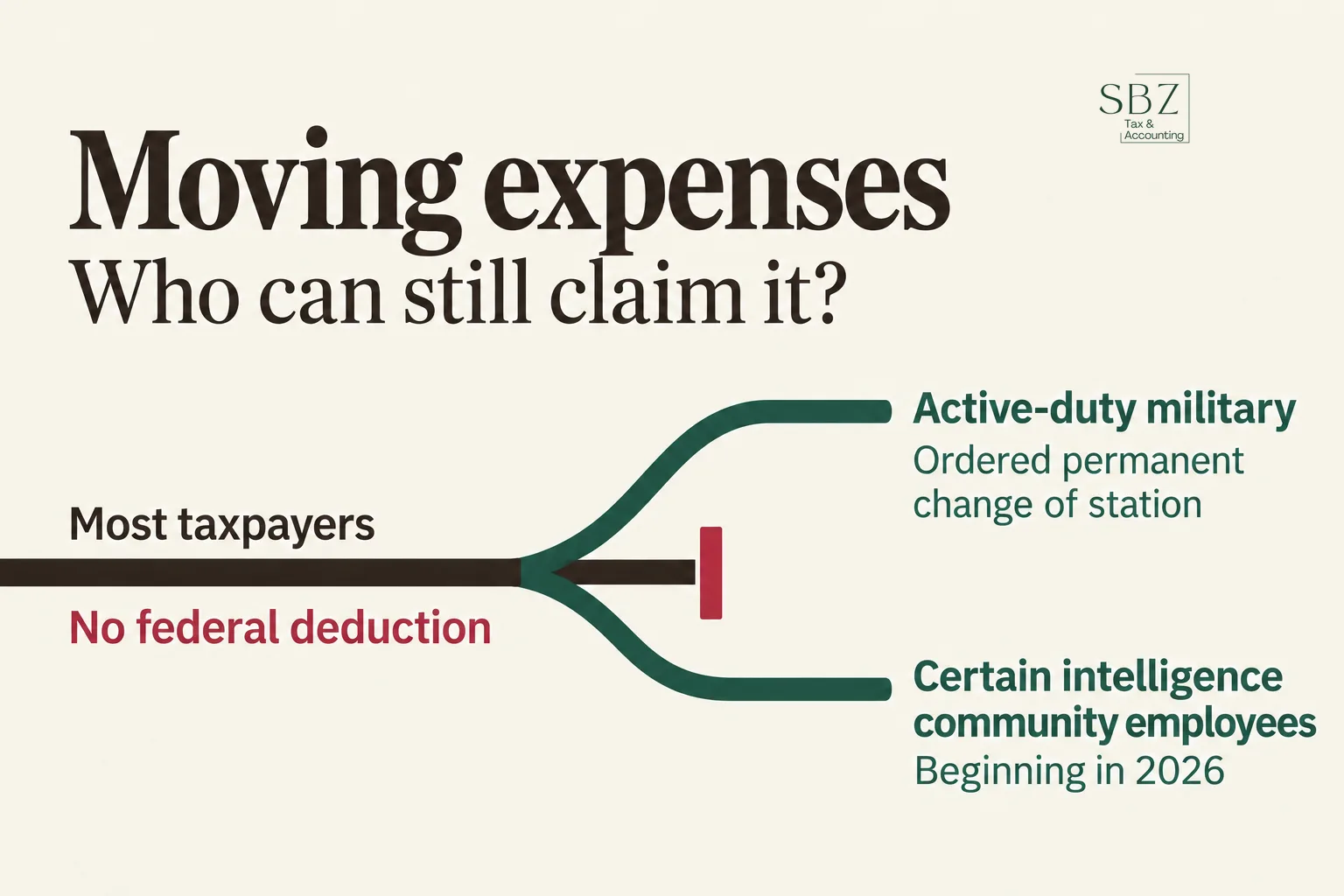
For most taxpayers, moving expenses are not a federal tax deduction. The deduction was suspended starting in 2018, and recent legislation made that suspension permanent. The main exceptions are members of the Armed Forces on active duty who move because of a military order, plus certain intelligence community employees beginning in 2026.
Here's the short version of who qualifies, what a business move changes, and where your state may differ.
Are moving expenses a tax deduction in 2025 and 2026?
Generally, no. The Tax Cuts and Jobs Act suspended the moving expense deduction for tax years 2018 through 2025. Legislation passed in 2025 then made the elimination permanent, so the same rule applies to 2026 returns.
This affects both the deduction and the tax treatment of employer help. If your employer pays for your move or reimburses you, that money is generally treated as taxable wages. It shows up in Box 1 of your W-2.
Because rules and thresholds can change, confirm the current treatment with the IRS or a tax professional before you file.
Who can still deduct moving expenses?
Two groups remain:
- Active-duty military. You can deduct unreimbursed moving costs if the move is a permanent change of station that the military ordered. The 50-mile distance test and the 39-week work test don't apply in that case.
- Intelligence community employees. Beginning in 2026, certain employees of the intelligence community who relocate because of a change in assignment may qualify.
If you're in one of these groups, you report the move on Form 3903. The deduction is taken as an adjustment to income, so you don't need to itemize.
What moving costs counted before the suspension?
Where the deduction applies, it covers the reasonable cost of moving household goods and personal effects, plus travel (including lodging) from your old home to your new one. It does not cover meals.
Costs like house-hunting trips, temporary housing, and the cost of selling your old home are not moving expenses. For a typical private-sector job relocation, none of this is currently deductible.
Can a self-employed person deduct moving expenses?
Not for a personal move, even if you work for yourself and the move helps your business. Being self-employed doesn't bring back the deduction.
Moving the business itself is a different question. If you relocate an office, shop, or studio, the cost of moving business equipment, inventory, and furniture is typically an ordinary business expense. You'd report it on Schedule C like any other cost of running the business.
The part people miss is the line between the two. Boxing up your kitchen is personal. Moving the commercial printer from your old storefront is business. When one truck carries both, keep an invoice or a clear breakdown so the business portion is supportable. For a broader look at what counts, see what business expenses are actually tax deductible.
New equipment bought for the new space may qualify for depreciation. Form 4562 is where that gets reported, and the Section 179 deduction can matter here too.
What if I work from home after the move?
Moving doesn't change the home office rules, but a new home can start a new set of facts. If you use part of the new place regularly and exclusively for your business, you may qualify for the home office deduction. How to deduct a home office on your taxes walks through the requirements.
Does it change anything if I'm selling my old home?
Selling costs aren't moving expenses, but they aren't ignored either. Agent commissions and certain closing costs generally reduce the amount you realize on the sale, which can lower a taxable gain. Many homeowners can exclude a large portion of the gain on a primary residence if they meet the ownership and use tests.
If you're moving out of California specifically, the tax picture goes beyond the move itself. California exit tax: what's been proposed, what's law, and what leaving actually costs covers what changes and what doesn't.
Does California allow a moving expense deduction?
California has historically not followed the federal suspension, which has meant a separate state-level treatment for qualifying moves. If you're moving to, from, or within California, don't assume the federal answer is the state answer. The Franchise Tax Board publishes its own form for moving expenses (FTB 3913).
State conformity can shift from year to year. Check the current FTB instructions for your filing year, or ask a preparer who handles California returns. A move that crosses state lines can also create part-year residency questions. The California tax brackets article explains how the state taxes income once you're a resident.
What should I do with my moving receipts?
Keep them anyway, sorted by purpose:
- Personal move costs. Not deductible federally for most people, but useful if your state allows a deduction.
- Business move costs. Keep invoices, mover contracts, and notes on what was transported.
- Employer reimbursements. Compare your W-2 to what your employer paid so nothing is reported twice or missed.
- Home sale documents. Settlement statements support your basis and any reported gain.
If you made a large move this year, ask about it before year-end. A short conversation with a professional on tax planning is easier than untangling it in April.
Frequently asked questions
Are moving expenses a tax deduction for a job relocation?
For most employees, no. The federal deduction is suspended permanently, apart from active-duty military and certain intelligence community employees. A reimbursement from your employer is generally taxable wages.
Can I deduct moving expenses on my 2025 or 2026 return?
Only if you're covered by an exception, such as a military permanent change of station. Everyone else generally can't claim them on either year's federal return.
Can I write off the cost of moving my business?
Often yes. The cost of moving business property and equipment is typically a deductible business expense, while personal household moves are not. Keep documentation that separates the two.
Can I deduct moving expenses on my California return?
California has historically treated this differently than federal law. Check the current Franchise Tax Board instructions and Form FTB 3913 for your tax year, since state conformity can change.
What's the next step?
If you moved this year, gather your receipts, your W-2, and any home sale paperwork, and sort business costs from personal ones. SBZ Tax can help you work out which pieces matter on your return, with remote service available nationwide. You can book a free consultation, call 818-748-2020, or visit the office at 190 Sierra Ct Ste 335, Palmdale, CA 93550. Local clients can also see our tax services in Palmdale.
This article is general information, not tax advice for your specific situation. Talk to a qualified tax professional about your circumstances.