On this page
- Where do IRS business activity codes come from?
- How do I look up an IRS business code?
- What are the most common IRS principal business activity codes?
- What happens if I use the wrong business code?
- Do I need a different code for each type of return?
- What if my business does multiple things?
- How does the business code fit into the bigger picture?
- Frequently asked questions
- Related reading
- Related reading
IRS Business Codes: How to Find the Right One for Your Tax Return
IRS principal business activity codes are six-digit classification numbers that tell the IRS what type of business you operate — they don't change how much tax you owe, but they need to be accurate and consistent year over year.
Every business return has a line for this code: Schedule C (line B) for sole proprietors, Form 1065 for partnerships, and Form 1120-S for S-corporations. The IRS uses these codes primarily for statistical analysis and industry benchmarking, not to calculate your tax liability. That said, getting it right is a basic part of filing correctly — and it matters more than most business owners realize.
Where do IRS business activity codes come from?
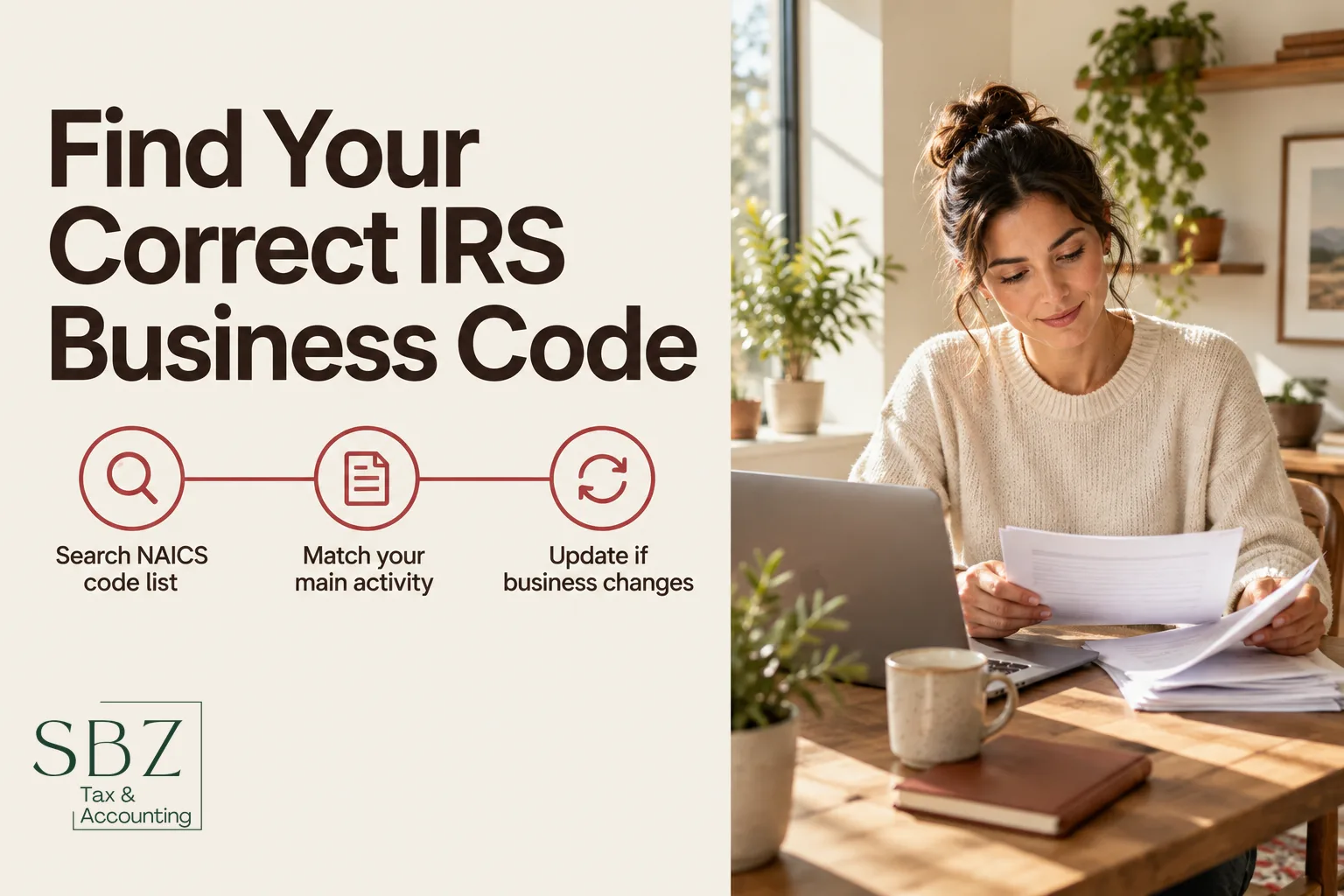
The codes are adapted from the North American Industry Classification System, or NAICS. The IRS maintains its own version of the code list in the instructions for each form, so the codes in your tax return instructions may differ slightly from a general NAICS lookup. Always pull the code from the instructions for the specific form you're filing — Schedule C instructions, Form 1065 instructions, or Form 1120-S instructions — rather than a third-party NAICS directory.
How do I look up an IRS business code?
Open the instructions for your return and go to the business activity code table, which is typically in the back. It's organized by broad industry sector (agriculture, construction, retail trade, professional services, and so on) with subcategories beneath each.
Start by thinking about what your business primarily does, not what it sells. A graphic designer who occasionally sells prints is still in "graphic design services" (code 541430), not retail trade. Match to the activity that generates the most gross revenue if you do more than one thing. If you genuinely can't find an exact match, each major section has "other" subcategories — using the closest reasonable code is better than leaving the field blank.
What are the most common IRS principal business activity codes?
Here's a sampling across industries common to small-business owners:
| Industry | Code |
|---|---|
| Tax preparation services | 541213 |
| Legal services | 541110 |
| Real estate agents and brokers | 531210 |
| Computer systems design | 541512 |
| Residential remodelers | 236118 |
| New single-family housing construction | 236115 |
| Lessors of residential buildings | 531110 |
| General freight trucking, local | 484110 |
| Full-service restaurants | 722511 |
| Offices of physicians | 621111 |
This is a small sample. The full list in the Schedule C instructions runs several pages across dozens of industries.
What happens if I use the wrong business code?
The IRS doesn't assess a penalty specifically for an incorrect business code. But there are real reasons to get it right:
- Industry benchmarking. The IRS uses business codes to compare deductions against industry norms. If your code doesn't match your actual activity, your return may look unusual relative to the benchmark — even if everything you deducted is legitimate.
- Consistency across years. Changing codes year over year without a genuine change in business activity can look sloppy and invite questions.
- State returns. Some states also collect and use the business activity code, so an error can carry forward.
If you've been using the wrong code, updating it on your current return going forward is generally fine. You don't need to file an amended return just to correct a business code.
Do I need a different code for each type of return?
The same underlying code system applies across Schedule C, Form 1065, and Form 1120-S, but pull the code from the instructions specific to your form — minor differences exist between versions.
If you run an S-corporation, the code appears on line B of Form 1120-S. If you're still working through whether an S-corp structure even makes sense for your situation, that question has bigger implications than the code line — the LLC vs. S-corp comparison covers the full picture.
What if my business does multiple things?
Use the code for your primary activity — the one that generates the most gross income. A freelance writer who also teaches workshops should file under writing services if writing produces the majority of revenue.
If your activities span two genuinely different industries (real estate and restaurant ownership, for example), it may be worth talking to a tax professional about whether separate legal entities make more sense. That question ties into both business tax structure and how income is reported across entities.
How does the business code fit into the bigger picture?
The business code is a small field on a large form. What drives your actual tax outcome:
- Accurate income reporting
- Documented, legitimate deductions
- Clean books throughout the year so nothing gets missed at filing time
- Timely estimated payments — the penalties accumulate faster than most people expect
If you're newer to running a business, building solid bookkeeping habits early prevents the year-end scramble and makes it far easier to identify deductions you'd otherwise miss. For those wondering whether they're leaving money on the table, a tax planning conversation before year-end — not after — is where that answer typically lives.
And if you're dealing with back taxes, late filings, or IRS correspondence on top of all this, that's a separate track worth handling sooner rather than later.
This article is general information, not tax advice for your specific situation. Tax rules and code classifications change — confirm current details with a qualified tax professional before filing.
Frequently asked questions
What is a principal business activity code on Schedule C?
It's a six-digit number that tells the IRS what type of business you operate. It appears on line B of Schedule C and is drawn from the code table in the Schedule C instructions. It doesn't affect your tax calculation — the IRS uses it for industry classification and statistical analysis.
Where can I find the IRS business codes list?
The most reliable source is the instructions for the return you're filing. For sole proprietors, that's the Schedule C instructions; for partnerships, Form 1065 instructions; for S-corps, Form 1120-S instructions. The code table is usually in the appendix at the back of the instructions document.
Can I change my business code from what I used last year?
Yes. If your primary activity has changed — or if last year's code was simply wrong — update it on the current return. No amended return is required just to correct a business code. If your business activity has genuinely shifted, use the code that best reflects what you're doing now.
Does my IRS business code affect my audit risk?
Not directly, but the IRS uses industry codes to benchmark deductions against industry averages. A return where the code doesn't match the reported activity, or where deductions fall far outside the norm for that industry, can attract additional scrutiny. Getting the code right supports the accuracy of everything else on the return.
What if I can't find an exact match for my type of business?
Use the closest code within the most relevant industry category. Every major section includes "other" subcategories for activities that don't fit neatly. A reasonable approximation is acceptable — and if your business is genuinely hard to classify, a tax professional can help you choose the most defensible option. Book a free consultation if you'd like a second opinion before you file.