On this page
- What is IRS Form 944 used for?
- Who has to file Form 944?
- Form 944 vs. Form 941: what's the difference?
- When is Form 944 due?
- How do you pay the tax on Form 944?
- How do you switch from Form 944 to Form 941?
- What if you made a mistake on a filed Form 944?
- What about state payroll filings?
- Your next step
- Frequently asked questions
IRS Form 944: Who Files It, What It Reports, and When It's Due
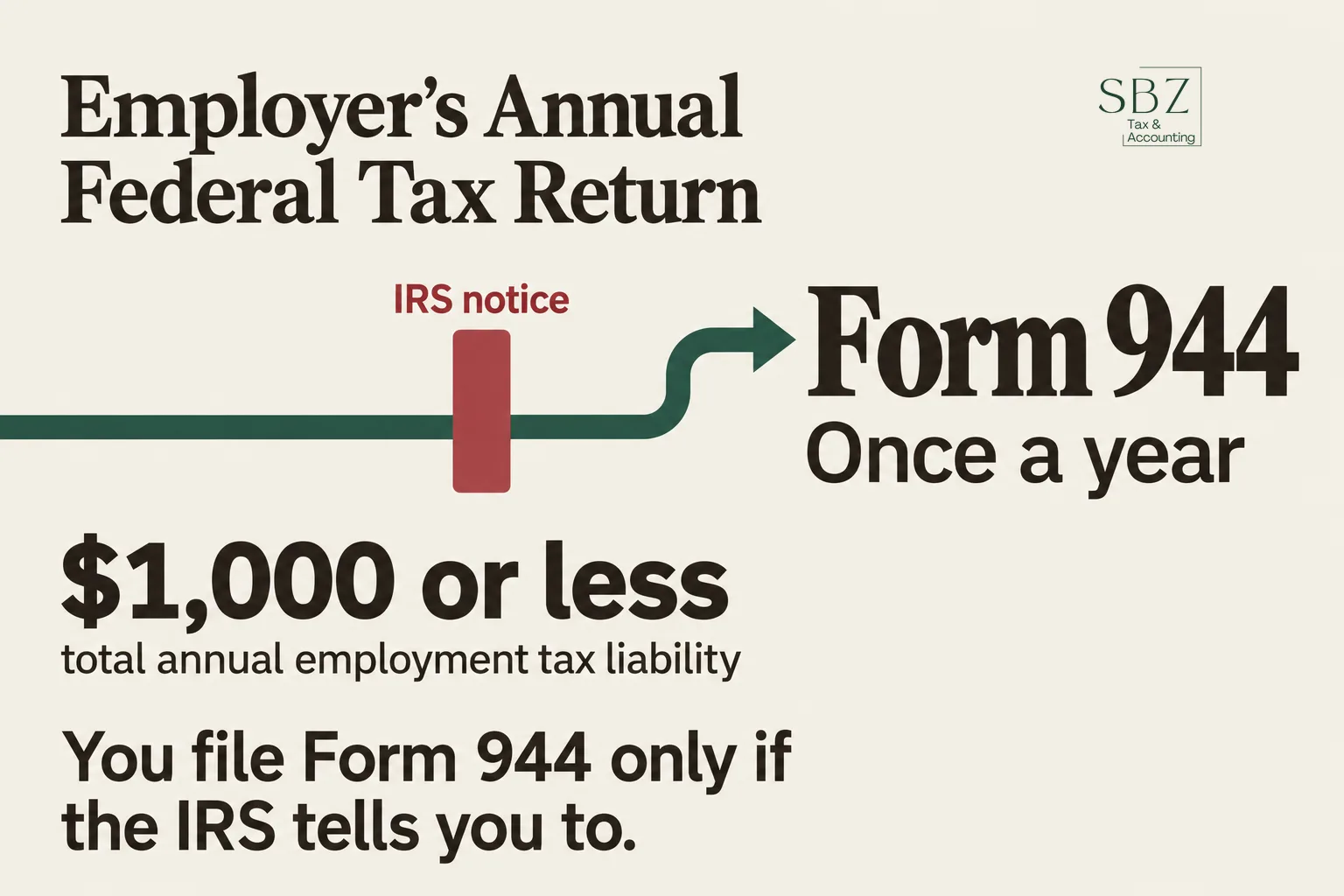
IRS Form 944, Employer's Annual Federal Tax Return, is the once-a-year payroll tax return for the smallest employers, generally those whose total annual employment tax liability is $1,000 or less. It replaces the four quarterly Form 941 filings with a single return. Here's the short version of who files it, what goes on it, and how to get off it if it no longer fits.
What is IRS Form 944 used for?
Form 944 reports the federal employment taxes you owe for the year: federal income tax withheld from employee wages, plus the employer and employee shares of Social Security and Medicare tax. It's the annual counterpart to Form 941, which covers the same taxes but is filed every quarter.
The IRS created it to cut paperwork for businesses with very small payrolls. A part-time household helper or a single low-wage employee in a new business might generate only a few hundred dollars of payroll tax in a year. Four quarterly returns for that amount is a lot of overhead.
Form 944 does not cover federal unemployment tax (FUTA). That's reported separately on Form 940, so a Form 944 filer still has a second federal payroll filing to track.
Who has to file Form 944?
You file Form 944 only if the IRS tells you to. When you apply for an EIN and indicate you'll have employees, the IRS looks at your expected payroll. If it expects your annual liability for withheld income tax, Social Security, and Medicare to be $1,000 or less, it sends a written notice assigning you to Form 944.
Two points people miss:
- You can't choose Form 944 on your own. If you haven't received the IRS notice, you file Form 941.
- The notice stays in force until it's changed. If your payroll grows, you keep filing Form 944 until the IRS notifies you otherwise or you ask to switch.
If you aren't sure which return you're on, check your original IRS notice or your business tax account. Guessing wrong creates penalty and notice problems later.
Form 944 vs. Form 941: what's the difference?
The taxes are the same. The differences are frequency, size, and cash-flow timing.
| | Form 944 | Form 941 |
|---|---|---|
| Filing frequency | Once a year | Four times a year |
| Who files | Employers the IRS notifies, with liability of $1,000 or less | Most other employers |
| Due date | January 31 following the tax year | End of the month after each quarter |
| Covers FUTA? | No (Form 940) | No (Form 940) |
If your payroll is growing, the annual return can start to work against you. Taxes accumulate for a full year before the return is due, and the deposit rules still apply during the year. That's why the IRS lets you switch to quarterly filing, covered below.
When is Form 944 due?
Form 944 is due January 31 after the end of the tax year. If January 31 falls on a weekend or federal holiday, the deadline moves to the next business day. If you made all your required deposits on time and paid the tax in full, you generally get 10 extra calendar days to file.
For the 2025 tax year, that means the return was due at the start of 2026. For the current year, it will be due in early 2027. Always confirm the exact date in the current instructions, since weekends and holidays shift it.
How do you pay the tax on Form 944?
The deposit rules are simpler than most people expect for a filer this small. If your total tax for the year is less than $2,500, you can generally pay it in full with the timely filed return instead of making deposits during the year. If your liability reaches $2,500 or more, you're expected to deposit through the Electronic Federal Tax Payment System (EFTPS) on the schedule the IRS assigns.
Because a Form 944 filer's liability is usually small, the biggest risk isn't the dollar amount. It's forgetting. A tiny balance that goes unfiled can turn into failure-to-file and failure-to-pay penalties that dwarf the original tax. If that's already happened, our guide to IRS and state tax problem help outlines the options for getting back in good standing.
How do you switch from Form 944 to Form 941?
If you'd rather file quarterly, you can ask the IRS to move you. The usual route is to call the IRS or send a written request, and the deadlines are early in the year you want the change to start. Check the current Form 944 instructions for the exact cutoffs, since they've differed between phone and mail requests.
Reasons employers switch include:
- Payroll has grown past the $1,000 range and a yearly balance feels risky.
- You want quarterly reconciliation so mistakes surface sooner.
- Your accountant or payroll provider prefers a quarterly rhythm.
Once you've switched, you file Form 941 each quarter and can request to go back to Form 944 only if you qualify again and the IRS agrees.
What if you made a mistake on a filed Form 944?
Use Form 944-X, the adjusted employer's annual return, to correct an error. It covers the same ground as Form 941-X for quarterly filers. Corrections for underreported tax generally go in the year you discover them, while overpayments follow their own claim rules, so read the instructions carefully before filing.
Clean records make corrections painless. Monthly bookkeeping services that reconcile payroll to your books are the easiest way to catch a withholding mix-up before it becomes an amended return. And if you're an owner who is also an employee, the S-corp reasonable salary rules affect how much payroll tax you generate in the first place.
What about state payroll filings?
Form 944 is federal only. Your state will likely have its own withholding and unemployment registration and its own filing schedule, which may not match the IRS's annual schedule at all. In California, for example, employers deal with separate state payroll reporting, covered in our overview of California payroll taxes. Check with your state's tax or labor agency for your own requirements.
If you also pay independent contractors, keep that separate from payroll. Contractors aren't reported on Form 944, but you may owe information returns; see do I need to send 1099s to my contractors?
Your next step
Start with your IRS notice: confirm whether you're assigned to Form 944 or Form 941, then check that your Form 940 and state payroll filings are on your calendar. If you're behind on any of them, file the oldest period first and pay what you can.
SBZ Tax helps small employers sort out payroll filings, and you can book a free consultation to talk through your situation. You can also review pricing, call 818-748-2020, or visit the office at 190 Sierra Ct Ste 335, Palmdale, CA 93550. We also work with clients remotely nationwide.
This article is general information, not tax advice for your specific situation. Talk to a qualified tax professional before making payroll or filing decisions.
Frequently asked questions
Can I choose to file Form 944 instead of Form 941?
No. The IRS assigns you to Form 944 by written notice based on your expected payroll. If you haven't received that notice, you file Form 941.
Is Form 944 the same as Form 940?
No. Form 944 reports income tax withholding, Social Security, and Medicare. Form 940 reports federal unemployment (FUTA) tax, and a Form 944 filer still files it separately.
Can I e-file Form 944?
Yes. The IRS accepts electronic filing for Form 944 through approved e-file providers, and it's the fastest way to get confirmation that the return was received.
What happens if I file Form 944 late?
The IRS can assess failure-to-file and failure-to-pay penalties plus interest on any unpaid tax. Filing as soon as you catch the miss, and paying what you owe, limits how much builds up.
What's Form 944-X?
Form 944-X is the correction form for a previously filed Form 944. You use it to fix errors in wages, withholding, or tax reported on the original return.