On this page
Trader Tax Status (TTS): IRS Requirements, Benefits, and How to Qualify
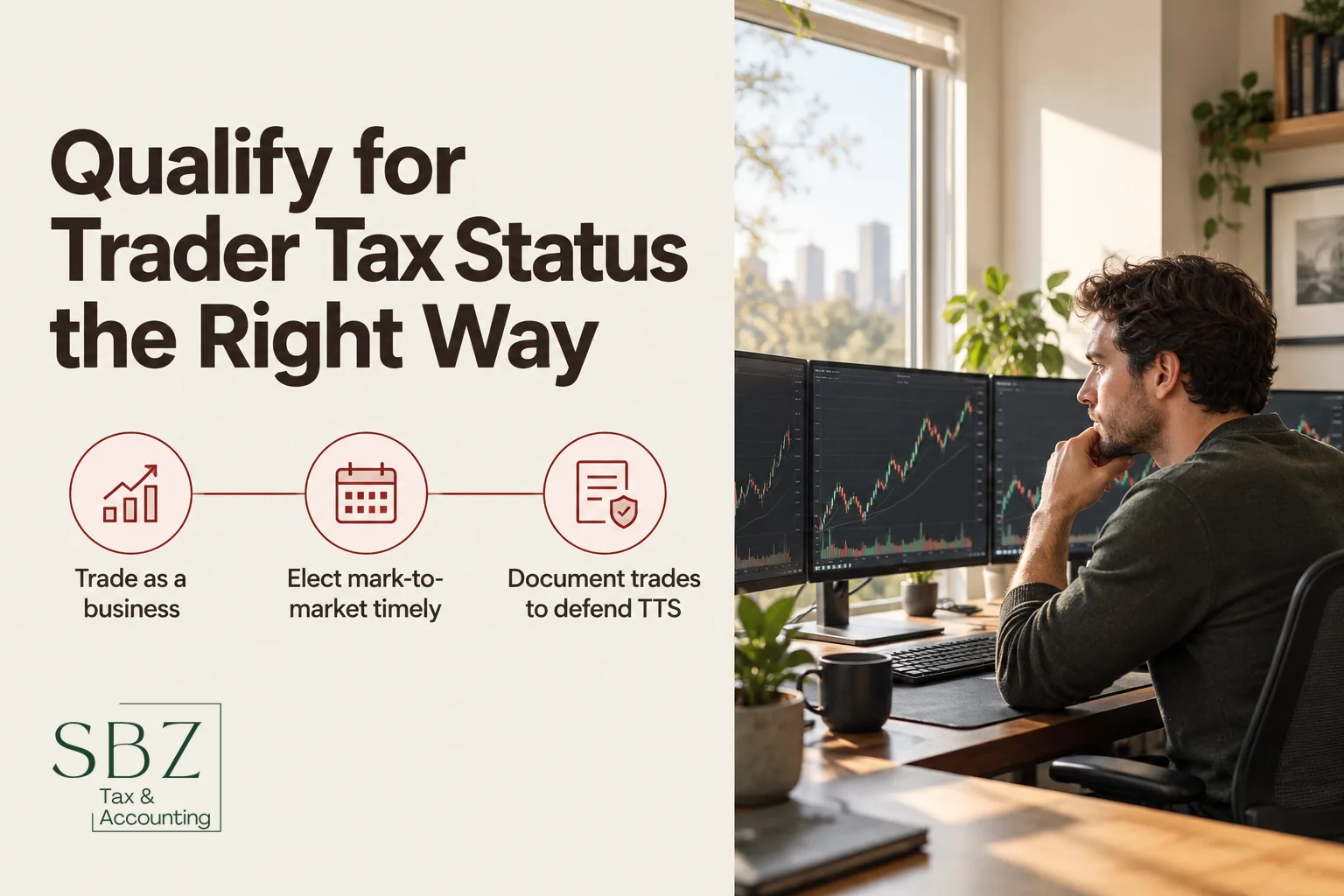
Trader tax status (TTS) is an IRS designation that allows qualifying active traders to treat their trading activity as a business — not a passive investment — unlocking deductions and elections that ordinary investors cannot access. The bar to qualify is higher than most people expect, and the benefits depend heavily on whether you also make the mark-to-market election.
What exactly is trader tax status?
The IRS does not publish a simple checklist for TTS. Instead, it applies a facts-and-circumstances test developed through decades of court cases. The core idea: if you trade with enough frequency, regularity, and business-like intent to be considered in the trade or business of trading — rather than simply investing — you may qualify.
That distinction matters on a tax return. Investors report gains and losses on Schedule D and can only deduct investment-related expenses as miscellaneous itemized deductions, a category with significant limitations. Traders with TTS can deduct ordinary business expenses on Schedule C and, if they make the Section 475(f) election, use mark-to-market accounting for their positions.
What are the IRS requirements for trader tax status?
No statute in the tax code explicitly defines TTS. The standard comes from court rulings, built around three factors:
1. Frequency and regularity of trading Courts look for substantial, continuous trading activity — generally hundreds of trades per year and multiple trades on most business days. Occasional trading, even with large positions, typically doesn't qualify.
2. Short-term profit motive TTS applies to traders seeking profit from short-term price swings, not long-term appreciation or dividend income. Holding positions for weeks or months works against a TTS claim. Holding them for minutes, hours, or a few days supports it.
3. Continuity and time commitment Trading must be a regular, ongoing activity — not something you do in the background. Many practitioners look for 25 or more hours per week devoted to trading research, monitoring, and execution, though the courts have not set a hard number.
Meeting all three factors doesn't lock in TTS automatically. It's a self-reported position on your return, and the IRS can challenge it on audit. Solid tax planning up front — and thorough records — are what hold the position together if it's ever questioned.
What tax benefits does TTS actually unlock?
Two categories of benefits open up if you qualify:
Ordinary business expense deductions Traders with TTS can deduct expenses directly connected to their trading activity — platform fees, data subscriptions, charting software, a home office used exclusively for trading, and professional education. These flow through Schedule C and reduce ordinary income.
The Section 475(f) mark-to-market election This is the bigger benefit, and it's a separate step — you have to elect it. Under MTM, you treat all open positions as if sold on December 31 each year, marking gains and losses to market. Those gains and losses are then treated as ordinary income and loss, not capital.
The main advantages of MTM:
- Trading losses are not subject to the $3,000 annual capital loss cap
- Wash sale rules do not apply to MTM positions
- Large trading losses can offset other ordinary income (salary, business income) dollar for dollar
The trade-off: MTM gains are taxed as ordinary income, not at preferential long-term capital gains rates. For profitable traders, that's a real cost. Whether MTM makes sense depends on your trading patterns and overall income situation — the math is worth running before the election window closes.
When must you make the mark-to-market election?
This is where traders get tripped up. To use MTM for a given tax year, you must attach an election statement to your prior year's tax return, by that return's due date. You cannot wait until you're filing the current year's return to decide.
Miss the deadline, and you lose MTM for that year. There's no late-filing workaround. Estimated tax planning for traders with MTM also works differently from the standard approach, since positions are marked on December 31 rather than on the sale date — which changes when you recognize income and what you owe each quarter.
What does TTS not do?
A few things TTS is commonly misunderstood to cover:
It does not create self-employment tax on trading gains. Even when trading income appears on Schedule C, it is not self-employment income and is not subject to SE tax. This distinguishes a trading business from most other Schedule C activities.
It does not fix wash sale exposure on its own. Without the 475(f) MTM election, wash sale rules still apply in full. TTS alone does not eliminate them.
It does not require an LLC or S-corp. Many TTS traders operate as sole proprietors. An LLC by default changes nothing for federal income tax purposes. An S-corp adds administrative overhead that rarely pays off for traders specifically, since trading income isn't SE income to begin with — the usual SE tax savings don't apply. If you're weighing structures anyway, the S-corp vs. LLC comparison covers the tradeoffs, and S-corp tax services may be relevant depending on your other business income.
How do you document and defend trader tax status?
TTS is self-reported. You file Schedule C for your trading activity and take the position that you qualify. The IRS can audit it, and documentation is what makes or breaks the defense.
Keep records of:
- Trade logs with dates, volumes, holding periods, and instruments
- Time logs showing hours spent on research, monitoring, and execution
- Receipts for all expenses with a clear trading business purpose
If your records are scattered, getting monthly bookkeeping organized around your trading activity is the first step — not an afterthought. For traders with multiple accounts, pass-through entities, or other business income running alongside trading, fractional CFO support can provide the kind of year-round financial oversight that keeps everything audit-ready.
If you've claimed TTS in prior years and are now receiving IRS correspondence, that's a job for IRS tax problem resolution — not something to handle with a self-prepared response.
The clearest starting point if you think you qualify: book a consultation to walk through your activity and tax picture before the election deadline for your current year passes.
Frequently asked questions
Do I owe self-employment tax on trading profits if I have TTS?
No. Trading gains reported on Schedule C under trader tax status are not self-employment income and are not subject to SE tax. This is one of the key differences between a trading business and most other Schedule C activities — the SE tax savings that attract people to S-corps don't apply here, since there's no SE tax to offset.
Can I still qualify for TTS if I hold some long-term positions?
Possibly, but long-term holds work against the claim. The IRS looks at whether your primary activity is short-term speculation. If a significant portion of your capital sits in buy-and-hold positions, it muddies the TTS picture. Some active traders maintain separate accounts to keep their short-term trading activity clearly distinct from their investment positions.
What happens if I claim TTS and the IRS disagrees on audit?
The IRS could reclassify your trading activity as investing, disallowing your Schedule C deductions. If you also elected MTM, that election could be unwound — potentially triggering back taxes, interest, and penalties. Strong documentation and a consistent, high-frequency trading record are the best defense. Thin records and a handful of trades per month rarely survive scrutiny.
Is the mark-to-market election reversible?
Not easily. Once made, the 475(f) election stays in place unless you receive IRS permission to revoke it — which requires a formal request and is not guaranteed. This is another reason to think carefully before electing, preferably with a tax professional who has handled TTS situations before.
This article is general information, not tax advice for your specific situation. Trader tax status involves a complex facts-and-circumstances analysis and the consequences of getting it wrong can be significant. Consult a qualified tax professional before claiming TTS or making any related elections.