
On this page
- What does Form 5329 actually report?
- Who has to file Form 5329?
- What exceptions avoid the 10% early-withdrawal tax?
- Does California add its own tax on early withdrawals?
- How do you fix an excess contribution?
- What if you missed an RMD?
- Where does Form 5329 get filed, and how long does the IRS have to assess?
- Can planning keep you off this form?
- Related reading
- Frequently asked questions
- What's the next step?
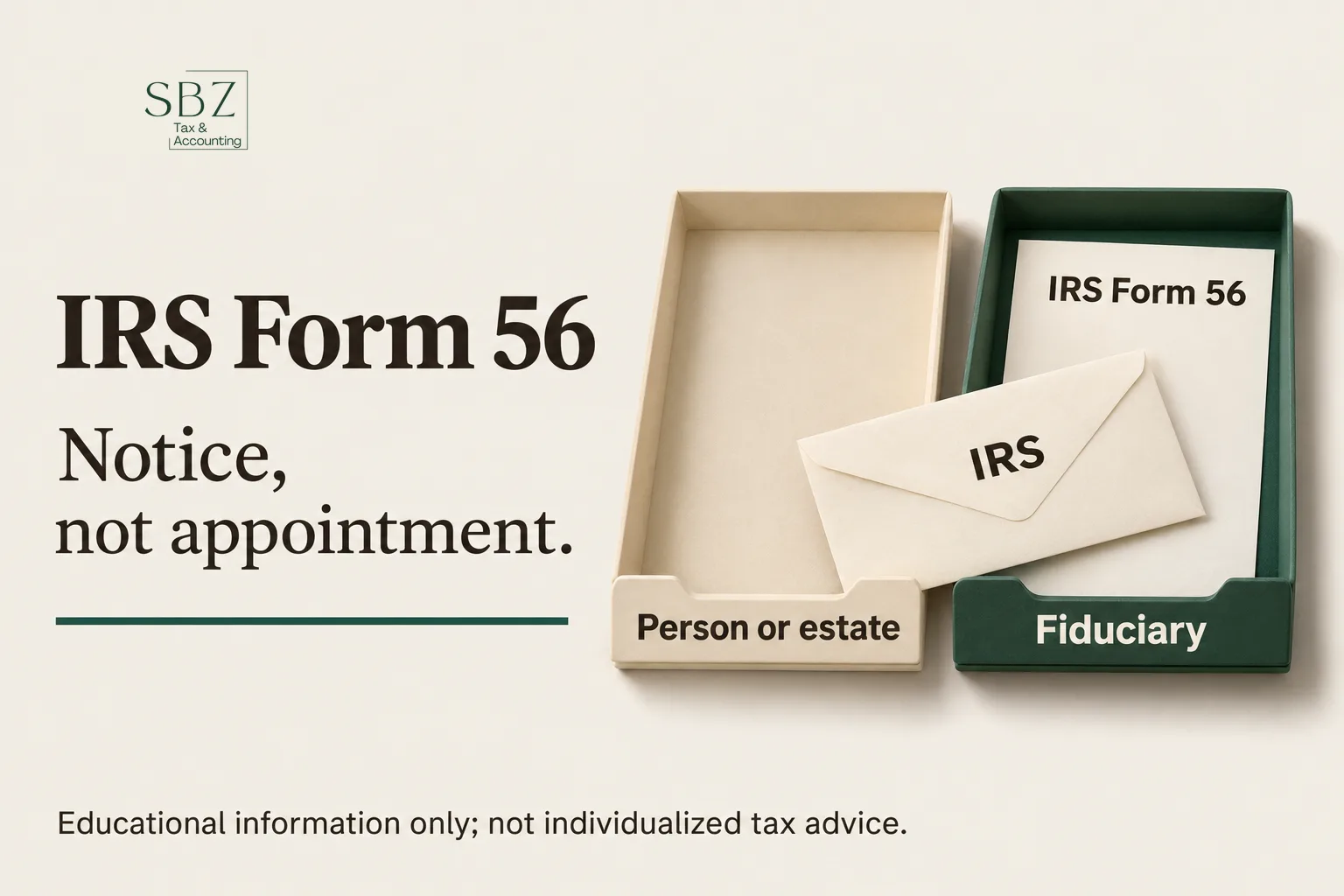
IRS Form 5329, "Additional Taxes on Qualified Plans (Including IRAs) and Other Tax-Favored Accounts," is the form you use to report the extra taxes that apply when a retirement account, HSA, or education account breaks its rules. Those rules include taking money out too early, putting too much in, or failing to take a required minimum distribution (RMD). Here's the short version of how it works and what to do with it.
What does Form 5329 actually report?
Form 5329 is a calculation form. It doesn't report the account activity itself; it computes the penalty-style taxes that sit on top of your regular income tax. The totals flow to Schedule 2 of Form 1040. If you want to see where that lands, our guide to IRS Schedule 2 walks through the line.
The form is organized in parts, and you complete only the ones that apply:
| Part | What it covers | Typical tax |
|---|---|---|
| I | Early distributions from retirement plans and IRAs | 10% of the taxable amount (25% for certain SIMPLE IRA withdrawals in the first two years) |
| II | Certain distributions from education accounts (Coverdell ESAs, qualified tuition programs) | 10% of the taxable amount |
| III | Excess contributions to traditional IRAs | 6% per year the excess stays in |
| IV | Excess contributions to Roth IRAs | 6% per year |
| V–VI | Excess contributions to Coverdell ESAs and Archer MSAs | 6% per year |
| VII | Excess contributions to HSAs | 6% per year |
| VIII | Excess contributions to ABLE accounts | 6% per year |
| IX | Missed or short RMD | 25% of the shortfall, or 10% if corrected within the allowed correction window |
The IRS revises the form and its line numbers each year, so work from the instructions for the tax year you're filing.
Who has to file Form 5329?
You file it if any of the situations above applies to you for the year and no exception wipes out the tax. For business owners and high earners, the most common triggers are:
- Withdrawing from an IRA or 401(k) before age 59½ without a qualifying exception.
- Contributing to a Roth IRA after your income pushed you over the limit, or contributing to an HSA while ineligible.
- Overfunding an HSA through a mix of payroll and personal contributions.
- Missing an RMD from an inherited or personal account.
If the only issue is an early distribution reported with code 1 in box 7 of Form 1099-R and no exception applies, the instructions generally let you skip Form 5329 and enter the 10% tax directly on Schedule 2. Any other code, or any exception you're claiming, usually means the form is required.
What exceptions avoid the 10% early-withdrawal tax?
Part I is where most of the nuance lives. You enter the amount that qualifies for an exception, along with an exception number from the instructions. Commonly used exceptions include:
- Distributions after death or because of total and permanent disability.
- Substantially equal periodic payments under Section 72(t).
- Unreimbursed medical expenses above the percentage-of-income floor.
- Payments made because of an IRS levy on the plan.
- Qualified birth or adoption distributions, up to the statutory limit.
- Certain emergency personal expense and domestic abuse victim distributions added by SECURE 2.0.
Dollar caps and eligibility details change, so confirm the figure in the current instructions before relying on any of these. The 10% tax is separate from the regular income tax you owe on a taxable distribution; an exception removes only the penalty.
Does California add its own tax on early withdrawals?
Yes. California generally imposes an additional 2.5% tax on early distributions that are subject to the federal 10% tax. It is reported on FTB Form 3805P rather than on Form 5329. If your federal exception applies, California's usually does as well, but confirm against the form's instructions for the year.
Other states handle this differently, so state returns deserve their own check.
How do you fix an excess contribution?
The 6% tax repeats every year the excess stays in the account, so timing matters. For IRAs, you can generally avoid the 6% tax by withdrawing the excess plus the net income attributable to it by your tax return due date, including extensions. For an IRA, that net income is taxed in the year the contribution was made, not the year you withdraw it, and the 10% early-withdrawal tax can apply to the earnings if you're under 59½. This is covered in IRS Publication 590-A.
HSAs work differently. A corrective HSA distribution of the excess and its earnings is generally reported as income in the year you receive it. See our walkthrough of IRS Form 8889 for how HSA contributions are tracked.
If the excess is Roth-related or tangled up with basis, Form 8606 matters too. Our explainer on IRS Form 8606 covers how basis and the pro-rata rule interact.
What if you missed an RMD?
Take the missed distribution as soon as you catch the error, then file Form 5329 for the year of the shortfall. The excise tax is 25% of the amount you should have taken but didn't. It drops to 10% if you correct the shortfall within the allowed correction window.
The IRS can waive the tax for reasonable cause. To request that, you complete Part IX, note the waiver on the form as the instructions direct, and attach a short statement explaining what happened and that you've since taken the distribution. Many first-time misses are waived when the explanation is credible and the fix is complete.
Where does Form 5329 get filed, and how long does the IRS have to assess?
Normally it's attached to your Form 1040. If you owe an additional tax but weren't otherwise required to file a return, the instructions let you file Form 5329 on its own, with payment.
On timing, SECURE 2.0 changed the assessment clock. For these taxes, the limitations period now generally starts from the filing of your Form 1040, even if you never filed Form 5329. The period is three years in general and longer for excess contributions. Because the details depend on the tax involved, check the current rule before assuming a past year is closed.
If you discover a missed Form 5329 for a prior year, a corrected filing may be the fix. Our guide to amending a return with Form 1040-X explains when that's the right route.
Can planning keep you off this form?
Mostly yes. Most 5329 problems come from contributions made without tracking the limits, or RMDs that nobody calendared. Business owners with solo 401(k)s, SEP plans, or S-corp wages that drive contribution limits are especially exposed because the limit depends on compensation figured at year-end. Year-round tax planning catches those before the return does.
If a notice has already arrived about an unreported penalty, that's a separate track. See our page on IRS and state tax problem help, and an IRS transcript request can show what the IRS has on file before you respond.
Related reading
- IRS Form 2848 Instructions: How to Fill Out the Power of Attorney, Line by Line
- IRS Notice CP2000: What It Means and What to Do Before the Deadline
Frequently asked questions
Do I have to attach Form 5329 to my tax return?
Usually, yes, if you owe one of its taxes or are claiming an exception the instructions require you to report on the form. The exception is a code 1-only early distribution with no exception, where you can enter the tax directly on Schedule 2.
Is the 10% tax on early distributions the same as income tax?
No. It's an additional tax on top of regular income tax on the taxable portion of the distribution. An exception removes the 10% but not the income tax.
Can I file Form 5329 by itself?
Yes, but only if you owe the additional tax and weren't otherwise required to file a Form 1040 for the year. Otherwise it travels with your return.
Can the IRS waive the missed RMD tax?
Yes, for reasonable cause, if you correct the shortfall and attach an explanation. Approval isn't automatic, so the statement should be specific.
What's the next step?
Pull your Forms 1099-R and 5498 and any HSA statements for the year, and compare each distribution and contribution to the limits before you file. If something doesn't line up, fix the account first and the form second.
If you'd like a second set of eyes, SBZ Tax works with business owners and high-income taxpayers nationwide, remotely. Book a free consultation, call 818-748-2020, or visit our office at 190 Sierra Ct Ste 335, Palmdale, CA 93550. This article is general information, not tax advice for your specific situation. Talk to a qualified professional before acting on it.